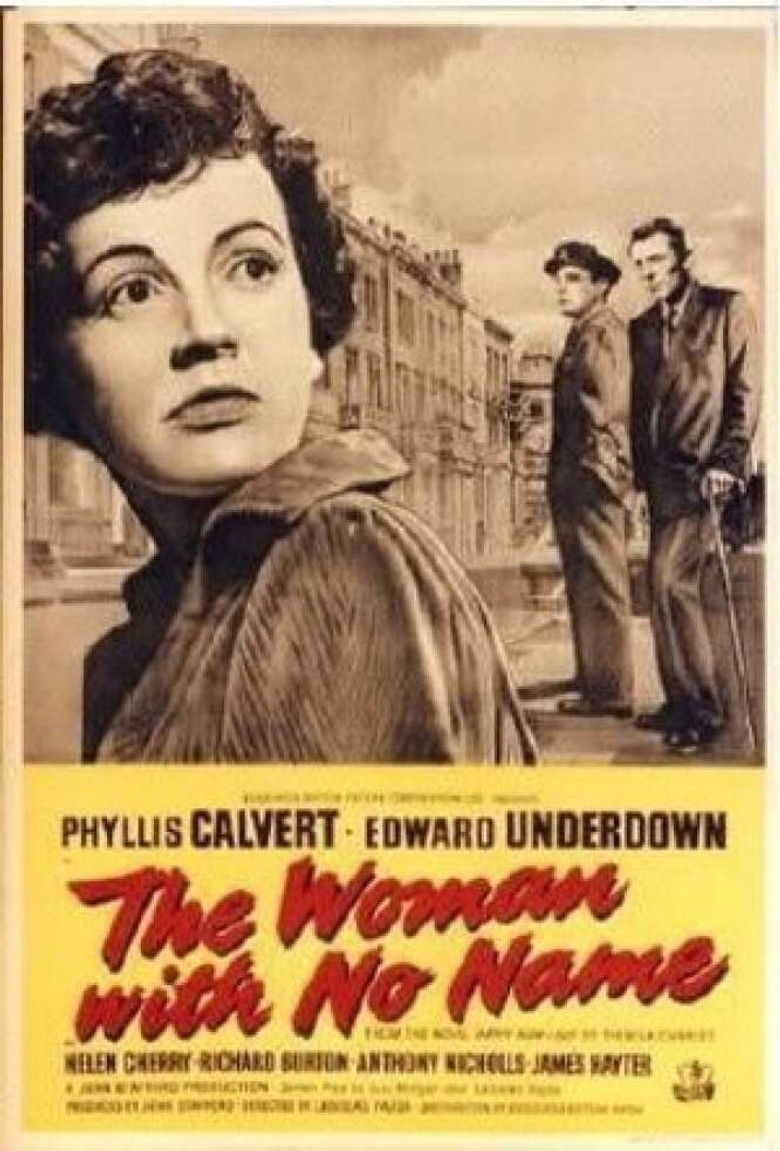
Yvonne Winter regains consciousness in a Swiss clinic with no memory of who she is or how she came to be there. The doctors, led by a calm but watchful physician, piece together fragments of her identity through documents and the testimony of strangers. When a man named Lake Winter arrives claiming to be her husband, Yvonne has no framework to accept or refuse him – she must rebuild a life from the outside in, trusting the accounts of people she cannot remember.
The arrival of Nick Chamerd introduces a competing version of Yvonne's past, one that places her in a different emotional orbit entirely. Sybil, a woman whose composure masks a private investment in the outcome, complicates the question of which man is telling the truth. What begins as a medical case study quietly reorganizes itself into a contest over identity, loyalty, and property – with Yvonne as both the prize and the only person incapable of arbitrating the dispute.
Woman with No Name works within the amnesia thriller tradition that post-war British cinema found particularly suited to anxieties about displaced identity and uncertain allegiance. The film uses its protagonist's blank slate not for sensation but for moral inquiry: if a woman cannot remember her choices, can she still be held accountable for their consequences? The question hangs over every scene without being resolved cheaply.
Ladislao Vajda, a Hungarian-born director who worked across several European industries before settling into British production, brings a Continental economy to Woman with No Name that distinguishes it from the more theatrical amnesia pictures of its period. The film is careful not to exploit Phyllis Calvert's predicament for melodrama; her Yvonne is observed with clinical restraint, which makes her gradual orientation toward one version of the truth feel earned rather than engineered. Richard Burton, still in his early screen career, registers as a man whose charm is precisely the thing that should not be trusted – a quality the film understands but does not underline. The script is most rigorous when it treats memory not as a plot mechanism but as a form of power: those who possess knowledge of Yvonne's past hold leverage over her present. In a postwar context where questions of who people had been under occupation carried genuine moral weight, that premise carried more charge than its domestic thriller framing might suggest.
– Classic Noir
Yvonne moves through a narrow hospital corridor toward a mirror at its far end. The camera holds at a medium distance, refusing to close in, so that she approaches her own reflection as a stranger would approach another person. The light is institutional – flat overhead sources cut by the shadow of a doorframe that bisects the corridor at the midpoint, leaving the mirror end slightly dimmer than the space Yvonne occupies. The composition places her twice in frame: once as subject, once as reflection, with neither version appearing more certain than the other.
The scene is the film's plainest statement of its central argument. Yvonne does not recoil from the mirror or reach toward it; she simply looks, with the measured attention one gives an unreliable document. What the shot establishes is not trauma but epistemological suspension – she is neither the woman she was nor a new woman, but a figure in transit between two states of being. Every subsequent scene in which another character offers her a version of her past is shadowed by this image of a self that could not yet confirm its own existence.
The cinematographer for Woman with No Name has not been definitively credited in surviving production records, which is itself a minor irony given the film's subject. What the photography demonstrates, regardless of attribution, is a disciplined preference for mid-range focal lengths that keep both character and environment in meaningful relation – no face is isolated from the space it occupies, and no room is shown without registering what it costs psychologically to be in it. The clinic sequences favour cool, even lighting that reads less as style than as condition: the world Yvonne wakes into offers no shadows to hide behind, which makes the film's later movements into more conventionally shadowed interiors feel like moral deterioration rather than visual flourish. Location shooting grounds the Swiss setting without romanticising it. The overall visual register is one of controlled austerity – each setup doing exactly what the scene requires and no more, which suits a story about a woman who cannot afford the luxury of inference.
The film has entered public domain circulation and Archive.org is the most reliable free source for a complete print, though transfer quality varies.
MUBISubscriptionMUBI periodically programmes British noir of the late 1940s and 1950s; check current availability as titles rotate on a fixed schedule.
TubiFreeTubi carries a range of British postwar thrillers in this period and may hold a streaming print, though availability is not confirmed and should be verified.