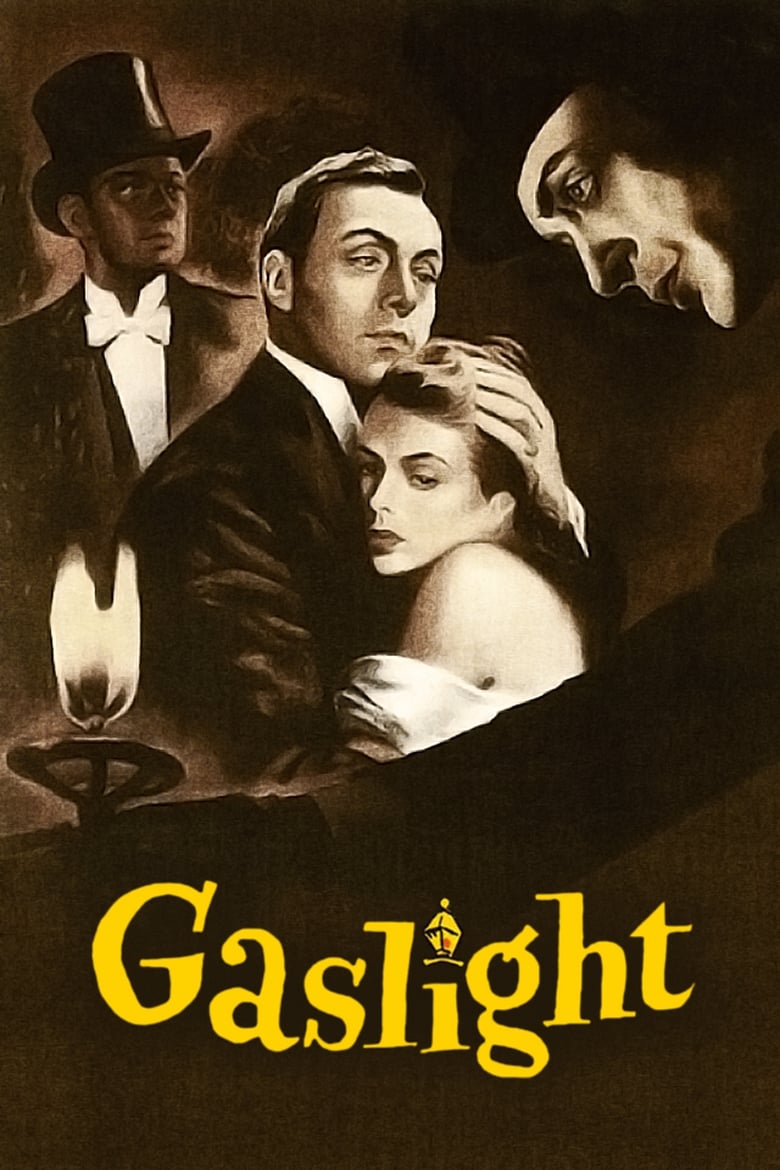
London, 1880s. Paula Alquist, a young soprano, witnesses the murder of her aunt – a celebrated opera singer – and flees the city, eventually completing her musical studies in Italy. There she meets Gregory Anton, a cultivated and attentive man who courts her with precision. They marry and return to the aunt's sealed Thornton Square house, where Paula hopes to begin a new life.
Once inside that house, Gregory's conduct shifts. Objects disappear and Paula is told she has moved them. The gaslights dim, but Gregory insists they do not. He isolates her from servants, neighbors, and her own past, constructing a private architecture of doubt designed to convince Paula – and the household – that her mind is failing. The only outside presence is Brian Cameron, a Scotland Yard inspector who recognizes Paula from a photograph of her aunt and begins to suspect that Gregory's interest in the house runs deeper than sentiment.
Gaslight belongs to a cycle of 1940s psychological thrillers – sometimes called 'female Gothic' within the noir adjacent territory – in which the domestic space itself becomes the site of menace. The film works not through urban danger or criminal underworlds but through the slower corrosion of identity, mapping the mechanics of coercive control onto the conventions of period melodrama and suspense.
Gaslight arrives at a precise cultural moment when Hollywood was beginning to examine the interior life of women under institutional and domestic pressure. Cukor's film, adapted from Patrick Hamilton's stage play, is less interested in mystery than in epistemology – specifically, who controls the terms by which reality is interpreted. Boyer's Gregory Anton is not the trench-coated criminal of hard-boiled tradition but something more refined and, in context, more disturbing: a man who weaponizes affection. Bergman earned her first Academy Award for a performance that traces, with clinical patience, the collapse and recovery of a woman's self-knowledge. The film does not quite achieve the visual density of noir proper – MGM's production gloss occasionally softens what Hamilton's source material kept sharp – but it names a social mechanism, lends it a vocabulary, and in doing so earns its permanent place in any serious account of American suspense cinema in the 1940s.
– Classic Noir
Ruttenberg and Cukor frame Paula at the center of the drawing room while Gregory holds court at the periphery. The gaslight fixtures are positioned high in the frame, their glow conspicuous against the dark paneling. When the light drops – slightly, measurably – the camera holds on Bergman's face rather than cutting to the source. The composition isolates her, the surrounding darkness pressing inward, and the choice not to show a mechanical cause keeps the event suspended between the physical and the psychological.
The scene encodes the film's central argument in a single visual gesture: Paula perceives something real, and the frame confirms her perception for the audience while Gregory's words deny it. This doubling – the viewer as privileged witness to a gaslighting that the victim cannot yet prove – turns observation itself into a form of moral implication. We see what she sees, we know she is not wrong, and yet we watch the doubt take hold.
Joseph Ruttenberg, working within MGM's characteristically high-key studio system, makes deliberate and strategic concessions to shadow in Gaslight that mark it as a departure from the studio's usual luminous finish. Ruttenberg uses the Victorian interior as an alibi for low-key lighting – candlelight, gas fixtures, curtained windows – that would feel stylized in a contemporary setting but here passes as period authenticity. The lenses favor tight focal lengths in the domestic scenes, compressing the already cluttered rooms and flattening the depth that might offer Paula an escape route within the frame. The attic sequences, where Gregory secretly searches for jewels, are filmed with a near-expressionist reduction of light, connecting that hidden space to his concealed motive. Throughout, the lighting does not merely establish mood but performs a moral function: the house is genuinely dark, the lights do genuinely dim, and the camera's fidelity to that physical fact quietly vindicates Paula at every turn.
The most reliable streaming home for the 1944 MGM version; check current availability as classic titles rotate seasonally.
TCMSubscriptionTurner Classic Movies periodically airs the film as part of themed programming blocks and with contextual introductions.
KanopyFree with library cardAvailable through many public library systems at no cost, making it the most accessible free option for eligible borrowers.