Dr. Philip Ritter, a respected London plastic surgeon, travels to a remote countryside clinic to recover from professional fatigue. There he meets Alice Brent, a pianist of considerable talent, and the two fall into a swift, consuming attachment. Before anything can be settled between them, Alice departs to honor a prior commitment – a man she has already promised to marry – leaving Ritter with little beyond the memory of her face.
Back in London, Ritter becomes absorbed in rehabilitative surgery at a women's prison. Among his patients is Lily Conover, a petty criminal whose disfigured features give him a pretext to act on an obsession he refuses to name. He reconstructs Lily's face to match Alice's precisely, then marries her – less out of affection than out of a compulsion to possess what circumstance denied him. Lily, now navigating a class and identity she was never shaped for, proves ungovernable; her old associations and habits reassert themselves, and the marriage deteriorates into mutual recrimination.
Stolen Face belongs to a particular strand of postwar British noir in which medical or scientific authority becomes the vehicle for male possessiveness carried to its logical and destructive end. The film shares territory with the continental tradition of the obsessive artist and his created subject, filtered here through the conventions of the Hammer thriller – efficient, economical, and unsentimental about the damage men do when they treat women as problems to be solved.
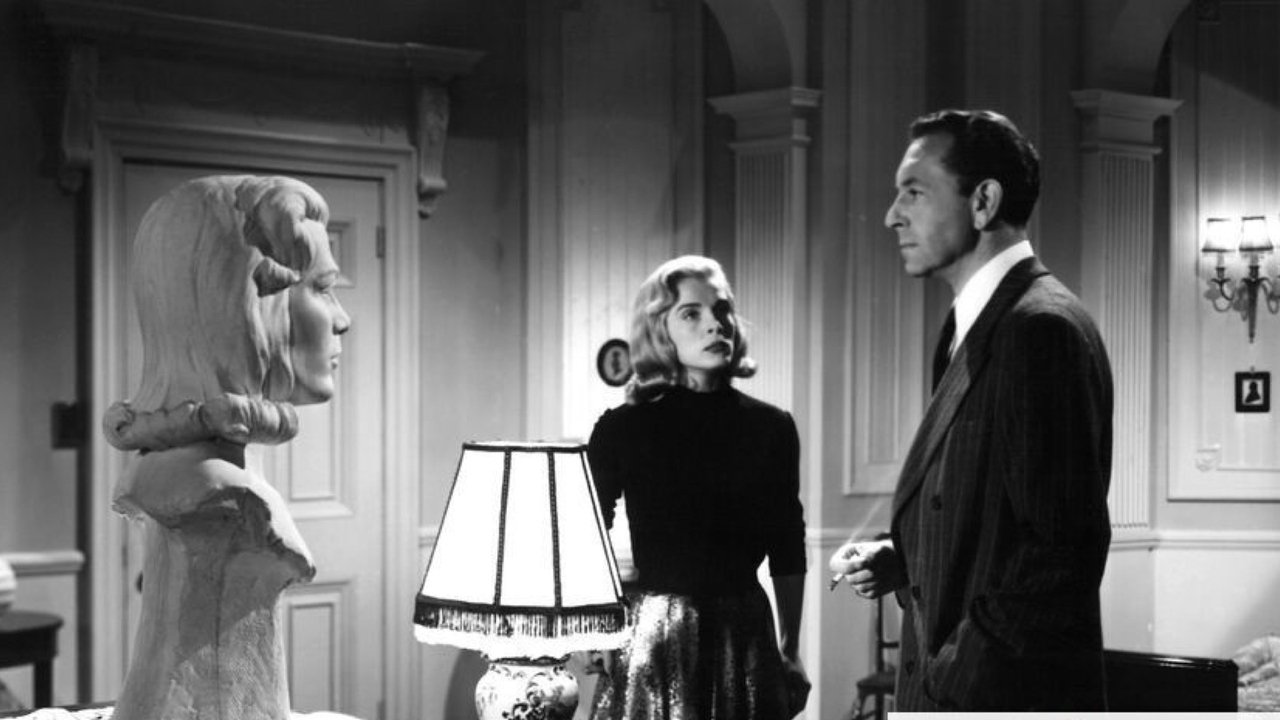
Stolen Face arrives at an instructive moment in Hammer's development, before the studio committed entirely to Gothic horror, and it shows a production house still working out what kind of darkness it could sustain. Terence Fisher, who would later define the Hammer aesthetic with Dracula and Frankenstein, directs here with the same clinical detachment that would characterize his horror work – and the parallel is not incidental. Ritter is an early Fisher protagonist in a line of men who confuse creation with ownership. The film is frank about the pathology without ever quite condemning it, which is where its genuine unease lies. Lizabeth Scott, cast in a double role, handles the contrast between Alice's composure and Lily's volatility with economy; Paul Henreid, characteristically contained, makes Ritter's fixation credible precisely because it never becomes theatrical. At 72 minutes the film cannot afford complexity it does not earn, and it earns enough – a minor entry in the transatlantic noir cycle, but one that anticipates the genre's preoccupation with identity as something imposed rather than inhabited.
– Classic Noir
Walter J. Harvey lights the prison consultation room as a space of deliberate contrast: institutional white walls that should suggest neutrality instead bleach the scene of warmth, while a single overhead source casts Lily's damaged face in relief, every shadow a topographical record of what surgery is about to erase. Fisher holds the camera at Ritter's eyeline as he studies her, so that the frame collapses the distance between clinical assessment and private longing – we see what he sees, and we understand, before he does, that the two are the same thing.
The scene argues the film's central proposition without dialogue: that Ritter's surgery is not rehabilitation but substitution, a man using professional license to manufacture the woman he was refused. Harvey's lighting refuses to glamorize the moment; the clinical harshness that falls on Lily is the same quality of light that, by the film's moral logic, will eventually fall on Ritter himself.
Walter J. Harvey shoots Stolen Face in the close-to-the-bone style that British quota productions of the period required – limited locations, disciplined studio work, and a preference for deep shadow over atmospheric elaboration. He uses hard sources to define interior spaces as either institutional or domestic, and neither category offers comfort: the clinic is cold with function, the marital home cold with pretense. Harvey does not reach for expressionist excess, which is in keeping with Fisher's direction; the distortion here is psychological rather than optical, and the cinematography supports that by staying rational in its compositions even when the narrative logic has ceased to be. Faces are lit to be read rather than adored, which matters in a film whose central act is the replication of a face. The London exteriors – brief but placed at moments of transition – introduce natural grey that the studio interiors refuse, making the outside world feel like the only honest register the film allows.
Tubi has carried Stolen Face as part of its rotating classic noir and Hammer library; picture quality is adequate for the budget production's original materials.
Archive.orgFreeA public domain print is available on Archive.org, though transfer quality varies and the Tubi stream is generally preferable for a cleaner image.
Amazon Prime VideoSubscriptionHas appeared in Prime's classic British cinema selections; availability is regional and subject to change, so confirm before seeking.