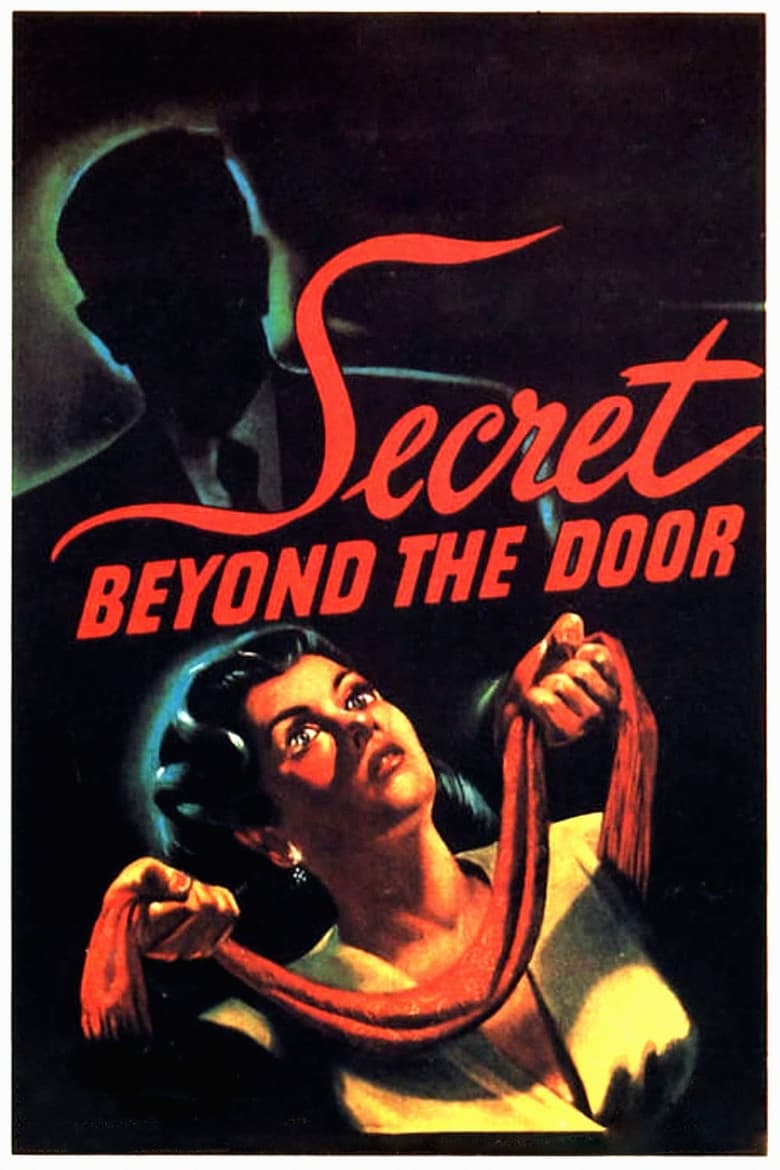
Celia Barrett, a wealthy American woman, meets the brooding architect Mark Lamphere while vacationing in Mexico and marries him within days of their first encounter. Returning to his imposing family estate in upstate New York, she begins to sense that the man she has bound herself to is concealing something far darker than ordinary reserve. Mark is distracted, prone to sudden absences, and surrounded by a household that seems to organize itself around the management of secrets.
Mark's obsessive hobby is the recreation of rooms in which famous murders took place, a collection housed in a locked wing of the estate. When Celia discovers that one room – number seven – is kept sealed even from his own guided tours, her suspicion hardens into dread. Mark's sister Caroline watches with cold detachment, the scarred housekeeper Miss Robey controls access to the house's interior life, and Celia begins to wonder whether her predecessor's fate may become her own.
Secret Beyond the Door occupies the psychological wing of the noir cycle, drawing on the gothic domestic thriller popularized by Rebecca and Gaslight while inflecting it with Freudian analysis and the clinical fatalism more typical of Lang's German work. The film's central argument – that the architecture of the mind mirrors the architecture of violence – pushes it beyond standard suspense into territory that is at once more ambitious and more unstable than most of its contemporaries.
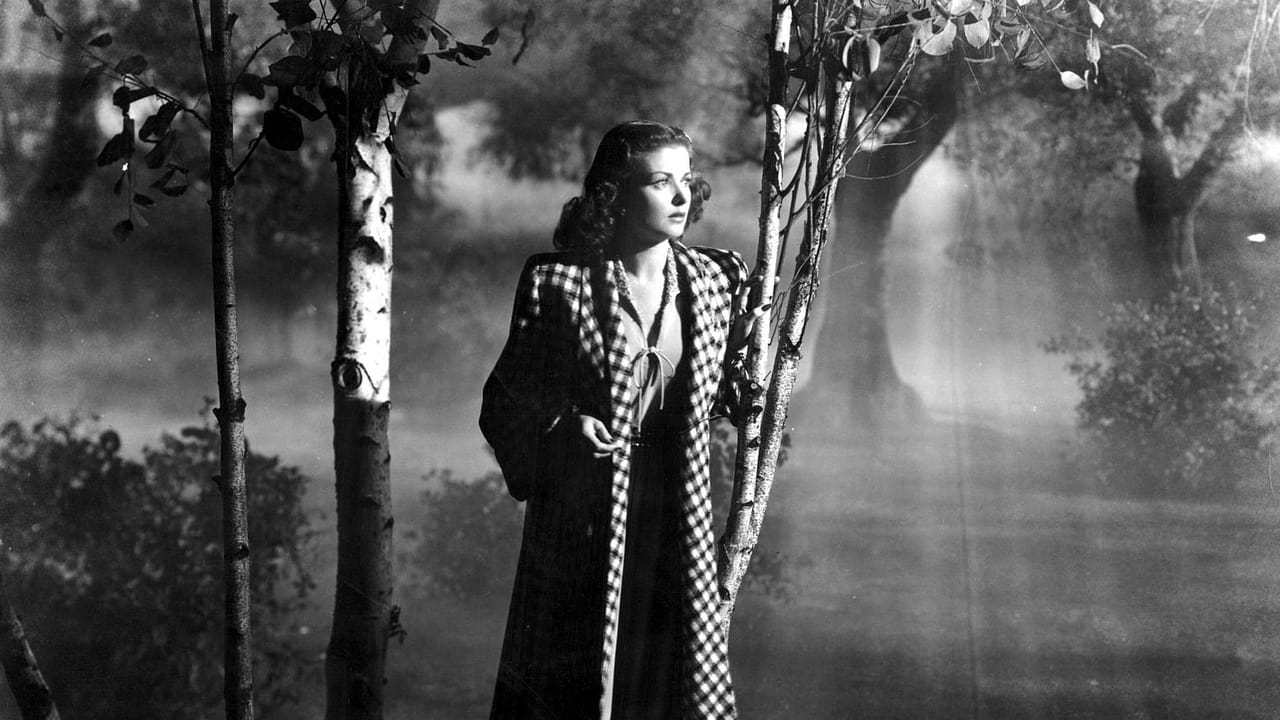
Fritz Lang's film arrives at the intersection of two currents running through postwar Hollywood: the vogue for Freudian psychodrama and the inherited formal vocabulary of the gothic melodrama. Produced through Diana Productions, the independent company Lang formed with Joan Bennett and her husband Walter Wanger, it carries the marks of unusual creative latitude alongside the strains of limited resources. What Lang achieves here is not a tightly engineered thriller but something more unsettled – a film that uses the premise of female jeopardy to examine the dangerous romanticism women are culturally encouraged to project onto unavailable men. Michael Redgrave's performance resists easy villainy, keeping Mark Lamphere genuinely ambiguous well past the point where the script begins to resolve him. Stanley Cortez's cinematography, meanwhile, pursues expressionist effects that occasionally outpace the narrative but consistently locate the film's moral argument in light and shadow rather than dialogue. Its weaknesses are real – the voiceover is overextended, the Freudian resolution lands with a thud – but the film's strangeness is its own form of integrity.
– Classic Noir
Lang and Cortez construct the approach to room seven as a corridor of diminishing light. The camera tracks with Celia at a low angle, the hallway walls pressing inward as practical illumination drops away and a single source – cold, directional – falls across the locked door. Shadow accumulates in the frame's corners until the door itself seems to float in a field of near-black. When the room's contents are finally shown, Cortez holds on Celia's face in a tight close-up before cutting to what she sees: the composed, terrible logic of a man who has made a room into a confession.
The scene distills the film's central premise into a single spatial act. The locked door is the unconscious rendered literal, and Celia's decision to open it is framed not as transgression but as the necessary and dangerous labor of understanding the person she has chosen to love. Lang refuses to make the revelation purely horrifying; there is something almost mournful in what the room contains, a quality that shifts the film's moral weight away from simple predator-and-prey and toward the more uncomfortable question of what we elect not to see in those we desire.
Stanley Cortez, whose work on The Magnificent Ambersons had already established him as an architect of chiaroscuro, brings to Secret Beyond the Door a rigorous commitment to shadow as psychological notation. Shooting primarily on studio sets designed to evoke the estate's institutional gloom, Cortez constructs lighting schemes in which characters are frequently half-consumed by darkness, their faces legible only in fragment. He favors hard single-source setups that carve deep shadows across walls and ceilings, creating an environment in which rooms appear to possess their own moral atmosphere. The recurrent use of low angles during scenes of psychological pressure elongates the architecture and reduces the human figure, reinforcing the film's argument that the past exerts a structural dominance over the present. The Mexican prologue, shot with slightly softer contrast, functions as a visual control – the warmth of that footage makes the estate's cold geometry feel like a punishment by comparison. Cortez's camera rarely offers neutral space; every composition is scored for unease.
Criterion's presentation is the most reliably sourced for a film of this era and is the recommended starting point for serious viewing.
TubiFreeTubi has carried the film in a serviceable public-domain or licensed print; picture quality varies, but access is immediate and free.
Archive.orgFreeArchive.org hosts multiple transfers of uncertain provenance; useful for research access but not a substitute for a cleaned print.