Films People Pull a Fast One Night Beat Reading Room On TV Shop
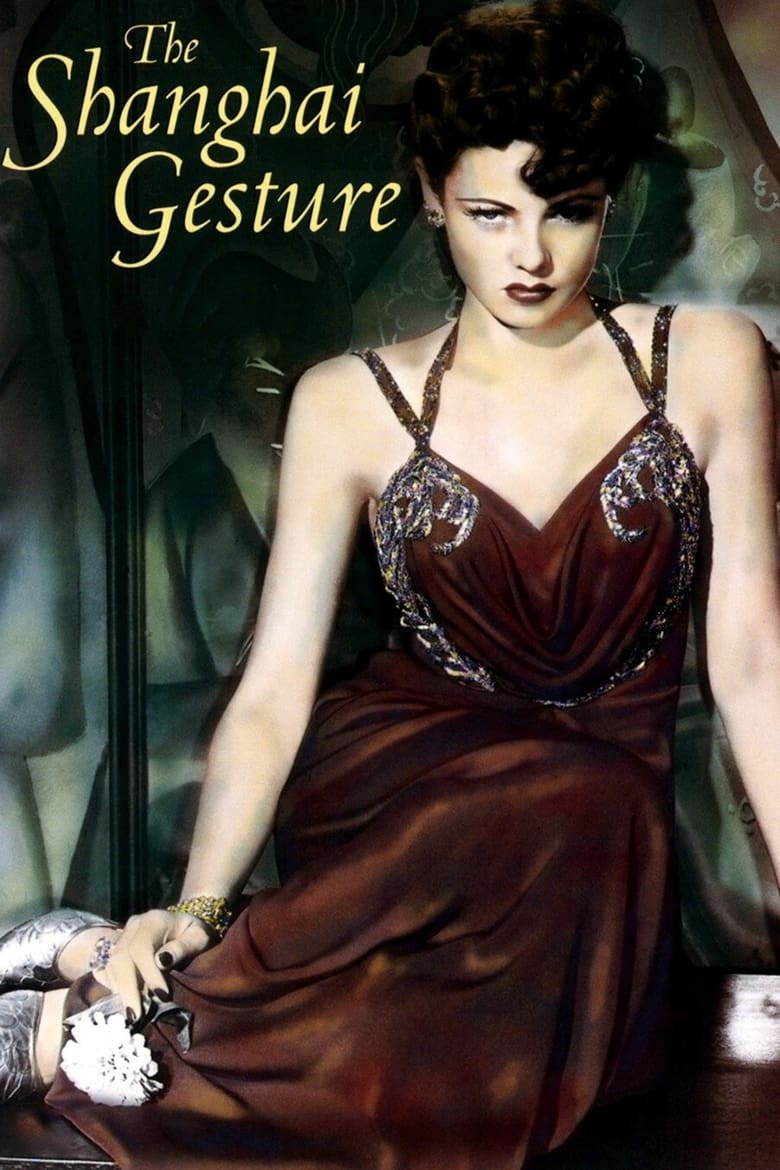
Shanghai Gesture 1941
1941 Arnold Pressburger Films
★★★☆☆ Notable
Film Noir · 99 minutes · Black & White

Shanghai Gesture

Directed by Josef von Sternberg
Year 1941
Runtime 99 min
Studio Arnold Pressburger Films
TMDB 6.2 / 10
"In the gambling dens of Shanghai, a man's sins find their way home through his daughter."

Sir Guy Charteris, a powerful British businessman, arrives in Shanghai with plans to demolish a notorious casino district for a commercial development. The establishment in his sights belongs to 'Mother' Gin Sling, a figure of iron authority who has presided over the city's underworld for decades. What begins as a transaction in colonial power becomes something more corrosive when Charteris brings along his daughter Victoria, a young woman of privilege who has never confronted the city's lower depths.

Victoria, calling herself Poppy Smith, falls under the spell of Doctor Omar, a dissolute and serpentine figure who serves as Gin Sling's instrument of pleasure and ruin. As Poppy descends into gambling, opium, and moral drift, Gin Sling watches with a purpose that transcends mere cruelty. She holds a secret that connects her past to Charteris in ways that neither power nor money can dissolve, and she is willing to use the daughter to settle what was done to the mother.

Von Sternberg constructs Shanghai not as a real city but as a moral ecosystem – a hothouse of obsession, debt, and hidden identity where the sins of one generation metabolise into the destruction of the next. The film operates in the register of Greek tragedy dressed in noir clothing, with fate moving not through coincidence but through the long patience of revenge. It stands as one of the more psychologically dense American productions of its decade, drawing on the conventions of the femme fatale and the corrupt patriarch while pushing both toward something stranger and more operatic.

Classic Noir

Shanghai Gesture occupies a peculiar position in the noir canon: made in 1941, it predates the genre's classical phase yet already contains its pathologies in concentrated form. Von Sternberg, working outside the major studio system with producer Arnold Pressburger, was freed from certain censorial pressures and used that latitude to build a film of genuine moral ugliness. The casino set – a circular pit of descending tiers, shot to suggest both a coliseum and a drain – is one of the period's most deliberately symbolic constructions. Ona Munson's Gin Sling is not the genre's standard seductress; she is a calculating survivor whose cruelty has a coherent origin in colonial exploitation and personal betrayal. Gene Tierney's performance as the disintegrating Poppy is more than decorative: her decline is rendered as a structural argument about inherited guilt. What the film ultimately reveals about its era is the American cinema's capacity – even under Production Code constraint – to dress a revenge tragedy in exotic spectacle and deliver something genuinely disturbing.

– Classic Noir
3 ★★★☆☆ Notable
Credits

The Crew

DirectorJosef von Sternberg
ScreenplayJosef von Sternberg
CinematographyPaul Ivano
MusicRichard Hageman
EditingSam Winston
Art DirectionBoris Leven
ProducerArnold Pressburger
Performances

The Cast

Close Reading

The Signature Scene

Shanghai Gesture – scene
The Casino Floor Poppy at the Roulette Wheel

Paul Ivano's camera finds Tierney from a high angle, placing her small and isolated within the casino's vast circular architecture. The frame is dense with extras and shadow, but a concentrated shaft of light isolates her face and the wheel in front of her. As the ball spins, Von Sternberg holds the shot long enough for the geometry of the pit – those descending rings of onlookers – to register as something inescapable. The composition rhymes the wheel's rotation with the descent of the tiered space itself, turning a game of chance into a diagram of entrapment.

The scene does more than register Poppy's addiction; it externalises the film's central thesis. She is not simply losing money but losing the identity her father's privilege constructed for her. Gin Sling watches from above, and her stillness against Poppy's feverish momentum clarifies the power relation: one woman is falling, the other has already survived her fall. The roulette wheel becomes the film's moral engine – random in appearance, engineered in fact.

Visual Language

The Cinematography

🎞️
Paul Ivano – Director of Photography

Cinematographer Paul Ivano, working in close collaboration with Von Sternberg, builds Shanghai almost entirely on studio stages, and the artificial construction is a deliberate expressive choice rather than a limitation. The casino set is lit to emphasise verticality and depth, with Ivano using hard top-lighting to carve faces into high-contrast relief against the crowded, shadow-filled background. Faces are frequently framed through gauze, smoke, or lattice screens, a technique that layers visual texture while suggesting concealment and moral ambiguity. Lens choices favour slight compression of the middle ground, keeping characters in close relation to the architecture that surrounds them – no one breathes freely in this space. The lighting grammar is consistent with the film's moral logic: Gin Sling is almost always rendered in controlled, cool illumination that conveys her deliberateness, while Poppy is increasingly caught in harsh, unflattering light that strips away the softness of her early scenes. Shadow work throughout recalls German Expressionist precedents without quoting them directly, positioning the film between studio glamour and something considerably darker.

In the Catalogue

Themes & Motifs

Availability

Where to Watch

Also in the Directory

See Also