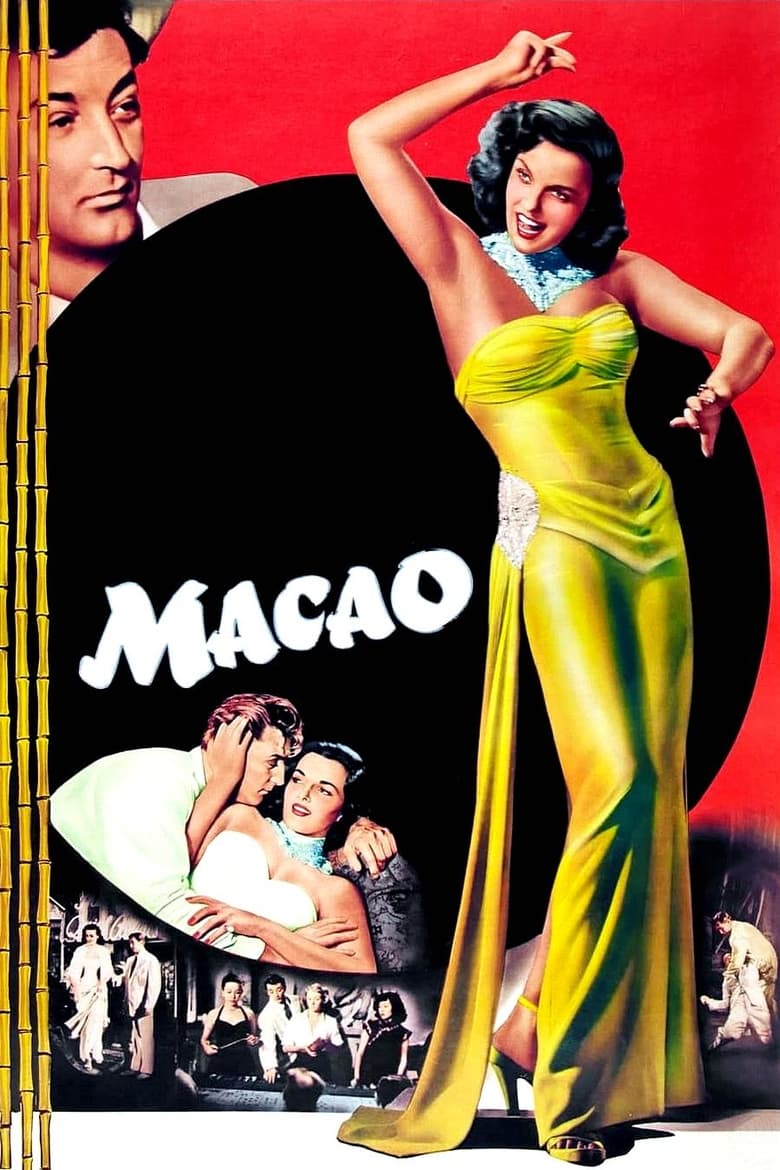
A passenger ship deposits three Americans onto the docks of Macao, the Portuguese enclave on the South China coast where extradition treaties do not reach. Nick Cochran (Robert Mitchum) is a drifter with a clouded past, deliberately vague about his reasons for being in the colony. Julie Benson (Jane Russell) is a nightclub singer who has learned to trust no one and use every advantage she has. Lawrence Trumble (William Bendix) presents himself as a traveling salesman but is almost certainly something more deliberate. From the moment they step ashore, Lt. Sebastian (Thomas Gomez), the colony's morally flexible police commander, is watching all of them.
The city's center of gravity is Vincent Halloran (Brad Dexter), a gambling kingpin who operates beyond the reach of American law and who has made Macao his permanent refuge. An American detective, Martin Stewart (Edward Ashley), is trying to lure Halloran into international waters where he can be arrested, and Nick finds himself drawn into that scheme against his will – his own record making him vulnerable to pressure from both sides. Margie (Gloria Grahame), Halloran's kept companion, drifts toward Nick with the half-resigned curiosity of someone who no longer expects anything to go well. Julie, suspicious of Nick's shifting allegiances, must decide whether the cynicism she has cultivated is a reliable guide or a habit she has mistaken for wisdom.
Macao operates as a hybrid of the exotic adventure picture and the noir procedural, using its offshore setting to compress the familiar genre tensions of identity, complicity, and escape into an unusually tight geography. The film is less interested in the mechanics of crime than in the question of whether a man with a damaged reputation can choose a different outcome when circumstance offers him the chance – and whether the woman watching him has enough at stake to care if he does.
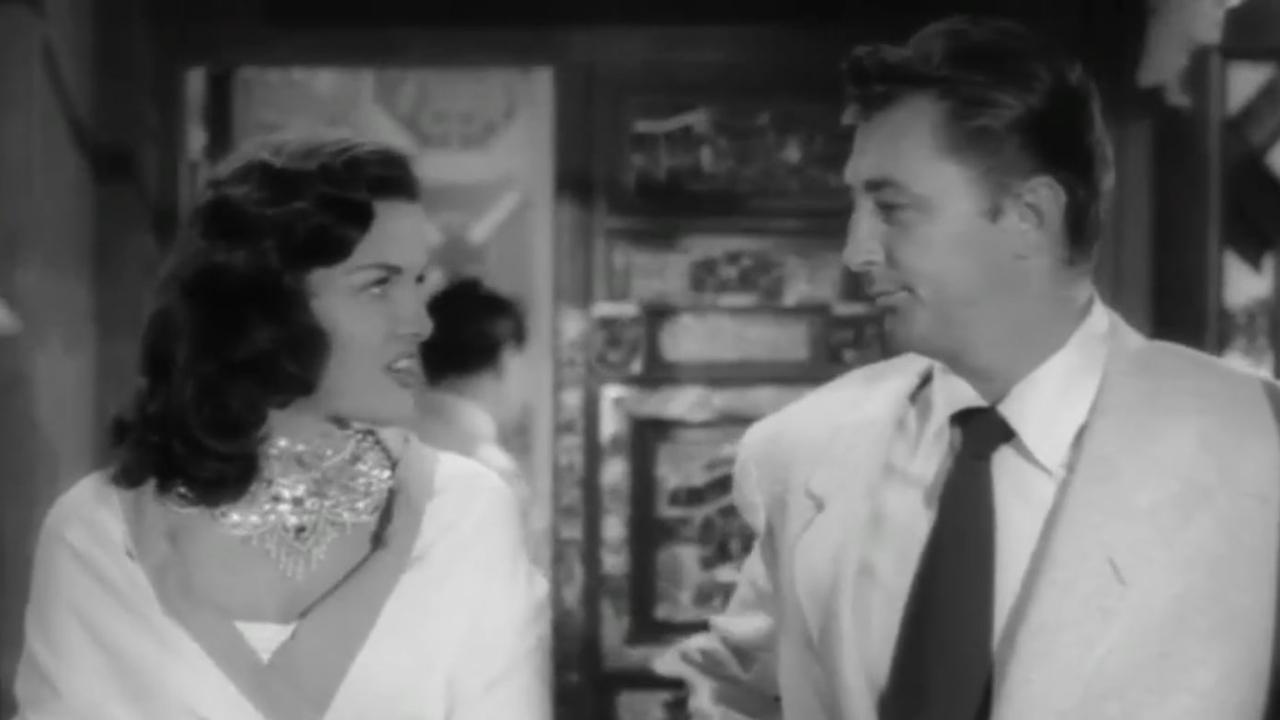
Macao is a film visibly pulled in competing directions, and that tension is now part of its interest. Josef von Sternberg was replaced during production by Nicholas Ray, and Howard Hughes personally supervised additional reshoots, leaving the finished picture a composite of intentions that never fully resolve. What survives of von Sternberg's work is a formal instinct for exotic atmosphere and the controlled presentation of desire, most legible in the way Jane Russell is lit and framed as an object of calculation as much as attraction. Mitchum brings his habitual economy to a role that the script underserves – his Nick Cochran is reactive where he should be enigmatic. Gloria Grahame, in a secondary role that the film does not develop adequately, registers more psychological texture in brief scenes than the leads are given material to sustain. As a genre entry, Macao belongs to that category of studio noirs where the setting does significant thematic work that the narrative cannot quite complete – the colony's lawless ambiguity standing in for a postwar moral disorder the film gestures toward without fully articulating.
– Classic Noir
Harry J. Wild shoots the climactic waterfront sequence with a low horizon line that gives the black water maximum screen presence, the dock lights catching only the upper surfaces of figures and the rigging above them. The frame is cluttered with industrial geometry – ropes, nets, the angular silhouettes of mooring equipment – and Wild uses these elements to partition space, trapping characters within portions of the image rather than allowing them to move freely through it. The net itself, which becomes the instrument of Halloran's fate, is introduced gradually in the background before the narrative needs it, so that when it becomes central it feels less like a plot device than like something the environment had prepared.
The scene concentrates the film's argument about entrapment and jurisdiction into a single image: a man caught in a net in water that belongs to no country's law. Nick, who has spent the film resisting being used as an instrument by any authority, becomes briefly the agent of an outcome he did not design. The location's neutrality – neither American nor entirely foreign – mirrors his own unresolved status, and Wild's reluctance to let any figure stand in full light keeps the moral accounting provisional even as the action concludes.
Harry J. Wild, whose RKO work in the 1940s included some of the studio's more rigorous noir photography, brings to Macao a visual approach calibrated to studio-constructed exoticism rather than location authenticity. The Macao of this film is built on soundstages, and Wild's response is to lean into controlled artificiality: lamplight that pools precisely where the script requires atmosphere, shadow patterns on walls that suggest labyrinthine space without the expense of constructing it. He favors a slightly compressed perspective that collapses depth in the nightclub and street sequences, making the colony feel enclosed and inescapable. Russell is consistently lit with a soft key that slightly separates her from the harder-edged treatment of the male players, a distinction that functions as a kind of visual argument about her character's position – present in the world of the film but not entirely of it. The waterfront sequences introduce genuine tonal contrast, Wild moving to harder, more directional sources that give the climax a texture absent from the interiors.
Criterion Channel periodically programs RKO noir cycles and is the most reliable streaming source for a correctly framed, clean transfer of this title.
TCMSubscriptionTCM broadcasts Macao with some regularity given its Mitchum and Russell pedigree; check the monthly schedule for air dates.
TubiFreeTubi has carried this title in ad-supported rotation, though transfer quality and availability vary; confirm current listing before viewing.