Howard Graham, a mild-mannered American munitions engineer, is in Istanbul completing a naval contract when an assassination attempt in a nightclub reveals that enemy agents consider him a liability. Colonel Haki, the shrewd chief of Turkish secret police, intervenes before a second attempt can succeed and arranges for Graham to be smuggled out of the country by cargo ship rather than the obvious route by air or rail. Graham, accustomed to conference tables and slide rules, finds himself aboard a slow freighter with strangers he cannot read, carrying a threat he cannot quantify.
Among the passengers are Josette Martel, a nightclub dancer whose loyalties remain opaque, her comedian husband Gogo, the oily merchant Kopeikin, and the courtly Professor Haller, whose archaeological credentials conceal a more lethal vocation. Graham attempts to cable his wife Stephanie, to maintain the appearance of an ordinary transit, but the voyage steadily closes around him. Trust becomes a calculation he is not equipped to make, and each port stop tightens the possibility of escape.
Journey Into Fear situates itself in the wartime spy thriller while reaching toward something quieter and more unsettling: the vulnerability of the ordinary man suddenly removed from every institutional protection he assumed was permanent. The ship becomes a floating trap in which guilt and innocence are indistinguishable from the outside, and the enemy wears the same evening clothes as the innocent.
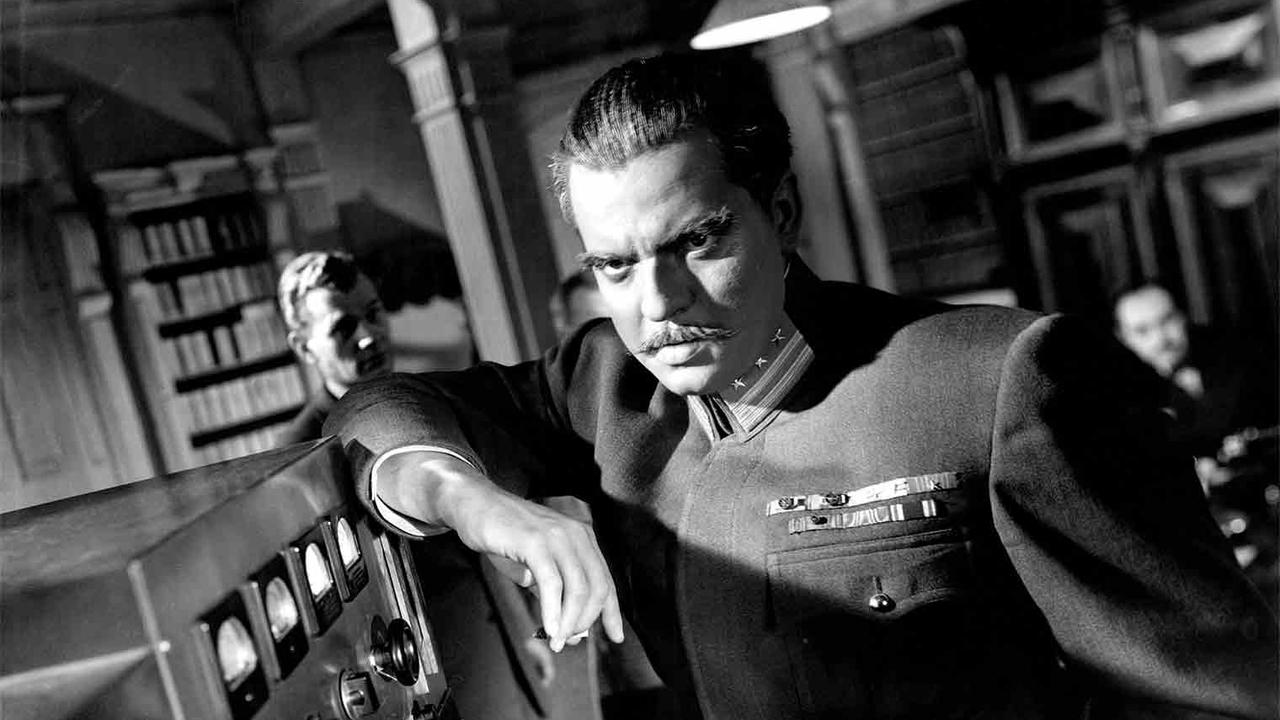
Journey Into Fear occupies an ambiguous but instructive position in the RKO noir cycle of the early 1940s. Adapted from Eric Ambler's 1940 novel and produced under Orson Welles's Mercury Theatre banner, it carries the fingerprints of Welles in its compositional restlessness and its taste for moral shadow, even though Norman Foster holds the directing credit. At 68 minutes it is compressed almost to the point of abstraction, stripping the Ambler source of its geopolitical texture to focus on Graham's private vertigo. Joseph Cotten is well cast precisely because Graham is not heroic – he is a technically proficient man rendered helpless by a world operating outside professional logic. Karl Struss's camerawork in the cramped ship interiors makes confinement itself a dramatic argument. What the film reveals about its era is the anxiety of competence without power: the specialist who can calculate a gun's trajectory but cannot navigate human deception. That is a distinctly wartime American fear, and the film registers it with unobtrusive accuracy.
– Classic Noir
Near the film's climax, Graham is forced onto a narrow exterior ledge high above a rain-slicked street, the camera pulling back to emphasize the sheer drop below and the inadequacy of his footing. Karl Struss lights the sequence so that the building's facade is almost entirely lost in darkness, leaving only the wet stone lip of the ledge and the pale smear of Graham's face catching what little ambient light rises from below. The frame refuses to grant him any compositional stability – he is always at the edge of the image as well as the edge of the building.
The scene condenses the film's central argument into a single image: a rational man stripped of every professional and social instrument, reduced to the arithmetic of balance and grip. Graham has no tradecraft, no weapon, and no ally within reach. What the ledge externalizes is the interior condition the film has been constructing since Istanbul – the discovery that expertise in one domain confers no immunity in another, and that survival may depend entirely on a kind of stubbornness that has nothing to do with intelligence.
Cinematographer Karl Struss, working on RKO's studio stages and confined sets, uses the freighter's corridors and cabins as instruments of psychological pressure rather than mere location. His lens choices favor slightly wider angles in interior spaces, which distorts depth and makes walls appear to lean inward without resorting to the overtly expressionist tilts that a less disciplined production might have employed. Shadow work is dense but purposeful: light sources are motivated by practical fixtures – portholes, bare bulbs, a single desk lamp – so that the resulting chiaroscuro feels earned rather than decorative. On deck sequences, Struss allows the flat grey of open water to function as negative space, isolating figures against a horizon that offers no information. The visual grammar consistently serves the film's moral logic: the world through which Graham moves is not dramatically dark so much as structurally unreadable, and Struss's cinematography makes illegibility itself the dominant atmospheric condition.
Journey Into Fear entered the public domain and is available in multiple transfers on Archive.org; print quality varies, so compare uploads before committing to a version.
Criterion ChannelSubscriptionWhen available in the Criterion Channel's rotating RKO or Mercury Theatre programming, this is the preferable option for image stability and correct aspect ratio.
TubiFreeTubi has carried the film in its classic noir library; check current availability, as titles rotate, but the transfer is generally cleaner than unvetted Archive.org copies.