Films People Pull a Fast One Night Beat Reading Room On TV Shop
Paid to Kill 1954
1954 Lippert Films
★★★☆☆ Notable
Film Noir · 75 minutes · Black & White

Paid to Kill

Directed by Montgomery Tully
Year 1954
Runtime 75 min
Studio Lippert Films
TMDB 5.9 / 10
"A man hires his own killer, then changes his mind – too late."

James Nevill is a London businessman on the edge of ruin. Facing financial collapse and a marriage that has long since turned cold, he makes a decision that crosses into irreversible territory: he contracts a hired killer named Paul Kirby to end his life, calculating that his insurance payout will rescue his company and provide for those he leaves behind. The arrangement is made through intermediaries, at a remove that allows Nevill to treat it, briefly, as an abstraction.

When Nevill's fortunes unexpectedly reverse – a deal comes through, the collapse is averted – he attempts to cancel the contract. Kirby refuses. The money has changed hands, the mechanism is in motion, and Kirby is not a man who unwinds agreements as a courtesy. Nevill now finds himself in the position of the hunted, unable to go to the police without confessing his own criminal intent, working against a clock only Kirby controls. The woman in his life, Joan Peterson, becomes both a complication and a potential liability.

Paid to Kill works the noir premise of a man destroyed by his own prior calculation, the trap sprung not by fate or femme fatale but by the protagonist's own contractual logic. Tully keeps the film tight within its budget, using London locations and studio interiors to sustain a mood of urban enclosure. The film belongs to a strand of British B-noir that borrowed American genre mechanics and refracted them through a more restrained, procedural sensibility.
Classic Noir

Paid to Kill occupies a specific and underexamined niche in the British noir cycle of the early 1950s – the Lippert-backed co-production designed to satisfy quota requirements while delivering genre product to both domestic and American markets. Montgomery Tully, a reliable craftsman of the second feature, constructs the film around a genuinely sharp premise: the self-arranged murder that cannot be undone. What distinguishes the film from its nearest contemporaries is less any stylistic ambition than its procedural coldness. Dane Clark, imported American talent whose career had slipped from the Warner Bros. first tier, brings a convincing edge of desperation to Nevill – a man whose sophistication has led him into a corner that sophistication cannot open. Paul Carpenter's Kirby is effective precisely because he is not theatrical; he is simply implacable. The film says something true about postwar male anxiety, about men who have structured their lives around control discovering that control is always conditional. At 75 minutes it has no room for waste, and largely it does not waste what it has.

– Classic Noir
3 ★★★☆☆ Notable
Credits

The Crew

DirectorMontgomery Tully
ScreenplayPaul Tabori
CinematographyWalter J. Harvey
MusicIvor Slaney
EditingJames Needs
Art DirectionJ. Elder Wills
ProducerAnthony Hinds
Performances

The Cast

Close Reading

The Signature Scene

Paid to Kill – scene
The Telephone Reversal The Call That Cannot Be Unmade

Nevill stands at the telephone in a mid-shot framed by the hard geometry of his office interior – a window behind him cutting the room into light and shadow with minimal gradation. Walter J. Harvey keeps the camera at eye level, refusing dramatic angles; the plainness of the framing is itself the point. When Nevill hears Kirby's response – that the contract stands – Harvey holds on Clark's face in close-up for a beat longer than comfort allows, the light falling across one side and leaving the other in flat darkness.

The scene is the film's moral fulcrum. Nevill is not a victim of circumstance or of another person's malice; he is the author of his own jeopardy, and the close-up refuses to let that pass unmarked. The telephone, an instrument of modern efficiency and business logic, has become the mechanism of a sentence he wrote himself. The film's argument about the limits of rational self-interest is made here, quietly, in a held close-up and a shadow that does not lift.

Visual Language

The Cinematography

🎞️
Walter J. Harvey – Director of Photography

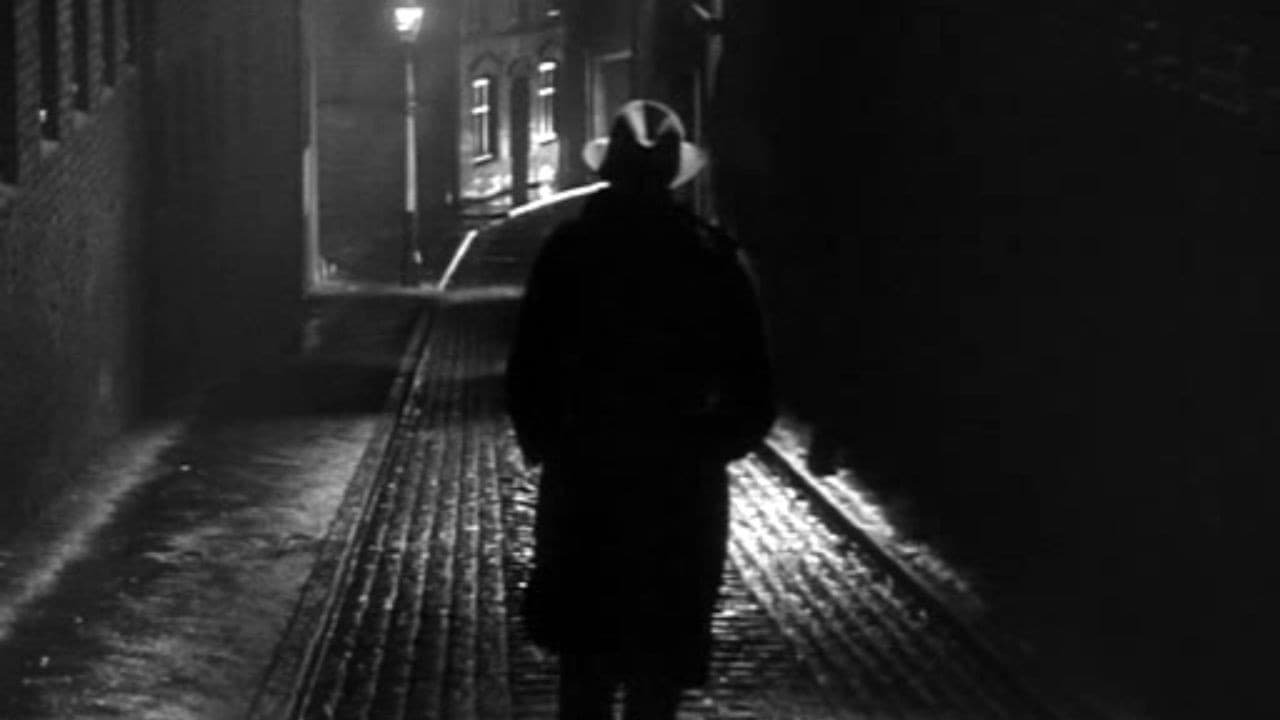
Walter J. Harvey shoots Paid to Kill in the mode of functional British studio noir – high-contrast lighting built from hard sources, shadow used as compression rather than atmosphere, interiors that feel enclosed without resorting to expressionist distortion. Harvey works with modest setups, likely due to the production's Lippert budget constraints, but turns limitation into consistency: the film's visual world is uniformly tight and unglamorous, which aligns precisely with its moral register. Location footage of London streets provides periodic relief from the studio while reinforcing the sense of a city that offers no refuge. Harvey's lens choices favour the mid-range; there are few wide establishing shots and fewer close-ups held for emphasis, which makes those that do appear carry disproportionate weight. The shadow work is economical rather than elaborate – a single source splitting a face, a doorframe cutting a figure into two tones – and it serves the film's central argument that ordinary spaces and ordinary men contain the geometry of entrapment.

In the Catalogue

Themes & Motifs

Availability

Where to Watch

Also in the Directory

See Also