Films People Pull a Fast One Night Beat Reading Room On TV Shop
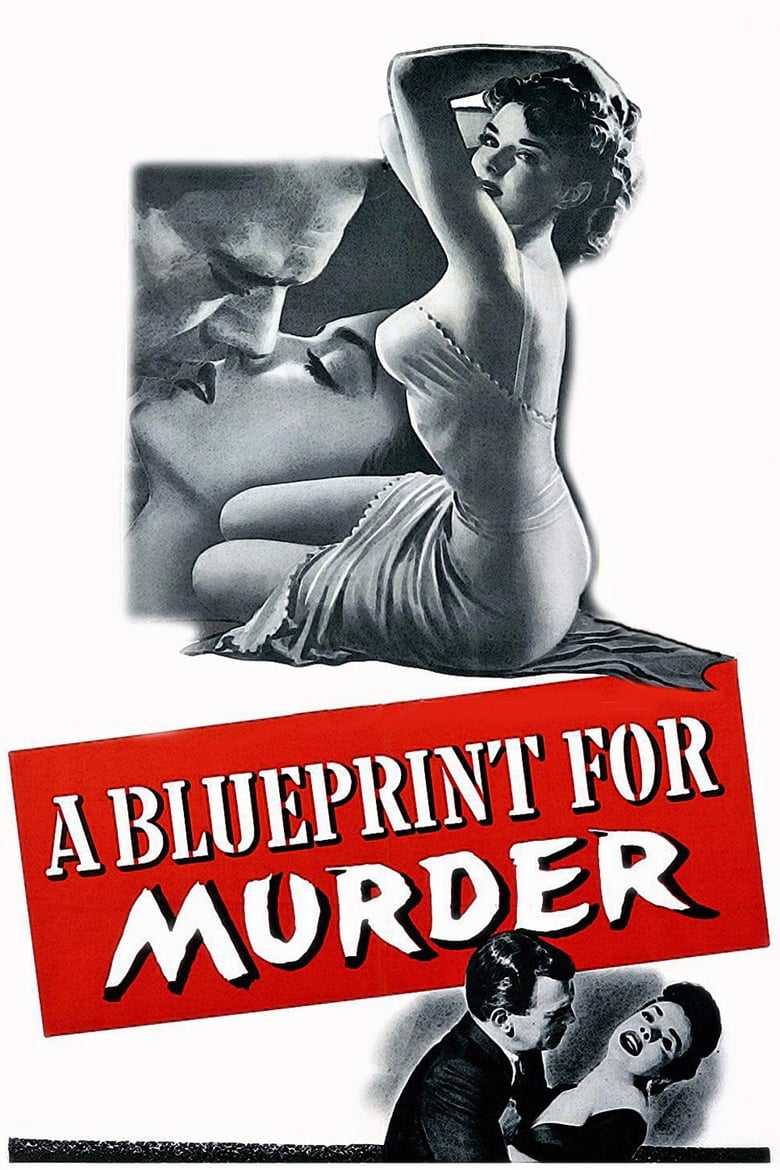
Blueprint for Murder 1953
1953 20th Century Fox
★★★☆☆ Notable
Film Noir · 77 minutes · Black & White

Blueprint for Murder

Directed by Andrew L. Stone
Year 1953
Runtime 77 min
Studio 20th Century Fox
TMDB 6.2 / 10
"A man suspects his nephew's widow of murder, and the evidence only sharpens his doubt."

When his young nephew Doug dies under suspicious circumstances, Whitney 'Cam' Cameron travels to Boston to settle the estate and finds himself drawn into the orbit of Doug's widow, Lynn – a woman of composed manner and uncertain motive. Doug's death follows that of his young daughter from an earlier marriage, and Cam begins to question whether accident and illness have been the only forces at work. Lynn, now positioned to inherit substantially, reads Cam's suspicion and meets it with a cool, practiced surface that neither confirms nor dispels his fears.

Cam's investigation pulls Fred Sargent, a family friend, and his wife Maggie into the web of suspicion. As Cam presses closer to the truth, he enlists the cautious assistance of Detective Captain Pringle and a persistent insurance investigator named Harold Y. Cole. The procedural machinery of the law proves slow and blunt against a suspect who has left no obvious trace, and Cam begins to contemplate a more direct form of justice – one that places him outside the boundaries of legal conduct and forces the question of how far a man will go when the law cannot follow.

Blueprint for Murder works the inheritance-and-poisoning vein of noir with disciplined economy, foregrounding the moral cost of vigilante logic and the particular dread of a killer whose weapon is patience. The film belongs to a cycle of postwar domestic thrillers in which murder intrudes not from the street but from within the family unit, and where the detective figure is himself compromised by grief and the desire for a resolution the courts cannot guarantee.

Classic Noir

Blueprint for Murder is a modest but carefully constructed entry in the Fox noir cycle, directed by Andrew L. Stone with the procedural sobriety he brought to several crime films of the period. What distinguishes it from routine programmer fare is the central performance by Joseph Cotten, who carries Cam's accumulating certainty with a quiet, controlled anguish that never tips into melodrama. Jean Peters counters him with a performance of studied opacity – Lynn Cameron is a study in withheld interiority, and the film is shrewd enough to let that opacity carry genuine menace. The film engages, obliquely, with postwar anxieties about domesticity and the unreliability of surfaces: the killer here is not a professional criminal but a figure embedded in the family structure, and the poison she may or may not have administered is the logical extreme of a certain kind of social calculation. Stone keeps the pacing lean across 77 minutes, and the film's refusal to sentimentalize its resolution gives it a harder edge than its modest reputation suggests.

– Classic Noir
3 ★★★☆☆ Notable
Credits

The Crew

DirectorAndrew L. Stone
ScreenplayAndrew L. Stone
CinematographyLeo Tover
MusicLeigh Harline
EditingWilliam B. Murphy
Art DirectionAlbert Hogsett
ProducerMichael Abel
Performances

The Cast

Close Reading

The Signature Scene

Blueprint for Murder – scene
The Ocean Liner Crossing Suspicion at Open Sea

Cinematographer Leo Tover frames the sequence aboard the ocean liner with a deliberate flatness of available light and confined geography – corridors narrow, the horizon absent, the ship's interior pressing the two figures into close and inescapable proximity. Cotten's face is lit from a hard side source that leaves the far cheek in shadow, splitting his expression between resolve and something less certain. Peters is shot in a cooler, more diffuse light that renders her unreadable. The camera does not cut away to reaction shots in the conventional rhythm; it holds, slightly longer than comfort permits, on the space between the two figures.

The scene enacts the film's central argument about evidence and certainty: Cam knows, or believes he knows, and yet knowledge in the absence of proof forces a man toward action that mirrors the crime he is trying to punish. The ship functions as a non-space, outside jurisdiction, outside the social contracts that have failed him on land. Whatever occurs here cannot be adjudicated, and the film understands that this is both the point and the horror.

Visual Language

The Cinematography

🎞️
Leo Tover – Director of Photography

Leo Tover's work on Blueprint for Murder is restrained in a way that serves the film's moral register precisely because it refuses expressionist excess. Tover, whose credits ranged from prestige pictures to tight studio programmers, shoots the domestic interiors with a flat, almost affectless lighting scheme that refuses to code spaces as safe or threatening by conventional noir grammar – the danger here is not announced by chiaroscuro but concealed within ordinary illumination. The camera favors medium shots and holds positions that place characters in frames within frames – doorways, windows, the geometry of institutional corridors. Shadow work appears selectively, used to mark psychological transition rather than as atmospheric wallpaper. The shift to the ocean liner in the final act introduces a different visual logic: tighter, more claustrophobic compositions that mirror the closing of narrative options. Throughout, Tover's lens choices keep focal depth shallow enough to isolate faces without distortion, maintaining the film's investment in reading – and failing to read – the human countenance.

In the Catalogue

Themes & Motifs

Availability

Where to Watch

Also in the Directory

See Also