Films People Pull a Fast One Night Beat Reading Room On TV Shop
Night Without Sleep 1952
1952 20th Century Fox
★★★☆☆ Notable
Film Noir · 77 minutes · Black & White

Night Without Sleep

Directed by Roy Ward Baker
Year 1952
Runtime 77 min
Studio 20th Century Fox
TMDB 5.8 / 10
"A man wakes with blood on his hands and a night he cannot remember."

Richard Morton, a moderately successful composer living in San Francisco, wakes one morning with no memory of the previous night. When a woman is found murdered, Morton begins to suspect that he may be responsible – a suspicion deepened by fragmentary recollections, an unexplained absence, and the discovery that the victim was known to him. His wife Laura is loyal but frightened; his past, it emerges, is crowded with women he has treated badly.

The investigation draws in two figures from Morton's recent history: Julie Bannon, a nightclub singer with a proprietary claim on his affections, and Lisa Muller, a European émigré whose composed exterior conceals something more volatile. As Morton attempts to reconstruct the missing hours, the loyalties of those around him prove elastic. Dr. Clarke, his analyst, occupies an ambiguous position between confidant and accuser, and the domestic arrangement Morton has built begins to reveal the rot beneath its surface.

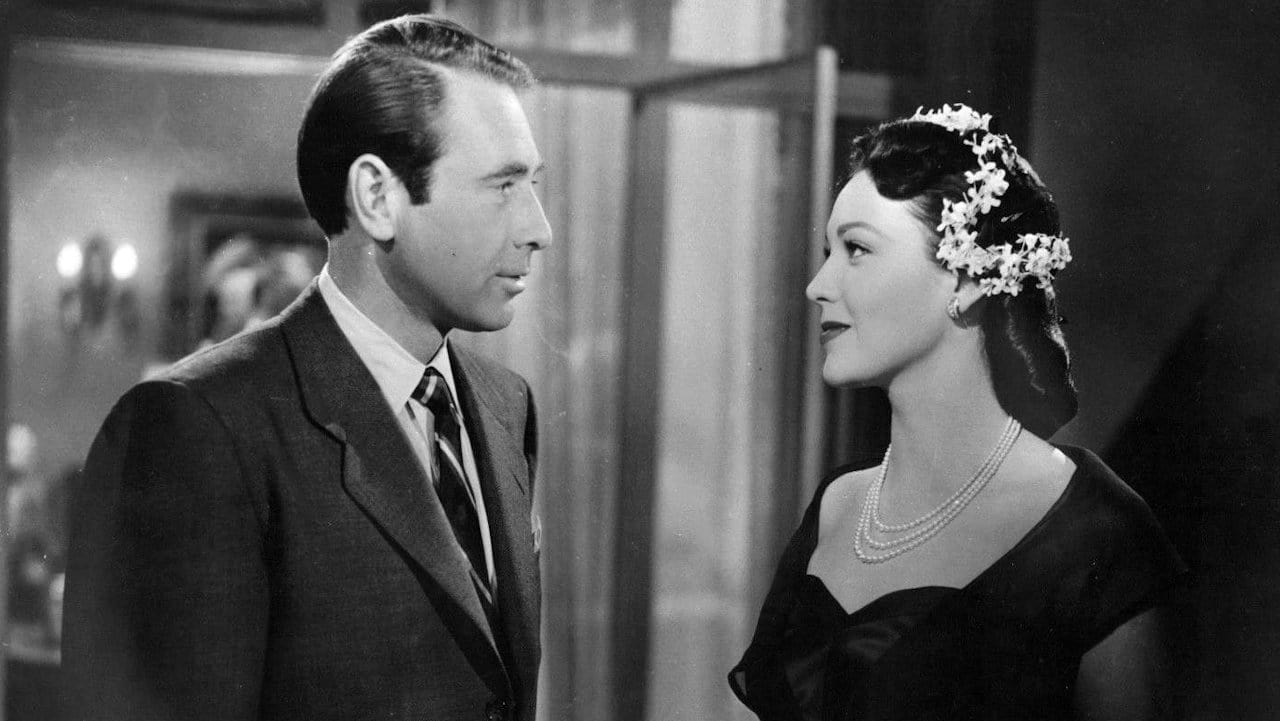
Night Without Sleep belongs to the strand of postwar noir organized around male instability rather than criminal conspiracy – films in which the protagonist's psychology is itself the labyrinth. The question of whether Morton is guilty is secondary to the film's interest in what guilt, real or imagined, does to a man already inclined toward self-destruction. The screenplay keeps its mechanics tidy while the performances carry the film's darker freight.
Classic Noir

Night Without Sleep is a modest but carefully considered entry in the cycle of amnesia-structured noirs that proliferated in the late 1940s and early 1950s. Roy Ward Baker, working at 20th Century Fox shortly before his return to Britain, brings the same controlled formalism he would later deploy in I'll Never Forget You and Inferno. The film's particular accomplishment is its triangulation of three women around a single weak man, each representing a different claim on his identity: the wife who wants stability, the singer who wants possession, the European woman who wants escape. Gary Merrill, never quite a star but reliably effective in compromised-male roles, plays Morton's disintegration with restraint rather than theatrics. Hildegard Knef, still something of a curiosity to American audiences in 1952, brings genuine opacity to Lisa Muller. The film does not fully trust its own psychological ambitions – the resolution is tidier than the premise warrants – but as a document of postwar masculine anxiety refracted through genre convention, it rewards careful attention.

– Classic Noir
3 ★★★☆☆ Notable
Credits

The Crew

DirectorRoy Ward Baker
ScreenplayFrank Partos
CinematographyLucien Ballard
MusicCyril J. Mockridge
EditingNick DeMaggio
Art DirectionAddison Hehr
CostumesRenié
ProducerRobert Bassler
Performances

The Cast

Close Reading

The Signature Scene

Night Without Sleep – scene
Morton's Apartment, Pre-Dawn Blood on the Piano Keys

Morton returns to consciousness in his apartment with the pre-dawn light coming in flat and cold through half-drawn blinds. Lucien Ballard holds the camera low and still, framing the piano in the middle distance so that Morton's hands, as they move toward the keys, enter the shot from below frame. The light catches the surface of the keys before it catches his face, a compositional choice that makes the instrument feel like an accusation. Shadows fall in parallel bars across the floor, the geometry too orderly for the chaos Morton is trying to reconstruct.

The scene establishes the film's central proposition without dialogue: that the thing Morton loves – music, creativity, the self-image of the artist – may be the vehicle through which his worst capacities express themselves. The piano is not a symbol of innocence but of a double life, and Ballard's framing refuses to let Morton's face dominate the image. The man is peripheral to the evidence of what he may have done.

Visual Language

The Cinematography

🎞️
Lucien Ballard – Director of Photography

Lucien Ballard's cinematography for Night Without Sleep operates within the studio system's constraints while finding room for consistent formal intelligence. Shooting on Fox's standing sets, Ballard favors deep-focus arrangements that keep both the protagonist and incriminating background detail in simultaneous resolution, denying Morton the luxury of a soft or evasive frame. His lighting setups lean on hard side-light and venetian-blind shadow patterns, techniques common to the period but deployed here with particular consistency: the shadows are never decorative, always tethered to Morton's state of knowledge. Night interiors are lit to suggest sourceless anxiety rather than dramatic expressionism, the darkness arriving gradually rather than as a set piece. Where other noirs of the era use shadow to signal evil, Ballard uses it to signal uncertainty, which is precisely what the screenplay requires. The result is a visual grammar aligned with the film's moral argument: that guilt and innocence are not opposites but gradations along a continuum the camera cannot resolve.

In the Catalogue

Themes & Motifs

Availability

Where to Watch

Also in the Directory

See Also