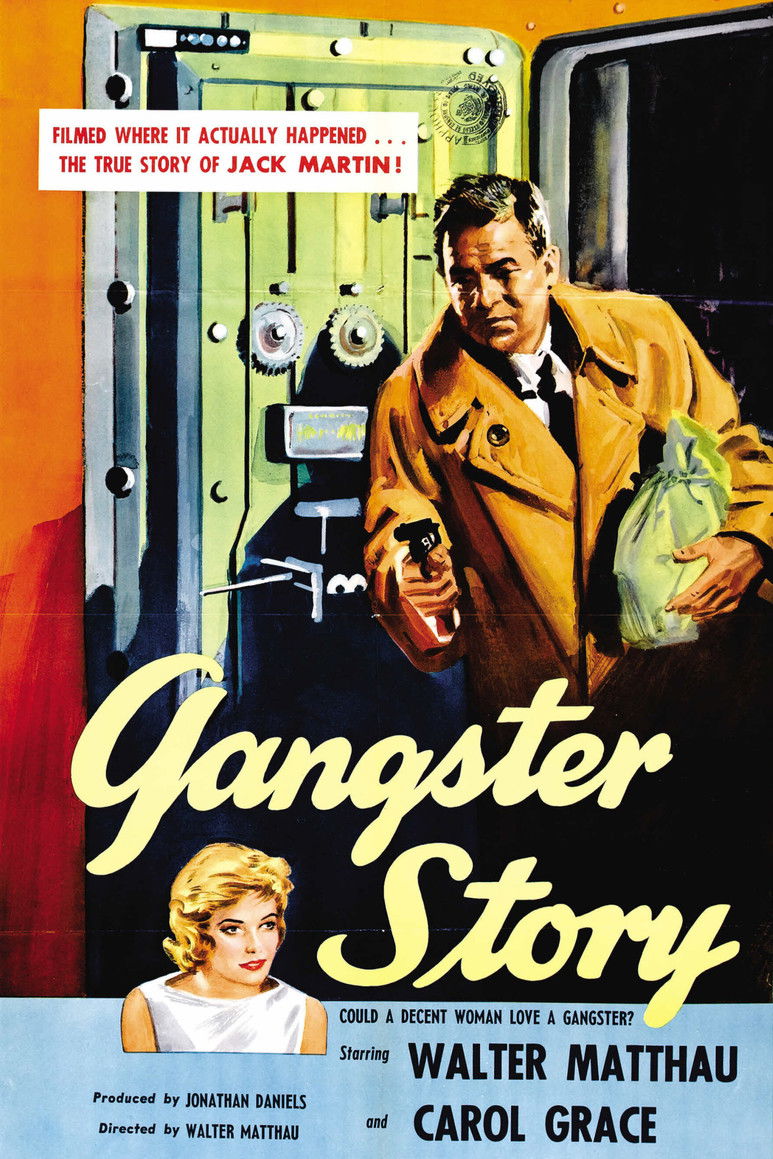
Jack Martin (Walter Matthau) is a mid-level syndicate operator who has spent years enforcing the arrangements of men more powerful than himself while cultivating the illusion of his own authority. When a lucrative territory dispute draws the attention of Earl J. Dawson (Bruce MacFarlane), a calculating superior within the organization, Martin's position becomes less a prize than a liability. Carol Logan (Carol Grace) occupies the space between the two men – connected to Martin by history and to Dawson by opportunity.
As Dawson tightens his grip on the operation, Martin finds that the loyalty he believed he had purchased from subordinates like Adolph (Garry Walberg) and the man known only as Plumber (Raikin Ben-Ari) is a currency that depreciates quickly under pressure. Allegiances shift along lines of survival rather than principle, and Martin must reckon with the possibility that he has misread every relationship that sustained him. Carol's position grows more ambiguous as the conflict sharpens, placing her at the intersection of competing dangers.
Gangster works within the compressed logic of the B-noir programmers that populated the late 1950s independent market, using a 65-minute frame to strip away the procedural scaffolding and concentrate on a single man's recognition of his own obsolescence. The film belongs to a cycle concerned less with crime as spectacle than with the internal accounting that crime demands – the moment when a man realizes the organization has already moved past him.
Gangster (1959) is a minor but coherent entry in the late cycle of American independent noir, produced under Swen Productions with the economy that defined the era's lower-budget output. What distinguishes it from similar programmers is the presence of Walter Matthau in a dual capacity – as director and lead performer – a combination that gives the film an unusual self-consciousness about performance and power. Matthau was not yet the figure he would become in the following decade, and there is something instructive in watching him inhabit a man whose authority is eroding in real time. The film understands the syndicate not as a romantic abstraction but as a bureaucratic structure, one that discards operatives through the same indifferent logic that any institution uses to manage its liabilities. Carol Grace, Matthau's wife at the time, brings an unforced tension to a role that could easily have been decorative. At 65 minutes, the film cannot afford waste, and largely it does not indulge in it. Its value to the genre is documentary as much as cinematic – a record of what noir looked like when its conventions had been fully absorbed into the industrial routine of American independent production.
– Classic Noir
The scene is staged in the grounds adjacent to the country club, where the manicured surfaces of leisure function as ironic backdrop to the transaction taking place. The camera holds at a middle distance, refusing close coverage that might soften the geometry of the encounter. Light falls unevenly – the open exterior provides no shelter of shadow, which is itself the visual argument: Martin is exposed, without the architecture of the city to absorb him. The frame keeps both men in view, denying either the compositional dominance that would signal safety.
What the scene establishes is the precise moment at which Martin's understanding of his situation catches up with Dawson's long-settled intentions. The country club setting – its connotations of legitimacy, of money that has laundered itself into respectability – marks the distance between where Martin operates and where power actually resides. He has arrived at a place that was never designed to admit him as anything other than a problem to be resolved.
Cinematographer Max Glenn shoots Gangster with the functional discipline that the production's economics demanded, but within those constraints makes choices that serve the film's moral logic. Working largely on location rather than studio sets, Glenn uses available architectural geometry to isolate characters rather than relying on expressionist lighting constructions. Shadow work appears selectively – concentrated at thresholds and in interior passages where the narrative turns – rather than applied as atmospheric wallpaper. The lens choices favor a moderate focal length that keeps figures in legible relation to their environments without the distorting pressure of wider glass, an approach that suits a film about men who believe they understand the space they occupy. Glenn's lighting in interior scenes tends toward a single dominant source, which creates hard falloff and positions characters in partial visibility – a technique that mirrors the film's recurring interest in what each character is withholding from others. The cinematography does not announce itself, which in the context of this material is a form of precision.
Public domain holdings frequently include independent productions from this era; search for the title directly, though availability should be verified.
TubiFreeTubi's catalog of late-1950s independent noir programmers makes it a reasonable first stop, though this specific title's presence should be confirmed before seeking.
Amazon Prime VideoSubscriptionClassic B-noir titles from independent studios of this period surface intermittently in Prime's rotating catalog; availability varies by region.