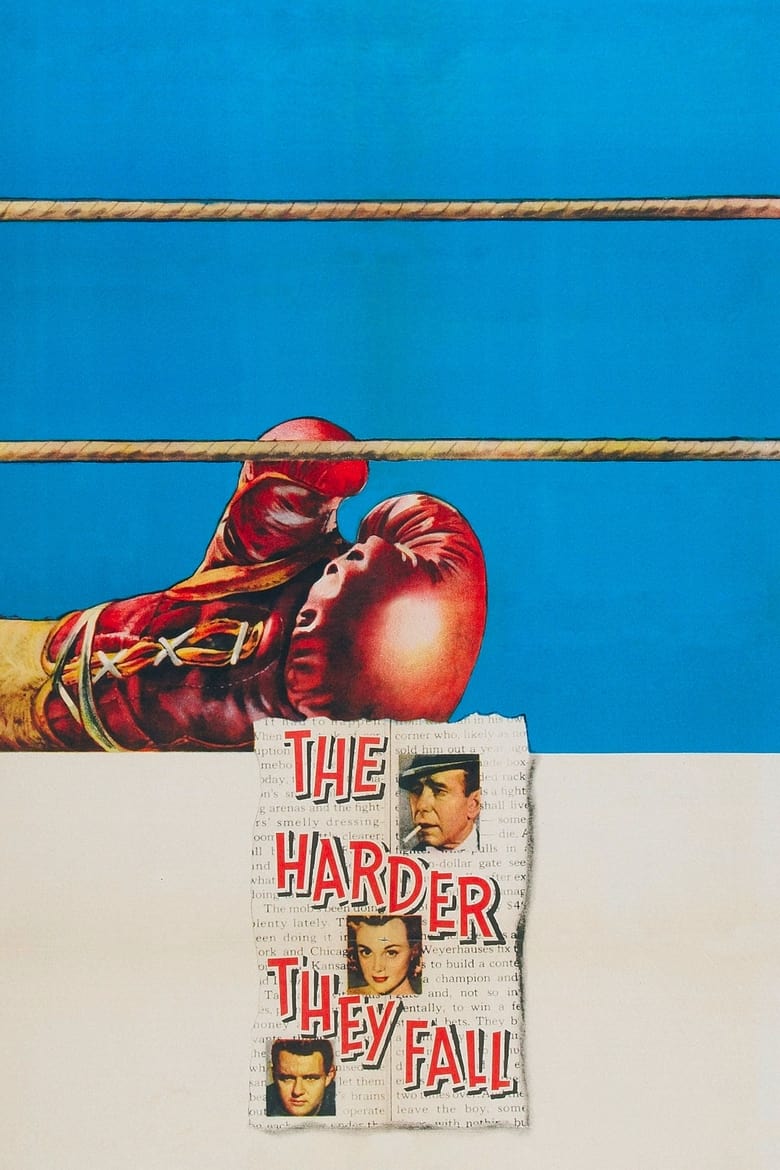
Eddie Willis is a down-on-his-luck sports journalist who accepts a job from Nick Benko, a cold-eyed boxing promoter with syndicate backing. The assignment is straightforward in appearance: write publicity copy for Toro Moreno, a physically imposing Argentine giant who can barely throw a punch. Benko intends to steer Toro through a string of fixed fights toward a heavyweight title bout, and he needs Willis's press connections and respectable byline to make the fraud credible.
As the manufactured campaign takes Toro from city to city, Willis watches the machinery of corruption operate at close range. Opponents take dives on schedule, gate receipts are skimmed before Toro ever sees them, and the fighter himself remains genuinely unaware of how thoroughly he is being used. Willis grows increasingly uneasy, caught between the regular paychecks Benko provides and the mounting pressure from his wife Beth, who reads the moral situation with greater clarity than her husband allows himself. When Toro finally faces a legitimate opponent in Buddy Brannen, the consequences of the entire fabrication become physical and irreversible.
The Harder They Fall occupies the intersection of sports noir and the expose picture, a form that gained particular traction in the early 1950s. Like Sweet Smell of Success, it is fundamentally concerned with the professional who trades his integrity by increments, telling himself at each stage that the compromise is temporary. The boxing world functions here less as background color than as a working model of how American commerce absorbs and destroys individuals who lack the protection of money or institutional power.
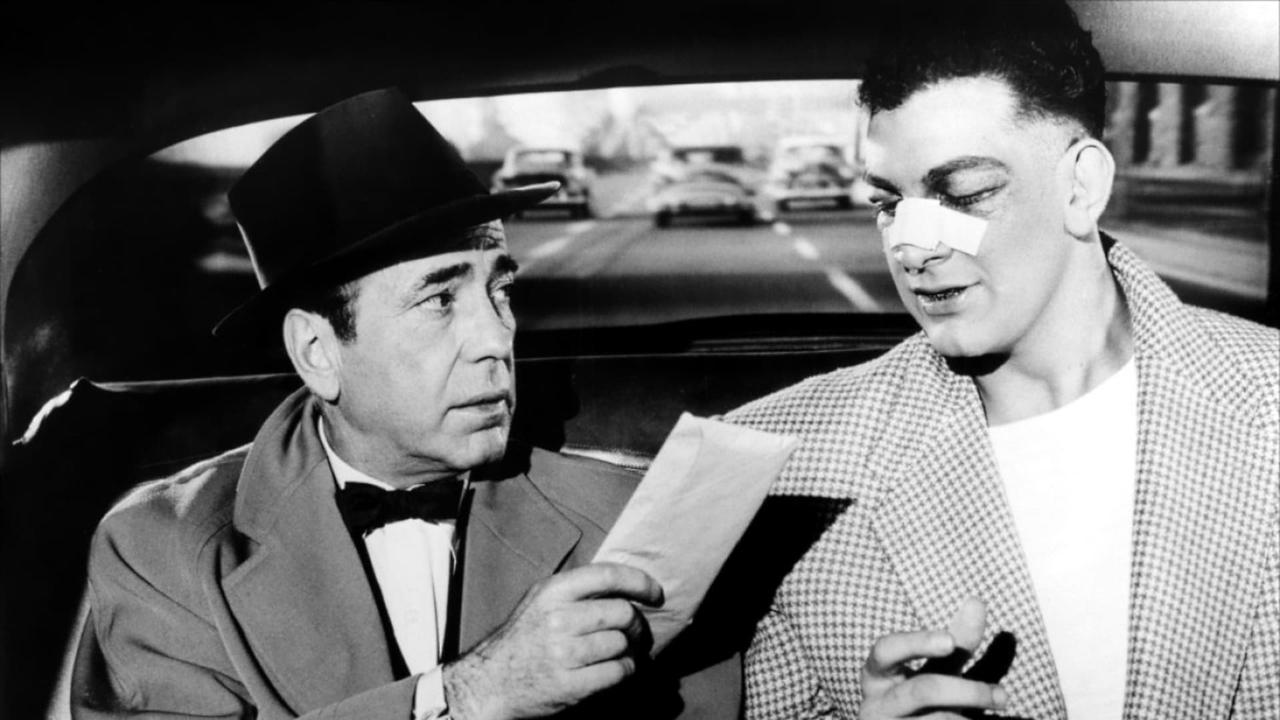
The Harder They Fall arrived in 1956 as Humphrey Bogart's final film, and that biographical fact has sometimes obscured what the picture actually accomplishes apart from its valedictory status. Mark Robson directs with the disciplined economy he brought to Champion seven years earlier, and the screenplay, adapted from Budd Schulberg's novel, understands that corruption in professional sport is not an aberration but a structural condition. Rod Steiger's Benko is the film's real engine – a promoter who operates without illusion or apology, whose menace lies precisely in his transparency. Against him, Bogart's Willis is a man who mistakes his own cynicism for self-knowledge, a journalist who has written enough about dishonesty to believe he can participate in it without being changed. The film belongs to a specific postwar cycle concerned with institutions – boxing commissions, press rooms, television studios – that launder exploitation into entertainment. Burnett Guffey's photography keeps the arena sequences brutally lit and the private conversations correspondingly dark, and that visual logic carries the film's argument without laboring it.
– Classic Noir
Benko lays out Toro's earnings in a sparse back-office interior, the overhead source casting a hard, unmodulated light across the desk surface while the edges of the frame recede into near-total darkness. Guffey holds the shot at medium distance, keeping both men in the same plane so that the physical disparity between Steiger's compact stillness and Lane's broad, bewildered mass reads as a diagram of power rather than a contrast of temperaments. The camera does not move. It does not need to.
What the scene argues is that the fix operates most efficiently when its victim is cooperative and grateful. Toro accepts the insulting figure without comprehension, and Benko's manner contains no visible contempt – only the mild patience of a man completing a routine transaction. Willis watches from the near edge of frame, and his position there, present but peripheral, is an accurate map of his moral condition throughout the film: close enough to see everything, far enough to believe he remains uninvolved.
Burnett Guffey shoots The Harder They Fall with a hardness that matches the subject and refuses the more expressionistic shadow geometry available to him. Working largely on studio sets that approximate New York press rooms, promoters' offices, and arena corridors, Guffey opts for sources that feel institutional – overhead practicals, window light from one side – rather than the canted, motivated lighting associated with gothic noir. The effect is closer to the documentary tradition, and it serves the film's argument that corruption here operates not in the shadows but under full illumination, in plain sight of everyone. The arena sequences are lit with the flat intensity of broadcast television, a choice that implicates the medium itself as complicit in the spectacle. Close work on Steiger's face tends toward slightly longer focal lengths, which compress his features against the background and give his stillness a pressurized quality. Guffey would win the Academy Award the following decade for Bonnie and Clyde, but his work here is an earlier demonstration of how documentary texture can serve moral argument.
The most reliably curated streaming home for Columbia noir of this period; check current availability as titles rotate seasonally.
TCMSubscriptionTCM broadcasts the film periodically as part of its Bogart retrospective programming and late-career Columbia rotations.
TubiFreeAd-supported availability has been intermittent; confirm current listing before scheduling a viewing.