Films People Pull a Fast One Night Beat Reading Room On TV Shop
Black Tuesday 1954
1954 Robert Goldstein Productions
★★★☆☆ Notable
Film Noir · 80 minutes · Black & White

Black Tuesday

Directed by Hugo Fregonese
Year 1954
Runtime 80 min
Studio Robert Goldstein Productions
TMDB 6.2 / 10
"A killer walks off death row and into something worse."

Vincent Canelli, a ruthless crime boss played by Edward G. Robinson, is hours from execution when he engineers a violent escape from the death house with the help of fellow condemned man Joey Stewart. Taking hostages – including a prison chaplain, Father Slocum, and a reporter named Frank Carson – Canelli forces his way into the outside world, using the captives as human shields while he searches for a cache of hidden money and a route out of the country.

The group of hostages splinters under the pressure of captivity. Peter Manning, a young man also caught up in the escape, harbors loyalties that are not entirely clear, while Hatti Combest, a woman with her own entanglements in Canelli's past, complicates the dynamic between captor and captive. Father Slocum works quietly at the edges, attempting to reach something human in Canelli, while the gangster's control over the group begins to fray as time runs short and the police tighten their cordon.

Black Tuesday belongs to the mid-decade cycle of American crime films that stripped the gangster picture down to its most functional elements – confinement, coercion, the countdown. Fregonese shoots it as a chamber piece under pressure, and Robinson, who had defined the genre at Warner Bros. two decades earlier, brings a weathered authority that gives the film a retrospective charge. The film does not romanticize its criminal or his fate, and that refusal is precisely its point.
Classic Noir

Black Tuesday arrives at a particular hinge point in Robinson's career, when his Warner Bros. mythology had calcified into cultural shorthand and the actor was working in leaner productions that asked him to dismantle rather than construct a persona. Fregonese, an Argentine-born director with a clean, unsentimental eye, keeps the film locked in close quarters and resists the temptation to inflate Canelli into legend. What emerges is a gangster picture that functions more as siege film than moral fable – the walls close in from the first reel, and the screenplay grants no character the comfort of a redemptive arc that feels earned. Stanley Cortez's photography, even within the constraints of a low-budget independent production, maintains a disciplined chiaroscuro that keeps every face readable as both threat and victim. The film's title refers to execution day, and Fregonese never lets that terminus drift from view. It is not essential noir, but it is precise, efficient, and notably free of sentiment – qualities that wore better than most of the period's more ambitious failures.

– Classic Noir
3 ★★★☆☆ Notable
Credits

The Crew

DirectorHugo Fregonese
ScreenplaySydney Boehm
CinematographyStanley Cortez
MusicPaul Dunlap
EditingRobert Golden
Art DirectionHilyard M. Brown
ProducerRobert Goldstein
Performances

The Cast

Close Reading

The Signature Scene

Black Tuesday – scene
The Hostage Room Canelli Holds the Room

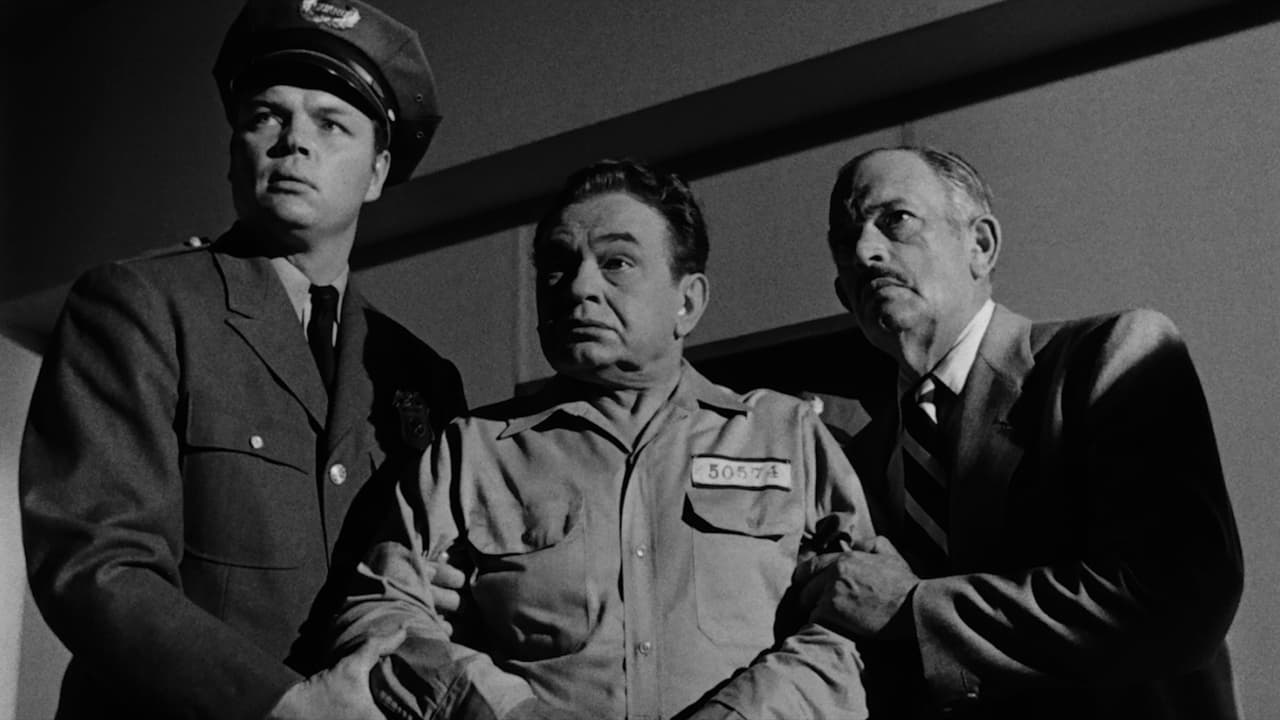
Cortez frames Robinson at the center of a cluttered interior, the light source kept deliberately off-axis so that half his face falls into shadow while the hostages behind him are caught in a shallow, diffuse glow. The camera holds at mid-distance, neither glamorizing the figure nor retreating from him – a neutral witness. Depth of field is compressed, pressing the background figures into a soft, undifferentiated mass, which concentrates all moral weight on the foreground.

The composition makes an argument the dialogue does not need to state: Canelli's dominance is architectural, written into the frame itself, but the softness behind him – the lives he controls – registers as something other than mere backdrop. It is mass and consequence simultaneously. When the camera finally adjusts, the slight shift in angle is enough to let Father Slocum enter the focal plane, and the geometry of the room quietly changes. Control, Fregonese suggests, is always provisional.

Visual Language

The Cinematography

🎞️
Stanley Cortez – Director of Photography

Stanley Cortez had already worked at the high end of the form – The Magnificent Ambersons, The Night of the Hunter – and his contribution to Black Tuesday demonstrates how a practiced eye adapts to reduced circumstances without surrendering discipline. Working on a tight independent budget, Cortez constructs a visual grammar built almost entirely on interior shadow work: hard key lights positioned to isolate faces while backgrounds dissolve into flat darkness, eliminating the spatial comfort that a more generously lit set would provide. The result is a film that feels perpetually compressed, as though the walls themselves are participants in the story's logic of entrapment. There is little camera movement; Cortez relies instead on strategic reframing within static setups, allowing actors to move in and out of the light as a form of moral punctuation. The lens choices favor a moderate focal length that keeps faces prominent without distortion, grounding the violence in the recognizably human rather than the expressionistically grotesque.

In the Catalogue

Themes & Motifs

Availability

Where to Watch

Also in the Directory

See Also