Trevor Stevenson, a American painter, arrives in a Mexican resort town with his wife Stella, seeking rest and the kind of sun-drenched clarity that might quiet the unease beneath their marriage. Trevor is volatile, possessive, and prone to blackouts; Stella is composed in the way that suggests long practice. When a young woman is found murdered near their hotel, the local investigator Henrique Monteros – cultivated, watchful, professionally skeptical – begins to take an interest in Trevor that goes beyond courtesy.
Monteros is himself drawn to Stella, and the triangle that forms between the three carries the film's real voltage. Trevor's inability to account for his movements on the night of the murder hardens suspicion into something close to certainty, and Stella must decide whether her devotion to a difficult man constitutes loyalty or complicity. The local community, refracted through figures such as the sharp-eyed Señora Reidl and the quietly threatening Gomez, presses in on the Americans as outsiders whose money and charm no longer insulate them.
Woman's Devotion works as both a procedural and a psychological study of a marriage tested to its structural limits. The Mexican setting – vivid, external, indifferent to imported anxieties – functions as the kind of foreign mirror that mid-decade noir used to strip its American protagonists of their usual cover. The film does not ask whether Trevor is guilty so much as it asks what guilt means when one person's survival depends on another's willingness to believe.
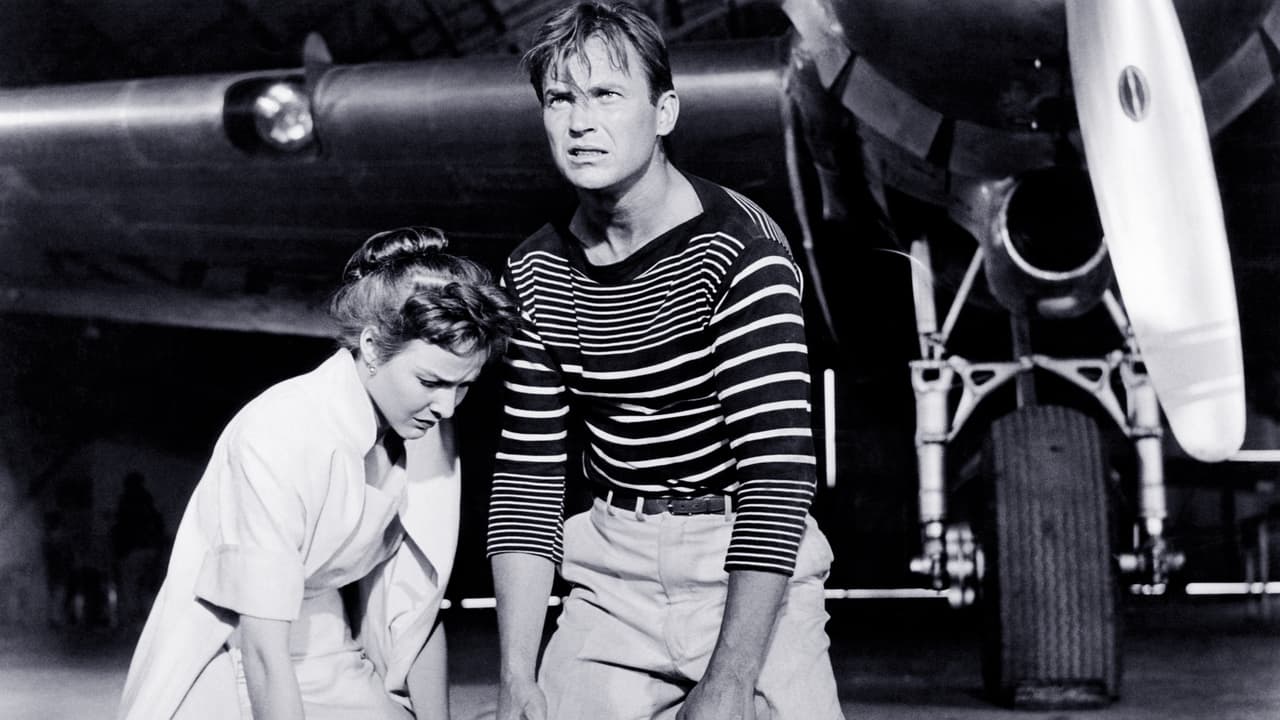
Woman's Devotion is a mid-tier Republic Pictures production that repays more attention than its modest reputation suggests. Paul Henreid, working here as director while taking a supporting role, brings a European detachment to the material that sits in productive tension with Ralph Meeker's characteristically American volatility. Meeker, who had already defined a certain kind of damaged masculinity in Kiss Me Deadly the previous year, plays Trevor Stevenson as a man whose instability is not theatrical but metabolic – something in the blood rather than the performance. Janice Rule matches him with a stillness that is never passive. The Mexican location shooting gives the film a texture that studio-bound contemporaries lack, and Les Baxter's score, rooted in Latin rhythms, deepens the sense of displacement without condescending to it. The film belongs to a distinct postwar subgenre in which American couples abroad discover that distance from home clarifies rather than dissolves the fractures in their lives. As a study in the uses of setting as moral pressure, it earns its place in the noir catalogue.
– Classic Noir
Monteros stands at the edge of a sun-blanched terrace, the camera positioned slightly below eyeline so that he appears to look down at Stella seated in the foreground. The light is flat and high – midday in Mexico – which removes the shadow work typical of studio noir and replaces it with a kind of overexposed clarity. There is no darkness to hide in. Stella's hands rest folded in her lap, composed, while the frame places her within Monteros's field of vision as both subject and object of scrutiny. The cutting between them is slow, giving each look its full weight.
The scene is the film's clearest statement of its central argument: that surveillance and desire, in this story, are the same act. Monteros is investigating her husband but watching her, and Stella understands both. Her stillness is not innocence – it is calculation, or something between calculation and exhaustion. The absence of conventional noir shadow here is purposeful; under this light, the usual places of concealment are unavailable, and what remains is two people in full visibility, each assessing what the other knows.
The cinematographer on Woman's Devotion is not confirmed in surviving production records, which is itself a minor symptom of Republic Pictures' lower-budget operations in this period. What the film's visual language reveals, regardless of attribution, is a considered strategy of using Mexican location photography against interior studio convention. Exterior sequences exploit hard equatorial light to flatten shadow and deny characters the tonal cover that noir conventionally grants them – guilt and concealment are usually served by darkness, and here they are forced into the open. Interior scenes, by contrast, use tight framing and low-key practical sources to reconstruct something closer to classical noir atmosphere. The effect is of two moral registers: outside, there is nowhere to hide; inside, everything is obscured. Lens choices in the interrogation sequences favor modest telephoto compression, reducing the physical distance between characters while suggesting psychological enclosure. The cinematography does not reach the formal ambition of the best work of the period, but its situational logic is sound.
Tubi regularly carries Republic Pictures titles from this period and is the most likely free streaming home for this film, though availability shifts; verify before seeking.
Archive.orgFreeIf the film has entered the public domain, Archive.org may carry a watchable print – check current holdings, as transfers vary in quality.
Amazon Prime VideoRent or BuyDigital rental through Amazon is a reliable fallback for Republic Pictures titles not currently on subscription platforms.