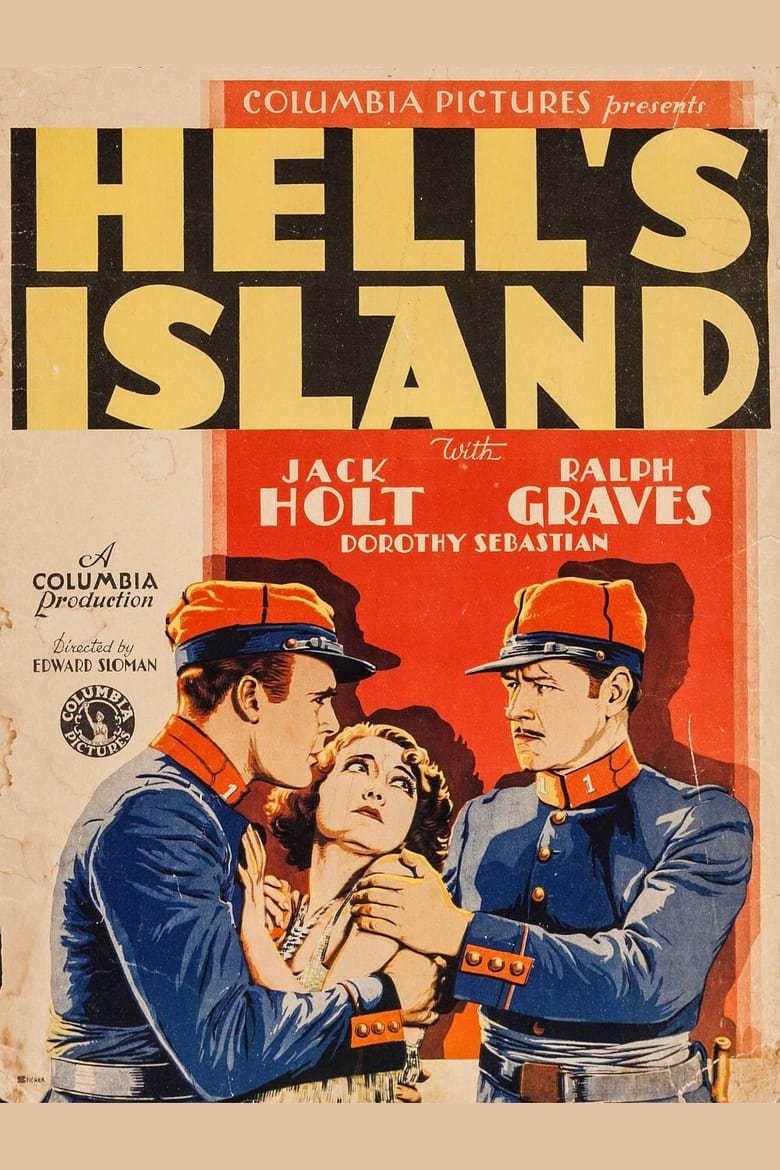
On a remote colonial island, two Foreign Legion veterans – Mac and Griff – find themselves bound by a friendship tested to its limits when they encounter Marie, a woman whose past is as uncertain as her loyalties. Mac is the harder man, defined by discipline and suppressed feeling; Griff is looser, more susceptible to desire. The island itself functions as a pressure chamber, cutting the characters off from the ordinary codes that might otherwise govern their behavior.
Marie's presence reconfigures the men's alliance. Griff moves toward her with an urgency that strains the bond between the two soldiers, while the local authority figures – Sergeant Klotz and the bureaucratic Monsieur Dupont – add layers of institutional menace and colonial indifference. Allegiances shift, motives are concealed, and the violence latent in the situation begins to surface through confrontation and betrayal. The friendship between Mac and Griff becomes the film's central casualty.
Hell's Island operates at the edge of the pre-Code crime film and the emerging noir sensibility, drawing on a foreign setting to strip its characters of social pretense. With desire, betrayal, and male rivalry as its engines, the film anticipates the moral geometry that would define noir's classical period – the triangle of two men and a dangerous woman, resolved through loss rather than triumph.
Hell's Island arrives in 1930 at a transitional moment, before the Production Code calcified Hollywood's moral vocabulary and before noir had acquired its defining visual grammar. Edward Sloman directs with a pragmatism suited to the era – this is a film of behavior and situation rather than atmosphere and shadow – but the structural logic is recognizably proto-noir. Jack Holt and Ralph Graves, a pairing Columbia deployed across several films, generate a credible male friction: one contained and wary, the other undone by appetite. Dorothy Sebastian's Marie is less the fully realized femme fatale of later noir than a woman whose ambiguity is a function of circumstance rather than design. What the film reveals about its era is the pre-Code freedom to let transgression register without mandatory punishment overwhelming the narrative. The island setting, handled on studio sets, enforces an isolation that removes the action from civic consequence. This is not essential noir, but it marks a point on the genealogy worth examining.
– Classic Noir
Ted Tetzlaff lights the scene with a single practical source positioned low and to one side, throwing one man's face into definition while leaving the other partially consumed by shadow. The frame holds both figures in a medium two-shot, the space between them carrying the weight of the scene. There is little camera movement; the tension is built through composition and through the slow adjustment of eyelines as each man calculates what the other knows.
The scene makes visible what the film has been arguing throughout: that the bond between Mac and Griff is not dissolved by Marie but by what each man is willing to do for her. The lamplight functions almost as a moral instrument, illuminating the man who still has something to lose and obscuring the one who already has.
Ted Tetzlaff, who would go on to photograph some of the most accomplished Hollywood work of the 1940s before turning to direction, brings a compositional economy to Hell's Island that exceeds the typical Columbia programmer of the period. Working largely on studio-built sets designed to suggest colonial architecture and tropical isolation, Tetzlaff uses deep shadow not as decorative atmosphere but as spatial logic – characters move through darkness as though it represents the zones of concealment their situations require. His lens choices favor a moderate focal length that keeps two or three figures in the frame without flattening the depth between them, which is essential in a film whose drama depends on the charged geometry of the triangle. The lighting setups are predominantly three-point arrangements with the fill deliberately underexposed, a technique that anticipates the high-contrast work Tetzlaff would develop more fully in his later collaborations. The island's heat and isolation are rendered not through location photography but through framing that makes the sets feel enclosed and inescapable.
Public domain prints of pre-Code Columbia films circulate on Archive.org and represent the most accessible route to this title, though print quality varies.
TCMSubscriptionTCM periodically programs pre-Code Columbia titles in thematic blocks and may offer the most stable broadcast-quality version available.
TubiFreeTubi carries a range of pre-Code and early sound-era titles; availability of this specific film should be confirmed, as catalog rotation applies.