Los Angeles, 1952. A series of apparently unconnected murders draws the attention of the city's homicide division when detectives begin to identify a pattern: each victim is a blonde woman, each killed outdoors, each left without a conventional motive. Sergeant Don Warde and Lieutenant Pete Hamilton work the case methodically, moving between crime scenes, police laboratories, and the apartment of Jane Saunders, a young woman whose resemblance to the victims places her at the center of the investigation.
The investigation gradually converges on Carl Martin, a brooding, emotionally arrested man whose obsessive grievances against a particular type of woman drive his crimes. Martin is not a criminal in the professional sense – no syndicate, no profit motive, no accomplice. His violence arises from a private pathology that the film treats with clinical restraint, refusing the comfort of easy villainy. The police procedural framework tightens around him even as the threat to Jane Saunders grows more immediate.
Without Warning occupies an instructive position within the semi-documentary strand of early 1950s noir, drawing on the procedural formulas established by The Naked City and its descendants while pressing toward something closer to a psychological case study. The film's interest lies less in whether the killer will be caught than in what his existence says about violence that hides in plain sight, indistinguishable from ordinary urban life until the body count demands attention.
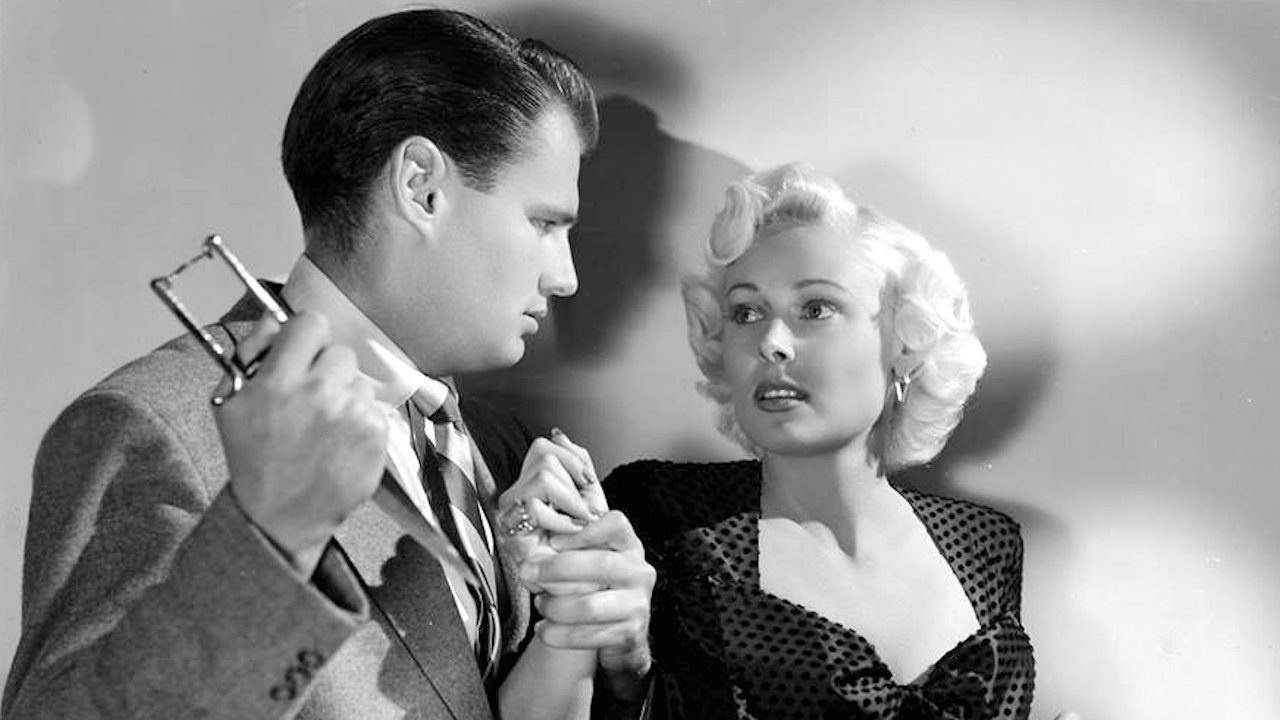
Without Warning arrives at a moment when American noir was negotiating the distance between expressionist shadow-play and the cooler, fact-based procedural mode that television and documentary realism were making fashionable. Arnold Laven, working with a lean budget at Allart Productions, chooses the procedural route but does not abandon the genre's moral unease. The film's most significant gesture is its refusal to aestheticize the killer's psychology: Carl Martin is not a romantic obsessive in the Welles or Lang tradition but a recognizably ordinary man whose pathology is all the more unsettling for its domestic scale. The serial-killer framework, still relatively uncommon in American cinema at this date, anticipates the clinical criminological portraits that would surface more fully in later decades. Edward Binns and Harlan Warde bring a functional, undecorated competence to their detective roles that reinforces the film's procedural logic. At 75 minutes, Without Warning does not overstay its argument, which is itself a kind of discipline the genre often failed to enforce.
– Classic Noir
Joseph F. Biroc frames the sequence in a public park rendered unfamiliar by failing light. The camera holds at a distance that refuses intimacy – there is no close identification with the pursuer and no dramatic warning for the pursued. Horizontal bands of shade cross the path between trees, and the figure of the blonde woman moves through alternating bars of late amber and deep shadow, her isolation made geometric by the composition. Biroc's lens keeps the background legible, the city's indifferent presence visible at the frame's edge.
The scene articulates the film's central argument: that violence of this kind requires no special darkness, no isolated setting, no theatrical staging. The park is a civic space, open and routine. By refusing to transform it into something expressly threatening, the film suggests that the killer's world and the ordinary world are not separate territories. The camera's distance is itself a moral position – observation without intervention, which is precisely the condition the city's institutions are racing to overcome before another woman dies.
Joseph F. Biroc, who would go on to a long career in both film and television, brings to Without Warning a visual discipline that resists the more operatic shadow conventions of studio-era noir. Shooting largely on Los Angeles locations, Biroc uses available architectural light and deep-focus compositions to anchor the film in recognizable urban geography rather than constructed menace. His lighting setups favor practical sources – street lamps, office fluorescents, the flat glare of interrogation rooms – which reinforce the procedural tone Laven is pursuing. When shadow work appears, it arrives without underlining: a doorway, a stairwell, the geometry of a park at dusk. The effect is a city that looks like itself rather than like a studio interpretation of itself, which is precisely the source of the film's unease. Biroc's restraint serves the story's moral logic: in a world this ordinarily lit, the killer has nowhere obvious to hide, and neither does the audience's comfortable distance from him.
Without Warning has entered the public domain and is available in full on Archive.org, though print quality varies across uploads.
TubiFreeTubi periodically carries public-domain noir titles of this era; availability may shift, but it is worth checking for a more stable streaming presentation.
Amazon Prime VideoSubscriptionAvailable through Prime or as a low-cost rental via third-party channels that aggregate classic and public-domain titles.