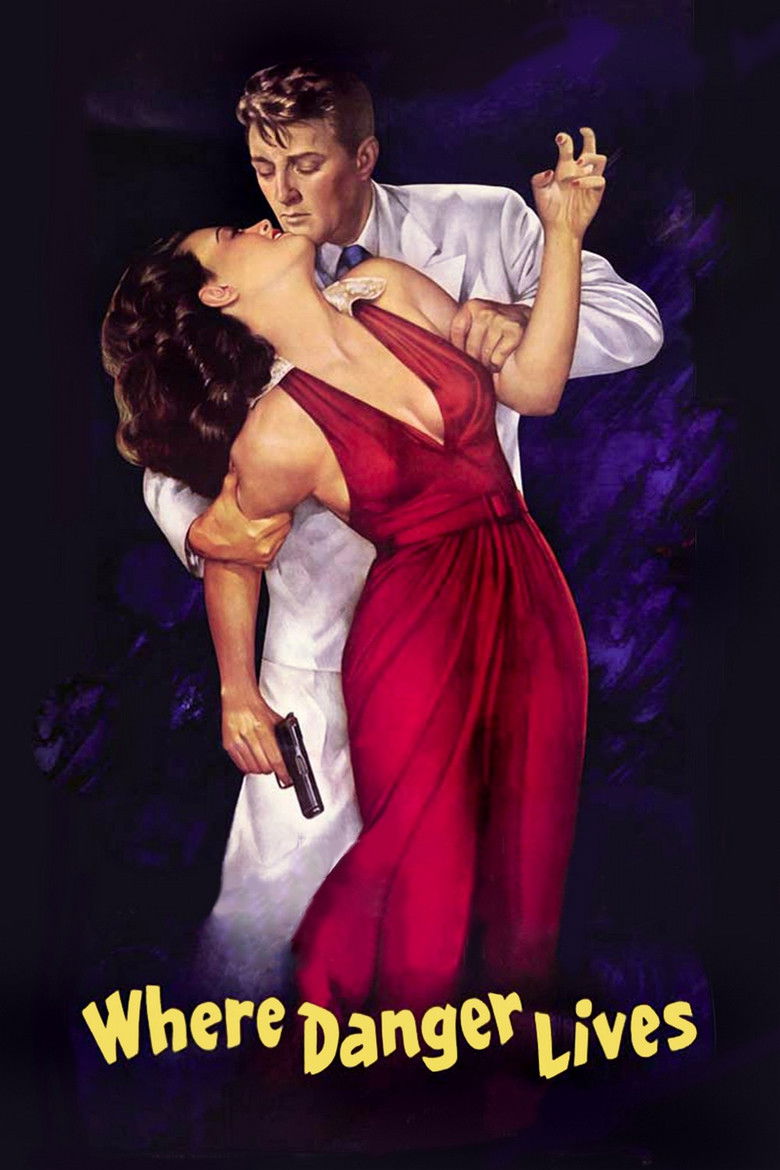
Jeff Cameron is a young physician at a San Francisco hospital, steady in his work and quietly attached to Julie, a nurse who regards him with measured affection. His routine fractures when he is called to treat Margo, a beautiful woman who has attempted suicide. Margo draws Cameron into her orbit with a combination of fragility and calculation, and he begins spending time with her despite every reasonable signal that he should not.
Cameron soon discovers that Margo is married to Lannington, a wealthy older man whose authority over her is less that of a husband than a warden. A violent confrontation leaves Lannington dead and Cameron injured, and Margo wastes no time shaping the narrative in her favor. A subdural hematoma, the consequence of the earlier struggle, begins to erode Cameron's judgment and coordination as the two go on the run south toward the Mexican border, passing through a succession of small towns where strangers grow suspicious and Cameron grows less capable of trusting his own perceptions.
Where Danger Lives is built around a premise fundamental to noir: competence as no protection against catastrophe. Cameron is not naive in the usual sense but is systematically disabled, first by desire and then by neurological injury, until he can no longer read Margo accurately or act in his own interest. The film belongs to a specific RKO cycle of the late 1940s and early 1950s in which medical or psychological impairment becomes the mechanism of doom, grounding the genre's fatalism in something close to clinical fact.
Where Danger Lives is a mid-tier RKO noir that rewards closer attention than its reputation usually invites. John Farrow keeps the pacing tight and the geography meaningfully oppressive as the couple descends from the city's ordered institutions into a corridor of desert towns that grow progressively more hostile and surreal. Robert Mitchum's performance is unusual within his filmography because his characteristic impassivity is literalized here as a symptom rather than a pose – his slackening affect and physical deterioration are written into the medical logic of the plot. Faith Domergue is less a femme fatale in the classical sense than a woman whose self-preservation instincts have calcified into something indistinguishable from malice, and Claude Rains, in a brief but precise appearance, establishes Lannington's suffocating control with economy. The film does not reach the formal ambition of the best RKO noirs of its period, and its final movement loses some of the pressure it has built, but as a study in compromised agency it sits comfortably within the serious body of work the studio produced during these years.
– Classic Noir
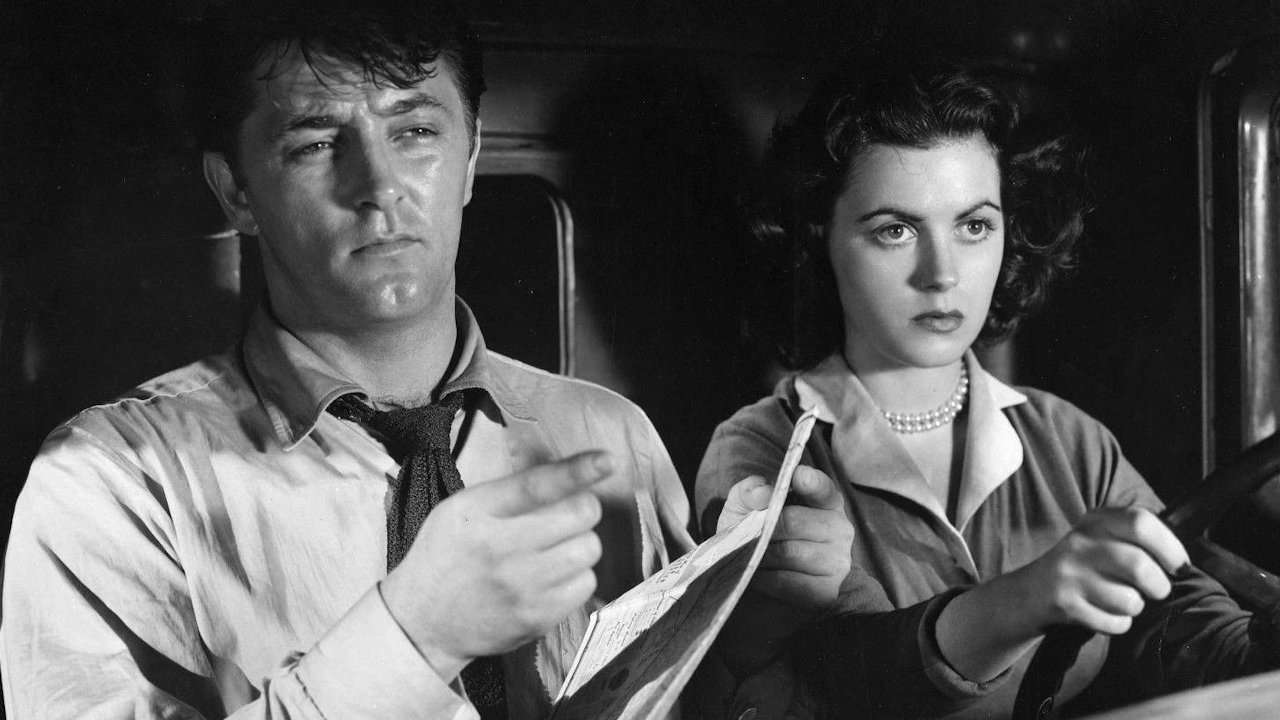
Musuraca frames Cameron at a diner counter in close medium shot, the surrounding space kept deliberately shallow so that the walls press in without any single source of threat being identifiable. The lighting falls hard from above and slightly behind, leaving Cameron's face partially shadowed in a way that reads less as mystery than as diminishment – the man is becoming obscured from the inside. Margo sits at a remove, her face better lit and watchful, the spatial arrangement communicating the inversion of power between them without a line of dialogue.
The scene argues the film's central proposition in purely visual terms: Cameron's medical training, his social position, his physical size – none of it translates into leverage here. The hematoma has made his body unreliable, and Musuraca's framing makes the environment unreliable in kind, so that Cameron occupies a world whose geometry no longer corresponds to any map he was trained to read. Margo, composed and attentive in her better light, has no such problem. She knows exactly where she is.
Nicholas Musuraca was among the small number of cinematographers who shaped the visual identity of American noir at RKO, and Where Danger Lives, while not his most cited work, demonstrates his precise command of psychological light. He makes consistent use of high-contrast setups with hard sources that flatten depth selectively, creating frames in which certain figures appear embedded in their environment while others seem to float unmoored within it. The desert locations introduce a different register – glare rather than shadow, exposure rather than concealment – but Musuraca treats both conditions as moral weather rather than scenic backdrop. Interior sequences use practical-source lighting that locates characters within rooms as if they are already under interrogation, and the progressive deterioration of Cameron's point of view is handled not through overt expressionist distortion but through incremental shifts in where the camera chooses to stand in relation to him, edging slightly wider, slightly more lateral, until the man at the center of the frame no longer appears to own it.
Criterion Channel has carried a number of RKO noir titles in stable transfers and is the most reliable source for contextual programming around films of this period; verify current availability before streaming.
TubiFreeTubi has previously offered Where Danger Lives at no cost, though print quality varies and availability shifts; check the current catalog before seeking it here.
Archive.orgFreeArchive.org hosts public domain or openly licensed prints of many RKO titles from this era; image quality is inconsistent but access is immediate and free.