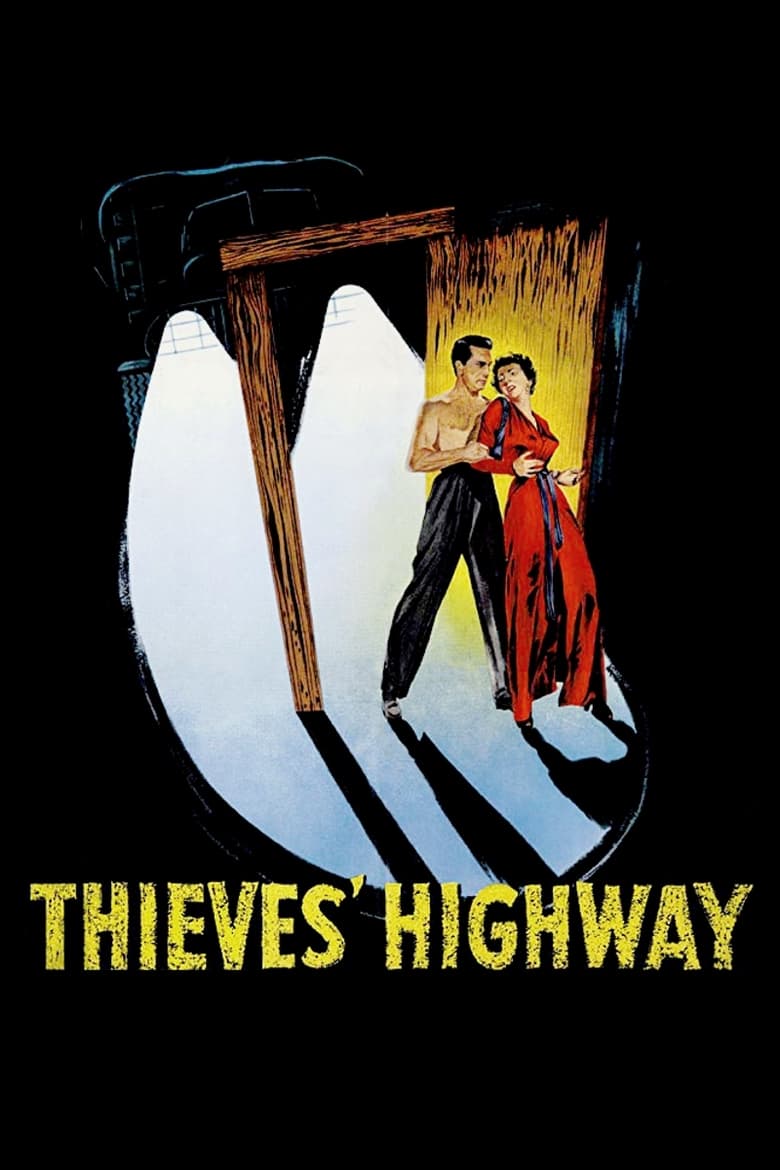
Nick Garcos returns from the war to find his father crippled and swindled by Mike Figlia, a San Francisco produce broker who operates as a racketeer within the trucking trade. Determined to recover what Figlia stole and settle the score, Nick partners with veteran hauler Ed Kinney and enters the brutal, overnight world of long-haul apple runs from California's Central Valley to the city's wholesale markets.
When Nick arrives at the Embarcadero docks ahead of his competitors, Figlia moves to absorb the load on his own terms, using Rica – a woman who works the margins of his operation – to delay and distract the young trucker. Rica is harder to read than she first appears, and her loyalties shift as she begins to understand what Nick represents. Meanwhile, Figlia's network of enforcers, crooked scales, and bent inspectors closes in on anyone threatening his monopoly.
Thieves' Highway frames its revenge narrative inside a documented economic reality: the exploitation of independent haulers by syndicate middlemen. The film belongs to the postwar cycle of socially conscious noir that draws equally from the crime picture and the labor expose, treating the American road not as a symbol of freedom but as a corridor of attrition where the weight of capital crushes individual effort.
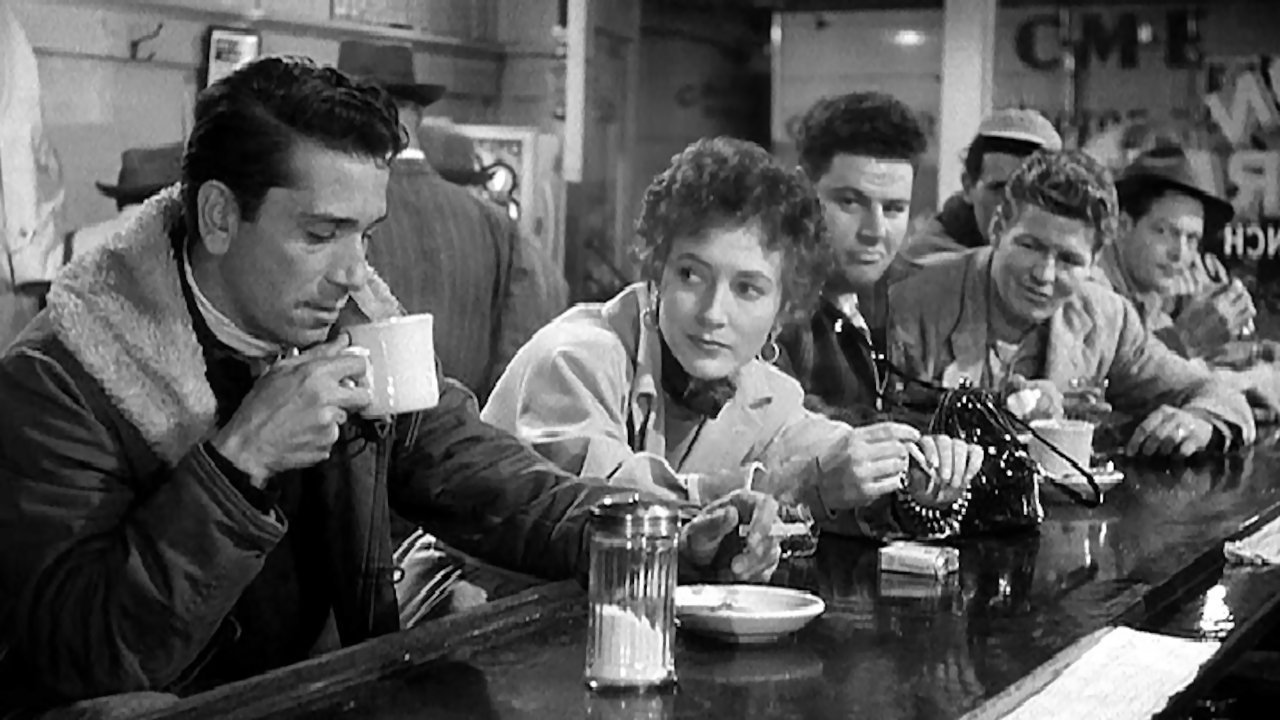
Thieves' Highway occupies a precise and undervalued position in the noir canon. Jules Dassin, directing in the last months before his blacklisting, channels the same commitment to social realism that distinguished Brute Force and The Naked City into a world of produce haulers and waterfront middlemen – terrain almost entirely absent from the genre. The film draws on A.I. Bezzerides's adaptation of his own novel, and the source material's insider knowledge of the trucking economy gives the corrupt mechanics of Figlia's operation an unusual credibility. Lee J. Cobb plays Figlia not as a theatrical villain but as a businessman whose ruthlessness is systemic, embedded in the ordinary procedures of commerce. Richard Conte anchors the film's moral weight without reducing Nick to a cipher of righteousness; the character's appetite for the score, not merely justice, keeps the noir logic intact. What the film ultimately argues is that the postwar economy replicated wartime hierarchies in civilian dress, with veterans returning to find the same structures of power waiting to absorb or destroy them.
– Classic Noir
Nick's truck rolls into the pre-dawn wholesale market and Norbert Brodine's camera holds low, shooting up at the cab so the vehicle occupies most of the frame against a sky still dark enough to flatten depth. The dock lights are practical and harsh, casting dense shadows beneath the loading platforms while leaving faces in half-light. When Nick climbs down, Brodine cuts to a medium close-up that isolates him against the geometric tangle of crates and stanchions – a man who has moved through the dark and arrived somewhere that does not yet know what to do with him.
The scene establishes the film's central irony before Figlia appears: winning the run has placed Nick at a disadvantage, not an advantage. He is on foreign terrain, exhausted, without cash, and surrounded by men who answer to the broker he has come to destroy. The victory of the haul is immediately converted into vulnerability, and the film uses the physical architecture of the docks – its controlled access, its insider protocols – to show how legitimate labor is absorbed and neutralized by organized money.
Norbert Brodine's cinematography for Thieves' Highway operates between two distinct registers. On the road and in the Central Valley orchards, he shoots on location with a long-lens compression that flattens the landscape into something indifferent and fatiguing – the geography of labor rather than the geography of spectacle. In San Francisco, the grammar shifts: tighter interiors, harder key lights, shadow fills pulled back to let faces emerge from near-darkness. Brodine had worked extensively in the studio system and understood how to carry location texture into controlled setups without losing continuity of tone. The dock sequences use the existing industrial geometry of the Embarcadero as a natural expressionist set, requiring little augmentation; warehouse walls and stacked crates generate the diagonal obstructions that noir conventionally builds on the backlot. Throughout, the lighting operates as a moral index – characters in Figlia's orbit are frequently shown in overhead or source light that produces unflattering, revealing shadows, while Nick is often shot in diffused or motivated light that preserves ambiguity.
The most reliably curated streaming source for Dassin's Fox-era work; the transfer is clean and the aspect ratio correctly preserved.
TubiFreeA free ad-supported option that has carried the film periodically; availability fluctuates, so confirm before viewing.
Archive.orgFreePublic domain prints circulate here with variable quality; acceptable for research purposes but not the preferred viewing experience.