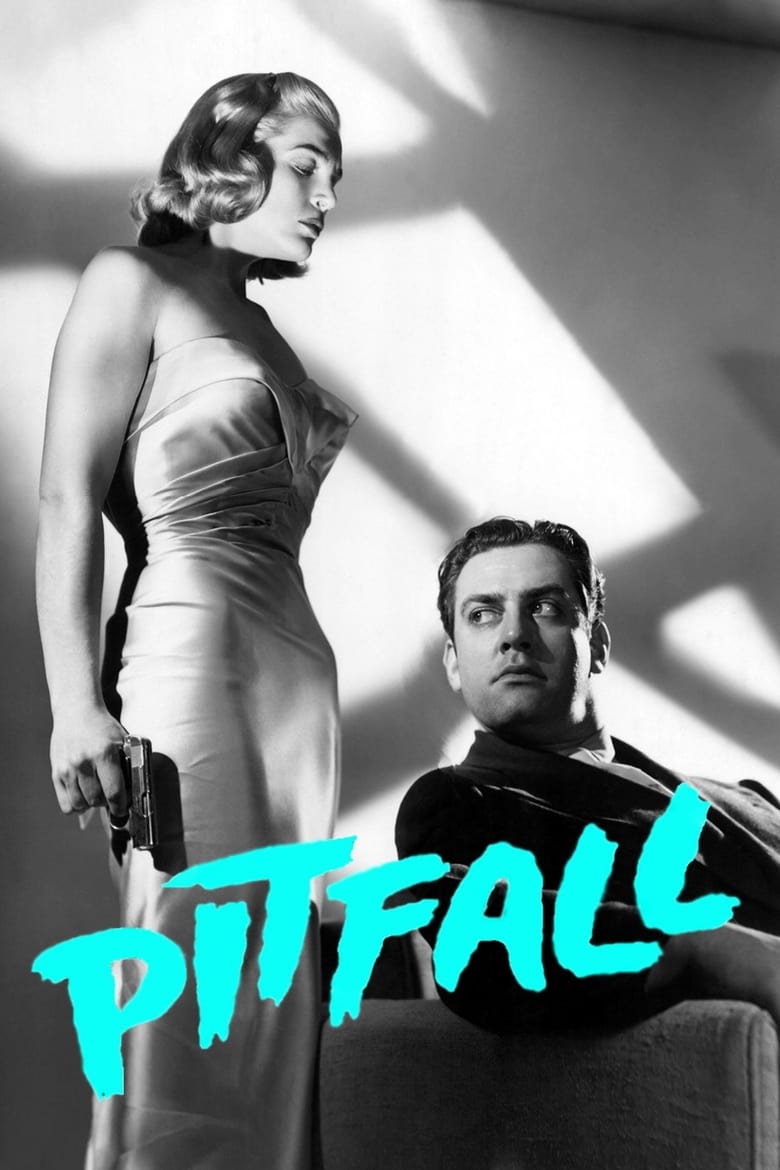
John Forbes is an insurance investigator living a comfortable, unremarkable life in suburban Los Angeles – a dutiful wife, a young son, a steady job. When he is assigned to recover assets purchased by a jailed embezzler named Bill Smiley, the trail leads him to Mona Stevens, a model who received gifts from Smiley and who occupies a world entirely unlike Forbes's own. The meeting is routine. It does not remain so.
Forbes begins seeing Mona, and what starts as professional contact slides into something he cannot easily name or abandon. Complicating the situation is MacDonald, a private investigator who was already surveilling Mona on Smiley's behalf and who has developed a possessive, threatening fixation on her. MacDonald is not a man who accepts boundaries. When Smiley is released from prison and learns what Forbes has done, the geometry of obligation, jealousy, and violence begins to tighten around all of them.
Pitfall belongs to a strand of postwar noir less concerned with criminal professionals than with ordinary men who discover their respectability is a veneer. The film's suburban setting is not backdrop but argument – the ranch house and the family car made to feel as confining as any cell. What follows is less a crime story than an anatomy of consequence, in which the distance between a small transgression and genuine ruin proves shorter than anyone anticipates.
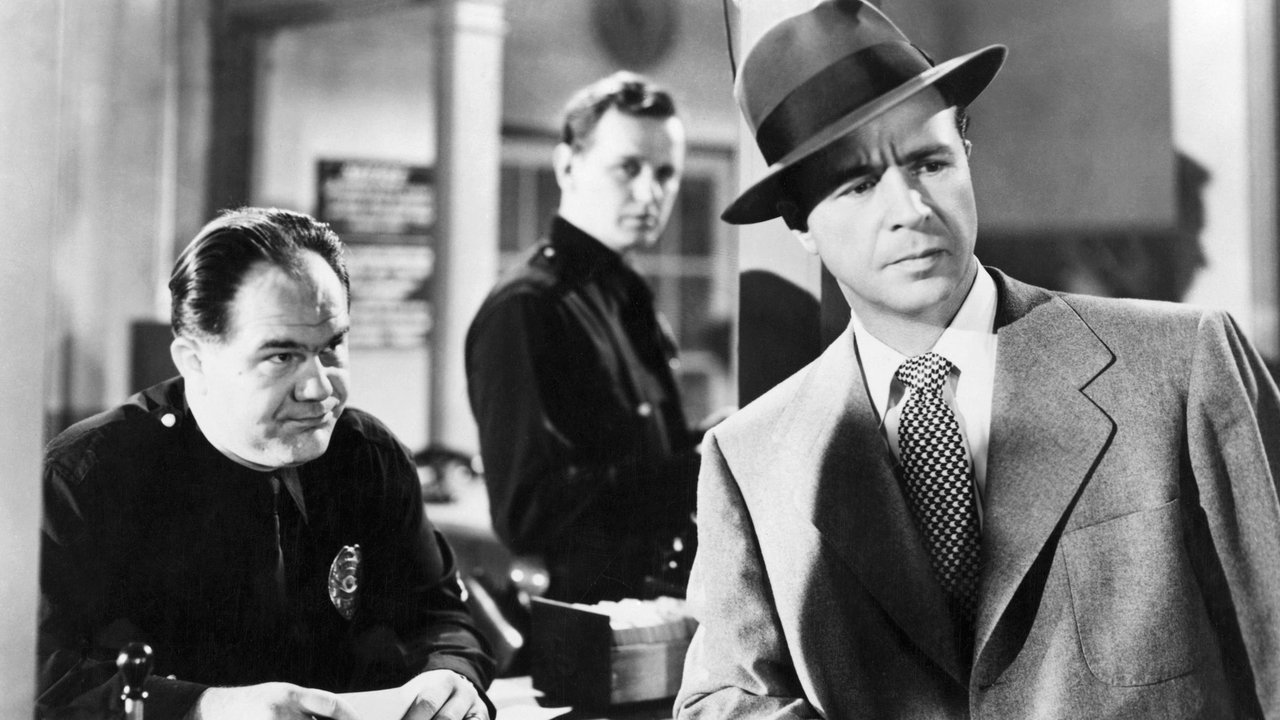
Pitfall arrived in 1948 as part of a cycle of noirs that turned the lens on the American middle class rather than on gangsters or hard-boiled detectives. André de Toth's direction is controlled and largely unsentimental, and the film's most pointed contribution to the genre is its refusal to glamorize Forbes's situation. Dick Powell, who had remade himself in noir with Murder, My Sweet four years earlier, plays Forbes as a man whose restlessness is mundane rather than romantic – boredom, not passion, is the inciting condition. Raymond Burr's MacDonald is among the more genuinely unnerving heavies of the period: physically imposing, sexually predatory, and operating entirely outside the moral framework the film otherwise observes. Lizabeth Scott brings a careful ambiguity to Mona that prevents her from settling into the femme fatale template. Jane Wyatt's Sue Forbes, often read as merely the wronged wife, is in fact the film's moral center and its most quietly devastating performance. What Pitfall achieves is a demonstration that the noir trap requires no exotic bait – only the ordinary dissatisfactions of a life that looked, from the outside, like enough.
– Classic Noir
Harry J. Wild frames MacDonald's approach in a low angle that exaggerates Burr's already considerable physical presence against the flat, grey light reflecting off the water. The boathouse interior is lit with minimal fill, leaving the far corners in deep shadow while a single practical source catches the planes of Burr's face from below – a lighting choice that dispenses with ambiguity about the scene's moral register. The composition keeps Mona small in the frame, the geometry of the shot making the argument before a word is spoken.
The scene crystallizes what the film argues about male entitlement and its capacity for violence. MacDonald is not a conventional noir antagonist driven by greed or ideology; he is driven by the belief that proximity confers ownership. His threat is not transactional but absolute, and Wild's camera refuses to diminish it. For Mona, and by extension for Forbes, the scene establishes that no private arrangement – however carefully managed – remains private for long.
Harry J. Wild had already demonstrated a facility with noir visual grammar on Murder, My Sweet and Cornered, and his work on Pitfall is distinguished by restraint rather than expressionist excess. Shooting largely on studio sets designed to replicate the flat geometries of postwar suburban Los Angeles, Wild uses deep focus to keep the clutter of domestic life legible in the background while his principals occupy the foreground – a compositional strategy that refuses to let the home disappear into soft-focus warmth. His exterior sequences, including the boat yard scenes, employ overcast natural light that flattens the California landscape and strips it of the glamour the setting might otherwise supply. Shadow work is reserved for scenes involving MacDonald, where low-key lighting and steep angles do moral characterization work that the script supports but does not overstate. The overall palette is brighter than many noirs of the period, and that brightness is itself a formal argument: the danger in Pitfall does not announce itself through darkness. It arrives in daylight.
Tubi has carried Pitfall as part of its classic noir library and is likely the most accessible free option for North American viewers, though availability should be confirmed.
Archive.orgFreeAs a film whose rights status has been uncertain, Archive.org has hosted Pitfall and offers a no-cost streaming and download option, though print quality varies.
Amazon Prime VideoSubscriptionPrime Video has offered Pitfall through its classic content agreements; availability shifts by region and should be verified at time of viewing.