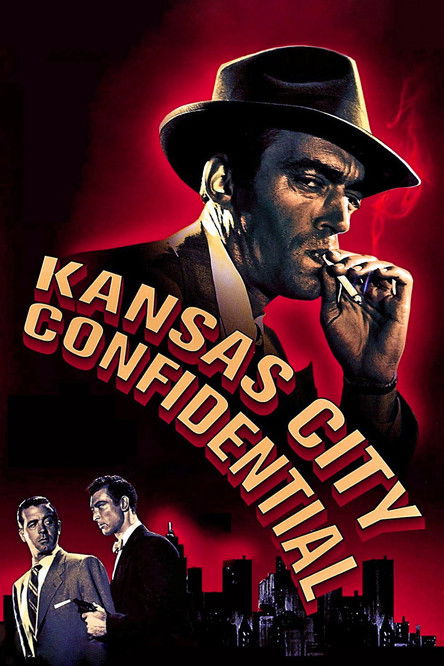
In Kansas City, an armored car robbery is executed with military precision by three masked men who have never met and never will – until things go wrong. Joe Rolfe, a flower delivery driver with a prison record, finds his truck used as an unwitting decoy in the heist. When police and press descend on him as the prime suspect, he is roughed up, humiliated, and ultimately released without charge. He has lost everything and is owed nothing, and that arithmetic hardens him into something the system should fear.
Determined to find the men who framed him, Rolfe traces the job's architecture to Tijuana and a web of small-time criminals holding their breath for a payoff that hasn't come. The mastermind – a retired police captain named Tim Foster, who designed the robbery as a final, anonymous score – watches from a distance as his carefully partitioned scheme begins to fray. Rolfe, posing under a false identity, falls into proximity with Foster's daughter Helen, a complication that neither man anticipated and that the film refuses to resolve cheaply.
Kansas City Confidential belongs to the procedural strain of early-1950s noir, less interested in psychological expressionism than in the mechanics of crime and the cold persistence required to survive its aftermath. The film's moral center is not innocence but endurance: Rolfe is no blameless everyman, and the men arrayed against him are drawn with enough texture to resist caricature. What the film ultimately stages is a confrontation between institutional betrayal and private accountability, with no guarantee that the right outcome and the just one will coincide.
Phil Karlson directed Kansas City Confidential in the same productive streak that would produce 99 River Street and The Phenix City Story, and the film bears the hallmarks of his approach: functional violence, compressed geography, and a refusal to sentimentalize the working-class men caught in institutional machinery. John Payne's Rolfe is a useful corrective to the era's more romantically afflicted protagonists – his grievance is economic and social, not existential, and Payne plays it with a tight, controlled anger that suits Karlson's rhythm. The supporting cast is the film's real achievement: Neville Brand, Lee Van Cleef, and Jack Elam as the three robbers form a credibly menacing ensemble, each man a distinct register of postwar male anxiety. Preston Foster's retired captain is more complex than the script strictly requires, a figure whose criminality is inseparable from his legitimate authority. At its core the film is a study in compartmentalization – of crime, of guilt, of identity – and it arrives at its conclusion with a moral arithmetic that is tidier than life but sharper than most of its contemporaries managed.
– Classic Noir
Karlson and cinematographer George E. Diskant stage the meeting of the three robbers in a low-ceilinged Tijuana cantina where the light arrives in narrow, lateral bands, catching faces at angles that make every expression provisional. The camera holds a medium distance, reluctant to grant any single man dominance of the frame. Shadows pool on the table between them rather than on the walls behind, an inversion of the usual expressionist grammar that keeps the threat interior, shared, unresolved. Diskant's lens choice flattens depth just enough to make the room feel airless.
The scene concentrates the film's central argument: these men are bound by a crime they committed separately and cannot discuss openly, and their mutual suspicion is indistinguishable from their mutual dependence. What the camera refuses to allow is the comfort of a clear hierarchy. They are equals in jeopardy, which is a more uncomfortable arrangement than guilt alone, and the stillness of the staging makes that equality feel like a trap closing around all of them.
George E. Diskant, who had already contributed to They Live by Night and On Dangerous Ground, brings to Kansas City Confidential a visual sensibility grounded in location texture and available-light logic rather than studio expressionism. Shooting on modest budgets, Diskant uses tight focal lengths to compress space and heighten the physical pressure between characters, a technique that suits Karlson's interest in men who have no room to maneuver. The Kansas City sequences rely on hard, direct light that leaves little shadow to hide in – an appropriate choice for a story about a man with no cover and no alibi. When the action moves to Mexico, the lighting grows more lateral and diffuse, introducing ambiguity into the frame at precisely the moment the narrative demands it. Shadow work is deployed not for atmosphere but for information: who is obscured, and when, tracks directly onto the question of who holds leverage. The cinematography functions as a form of moral accounting, and it is precise enough to reward attention.
Kansas City Confidential has circulated on Tubi in a serviceable public-domain transfer; confirm availability as library listings change.
Archive.orgFreeA public-domain print is available for streaming and download, though image quality varies by source.
Amazon Prime VideoSubscriptionHas appeared in Prime's classic film rotation; check current availability as catalogue rights shift.