Films People Pull a Fast One Night Beat Reading Room On TV Shop
Sweet Smell of Success 1957
1957 Hecht-Hill-Lancaster Productions
★★★★☆ Essential
Film Noir · 97 minutes · Black & White

Sweet Smell of Success

Directed by Alexander Mackendrick
Year 1957
Runtime 97 min
Studio Hecht-Hill-Lancaster Productions
TMDB 7.6 / 10
"In a city that never sleeps, power is the only currency that matters."

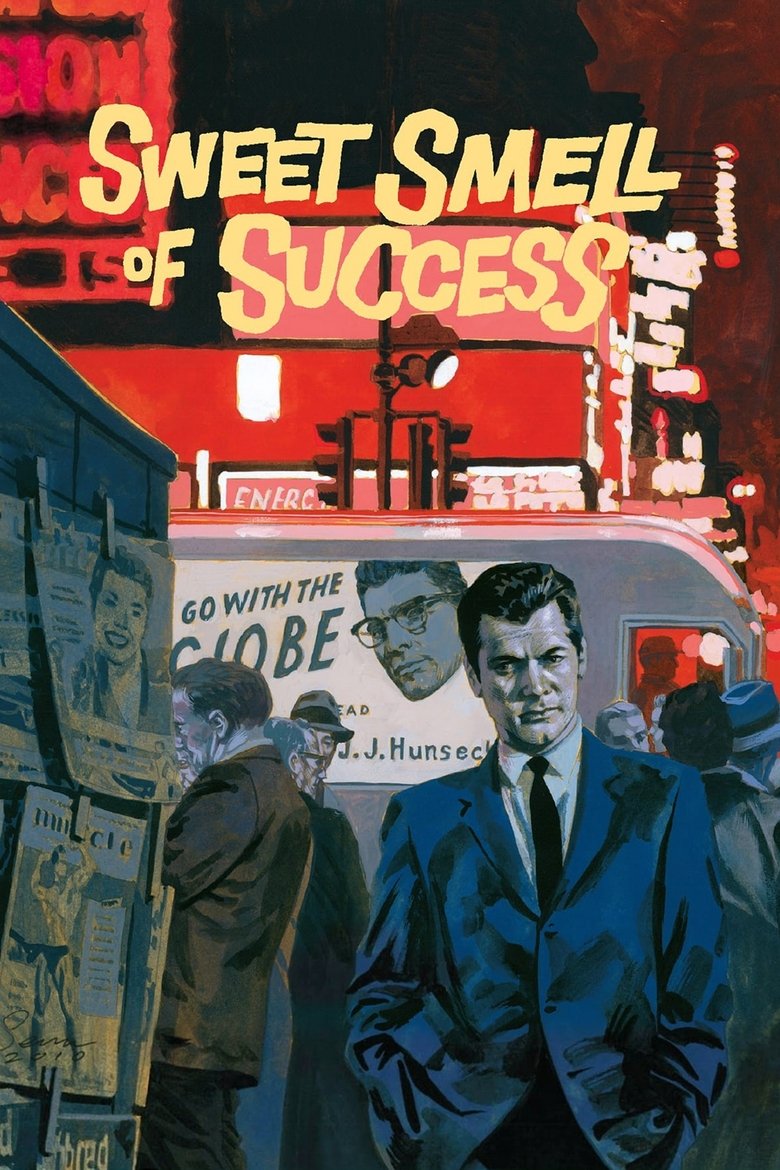
New York City, the mid-1950s. Sidney Falco is a small-time press agent scraping for column space in the gossip pages, his livelihood entirely dependent on the goodwill of J.J. Hunsecker, the most widely read – and most feared – newspaper columnist in the country. Hunsecker holds court at the '21' Club like a feudal lord, dispensing favor and ruin with equal indifference. When Falco fails to plant an item breaking up his sister Susan's relationship with jazz musician Steve Dallas, Hunsecker cuts him off, and Falco's already precarious existence begins to crack beneath him.

Desperate to reclaim his access, Falco agrees to frame Steve Dallas on a drug charge, drawing a corrupt cop into the scheme and compromising what few principles he has left. The plan works – temporarily – but Hunsecker's obsession with Susan deepens in ways that suggest something more than fraternal concern, and Susan herself begins to understand the web her brother has spun around her entire life. Falco, who fancied himself a manipulator, discovers he has been a tool from the beginning, useful only until he is not.

Sweet Smell of Success operates within the noir tradition of the power drama rather than the murder mystery, its tension rooted in exposure, humiliation, and the slow collapse of self-deception. The film stands alongside the small number of noirs that identify corruption not in the criminal underworld but at the center of respectable public life – the column, the byline, the broadcast – where influence is traded as openly as money and the damage is done in print.
Classic Noir

Sweet Smell of Success belongs to a narrow category of films that function simultaneously as genre pictures and as precise social documents. Alexander Mackendrick – a Scotsman better known at the time for Ealing comedies – brings an outsider's diagnostic clarity to Clifford Odets and Ernest Lehman's screenplay, refusing sentiment without resorting to nihilism. The film is a dissection of mid-century media power, depicting a Manhattan in which information is a weapon and visibility is conditional on submission. Burt Lancaster's Hunsecker is one of the period's genuinely disturbing screen presences, a man whose public authority masks something private and pathological. Tony Curtis, cast against type, delivers a performance of sustained moral degradation that remains undervalued. The film was a commercial failure on release, dismissed by many as unpleasant – a reaction that now reads as confirmation of how accurately it had identified something true about the machinery of American celebrity culture.

– Classic Noir
4 ★★★★☆ Essential
Credits

The Crew

DirectorAlexander Mackendrick
ScreenplayClifford Odets
CinematographyJames Wong Howe
MusicElmer Bernstein
EditingAlan Crosland, Jr.
Art DirectionEdward Carrere
CostumesMary Grant
ProducerJames Hill
Performances

The Cast

Close Reading

The Signature Scene

Sweet Smell of Success – scene
The '21' Club Booth Hunsecker Receives His Supplicants

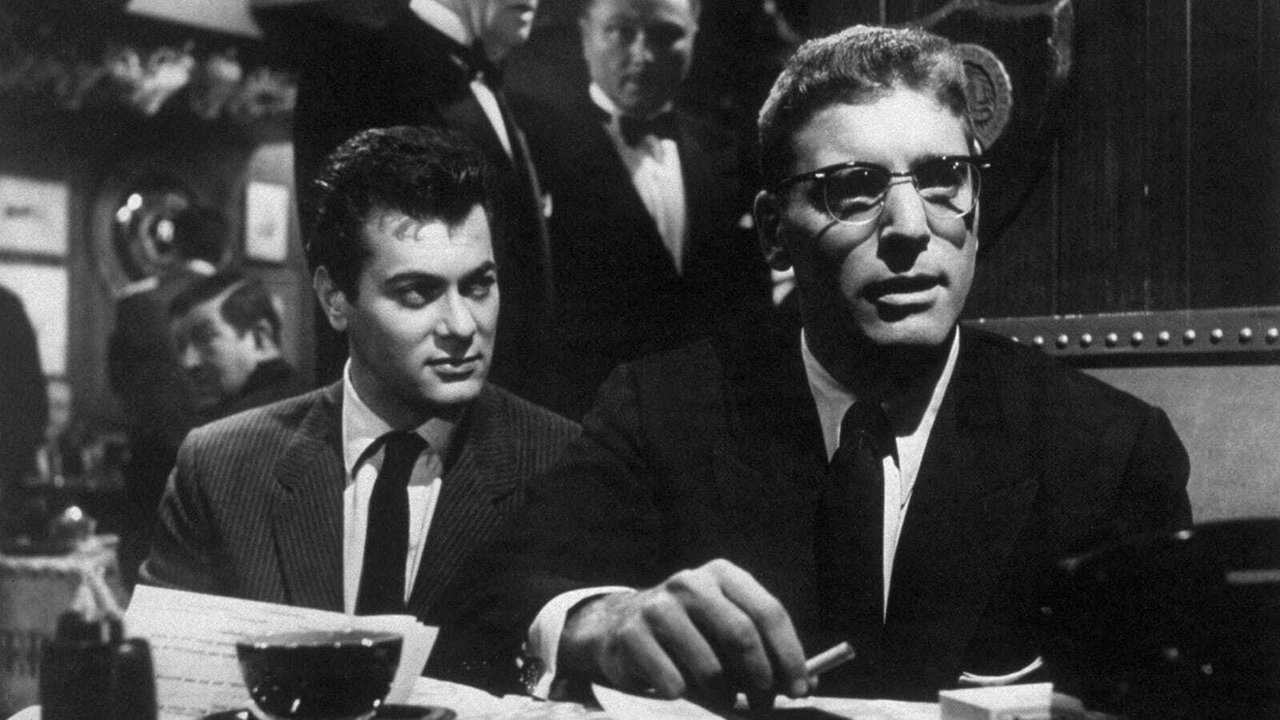
James Wong Howe shoots the '21' Club scenes with a compositional ruthlessness that encodes power in geometry. Hunsecker occupies the frame's dominant axis, slightly elevated, lit with a directness that emphasizes Lancaster's broad planes and cold eyes, while Falco – and everyone else who approaches the booth – is placed lower, often at an angle, partially obscured. Howe uses the shallow depth of the club's interior to compress figures into the background, turning the restaurant into a stage where proximity to the center is its own measure of status. Glasses, candles, and chrome surfaces fragment light into small competing glints that never add up to clarity.

The scene crystallizes the film's central argument: that public space in this world is never neutral but always owned, and that Falco's eagerness to enter Hunsecker's orbit constitutes a form of self-erasure. Every smile Falco produces in that booth is a performance of diminishment. Hunsecker barely looks at him directly – not because he is indifferent, but because sustained attention would confer a dignity he withholds as a matter of policy.

Visual Language

The Cinematography

🎞️
James Wong Howe – Director of Photography

James Wong Howe shot Sweet Smell of Success almost entirely on location in New York City – the streets of Midtown, Broadway at night, the actual facade of the '21' Club – and the decision shapes every frame. Rather than the controlled shadows of studio noir, Howe works with the ambient light of the city itself: neon signs, shop windows, and streetlamps that produce uneven, unpredictable illumination. He used wide-angle lenses in confined spaces to distort perspective and emphasize the claustrophobic proximity of the city's social transactions. In exteriors, pools of sodium light carve figures out of darkness without softening them, producing a look that is less expressionist than clinical. The overall visual strategy mirrors the screenplay's moral argument: this is a world with nowhere to hide, where every interaction is conducted in some form of public view, and yet genuine transparency – about motive, about desire, about the cost of what is being traded – remains permanently unavailable.

In the Catalogue

Themes & Motifs

Availability

Where to Watch

Also in the Directory

See Also