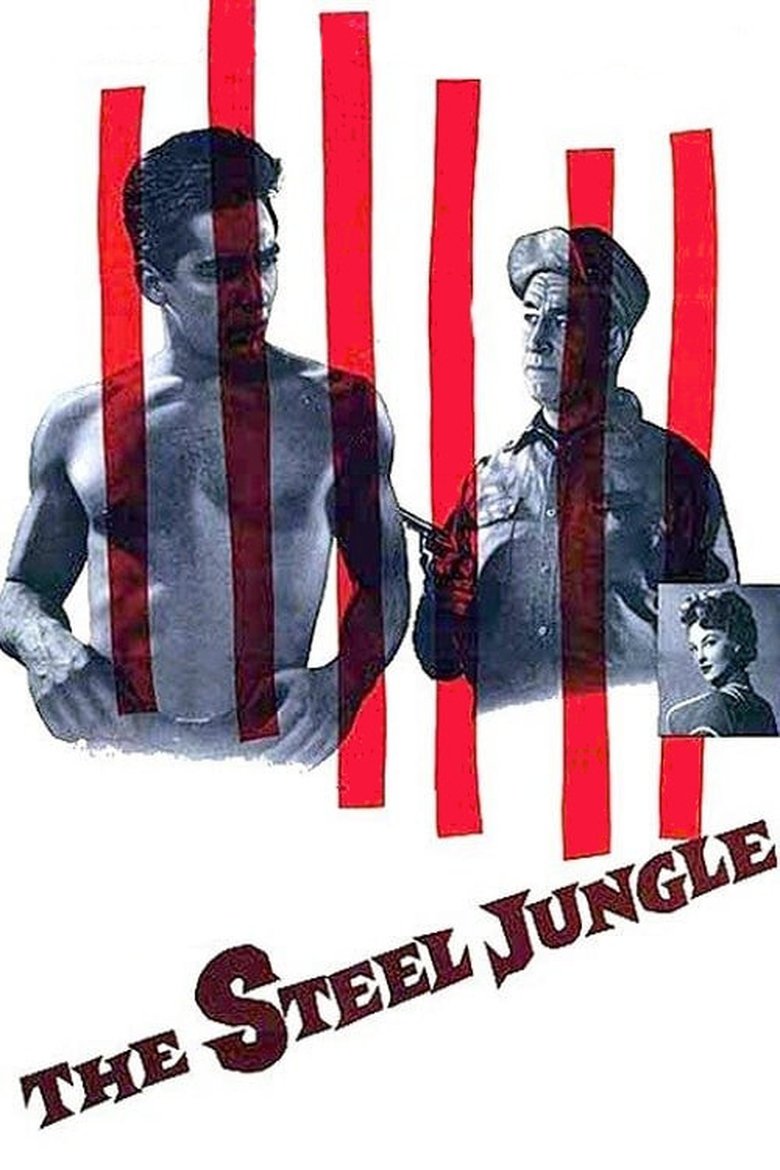
Ed Novak (Perry Lopez) is a small-time operator whose criminal associations land him inside a state penitentiary, where he is forced to navigate the rigid and violent hierarchy of prison life. His wife Francie (Beverly Garland) waits on the outside, her patience thinning under the weight of uncertainty and financial pressure. Warden Bill Keller (Walter Abel) runs the institution with a studied pragmatism, neither cruel nor naive, watching the population beneath him as one watches weather – looking for signs of what is coming.
Inside, the real pressure comes from Steve Marlin (Ted de Corsia), a syndicate figure whose reach extends well beyond the walls. Marlin works on Novak steadily, leveraging connections and threats in equal measure, angling to use him as an instrument for something larger. The prison doctor, Lewy (Kenneth Tobey), occupies an uneasy middle ground, while the predatory Lupo (Leo Gordon) enforces the informal law of the yard with casual brutality. Allison Hayes appears as Mrs. Archer, a figure whose loyalties complicate Novak's already compromised position and whose presence reminds him of everything the syndicate can offer – and take away.
Steel Jungle belongs to the cycle of mid-1950s prison noirs that used the institutional setting not merely as backdrop but as argument – the prison as a compressed image of postwar American social order, where power operates through procedure and coercion simultaneously. The film asks how much of a man survives intact when every relationship is transactional and every exit is controlled by someone else.
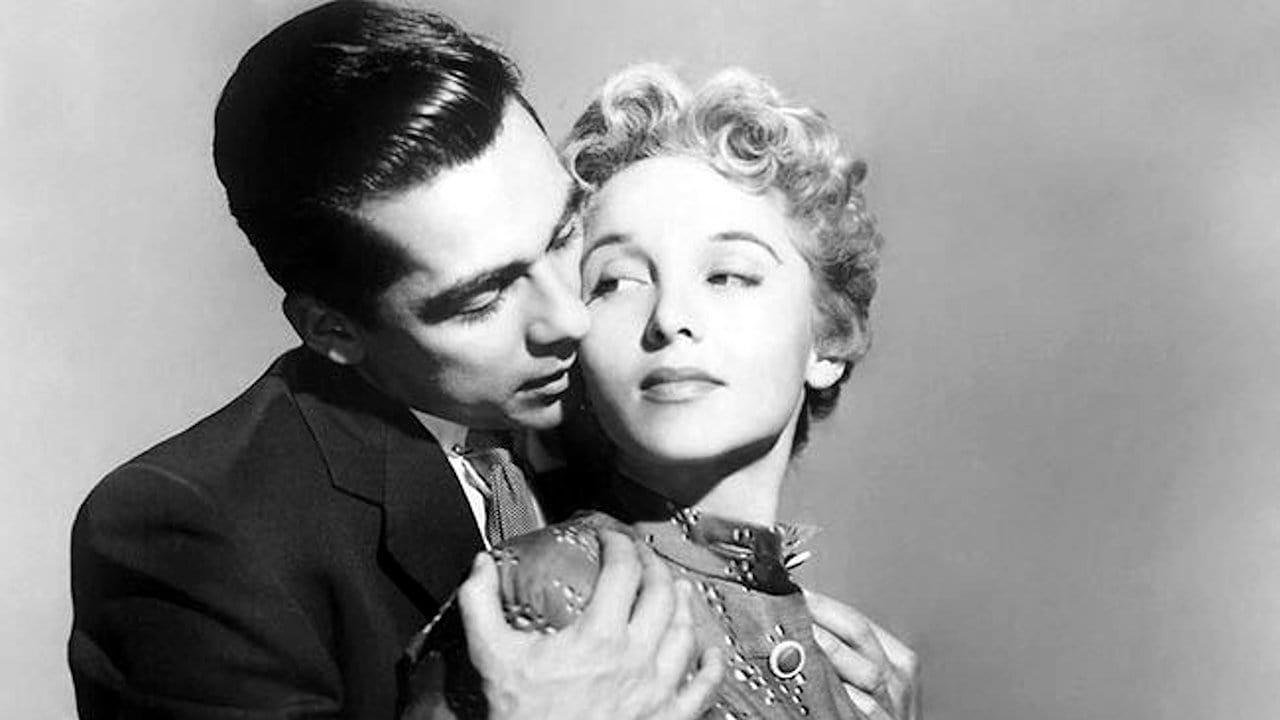
Steel Jungle arrives in 1956 as Warner Bros. was refining a mode of social-problem noir that traded in institutional settings – prisons, courtrooms, precincts – as spaces where the genre's characteristic moral pessimism could be grounded in bureaucratic plausibility. Walter Doniger, working from a script alert to the mechanics of prison power, keeps the film from collapsing into melodrama by insisting on procedure: the rhythm of count calls, the economics of contraband, the careful staging of who speaks to whom in the yard. Perry Lopez brings a physical restraint to Novak that suits the material; this is not a man given to speeches. Ted de Corsia, a reliable carrier of menace across several noirs of the period, finds in Marlin something more considered than his usual blunt force. The film does not argue for rehabilitation or condemn the system in any schematic way; it documents how pressure works on a man of limited options, which is the genre's most honest subject. Within the crowded field of 1950s prison pictures, Steel Jungle is a competent and occasionally precise entry.
– Classic Noir
J. Peverell Marley frames the exchange in the prison yard with the walls visible at the edge of every shot – not as dramatic architecture but as a steady reminder of enclosure. The midday light is flat and institutional, offering no shadow to retreat into. Marley's camera holds at a medium distance as Marlin approaches Novak, the other men in the yard moving around them with the practiced indifference of those who know when not to look. A slight low angle on de Corsia adds mass without resorting to distortion; the composition gives Marlin the frame's weight while Lopez's Novak is caught in the middle distance, neither foreground nor background.
The scene's argument is spatial as much as dramatic. Novak cannot back away; the geometry of the yard and the framing itself deny him exit. What the scene reveals is not simply that Marlin has power over Novak but that the prison has restructured reality so thoroughly that Marlin's logic is the only logic available. The film's central claim – that institutional life does not reform so much as reorient a man's understanding of what is possible – is made here without dialogue, in the arrangement of bodies in open space.
J. Peverell Marley's work on Steel Jungle reflects a cinematographer who understood that prison settings resist the noir toolkit's most familiar instruments. Deep shadow and chiaroscuro, the grammar of urban noir, are largely unavailable in the institution's controlled environment – the lights stay on, the spaces are deliberately legible. Marley responds by finding his moral texture in composition and spatial pressure rather than darkness. Interior cell-block sequences use the geometry of bars and corridors to create confinement within the frame itself, the architecture doing what shadow might do elsewhere. For exterior yard scenes, Marley shoots in a hard, directionless light that flattens hierarchy and exposes vulnerability. The studio-shot interiors are handled without fuss, the camera remaining close enough to faces that the absence of expressive shadow becomes its own statement – these men are seen clearly, which in this world is its own form of danger. The visual language serves Doniger's argument: in the prison, there is nowhere to hide.
Tubi has carried Warner Bros. catalogue titles of this period and is the most likely free point of access, though availability should be confirmed at time of viewing.
Archive.orgFreeIf the film has entered the public domain or been made available through institutional deposits, Archive.org offers streaming and download without cost.
TCMSubscription / BroadcastTCM periodically programmes Warner Bros. mid-decade crime pictures in themed blocks; the channel remains the most contextually reliable broadcaster for films of this era.