Films People Pull a Fast One Night Beat Reading Room On TV Shop
Outside the Wall 1950
1950 Universal International Pictures
★★★☆☆ Notable
Film Noir · 80 minutes · Black & White

Outside the Wall

Directed by Crane Wilbur
Year 1950
Runtime 80 min
Studio Universal International Pictures
TMDB 6.1 / 10
"A man walks out of prison into a world that has already decided what he will become."

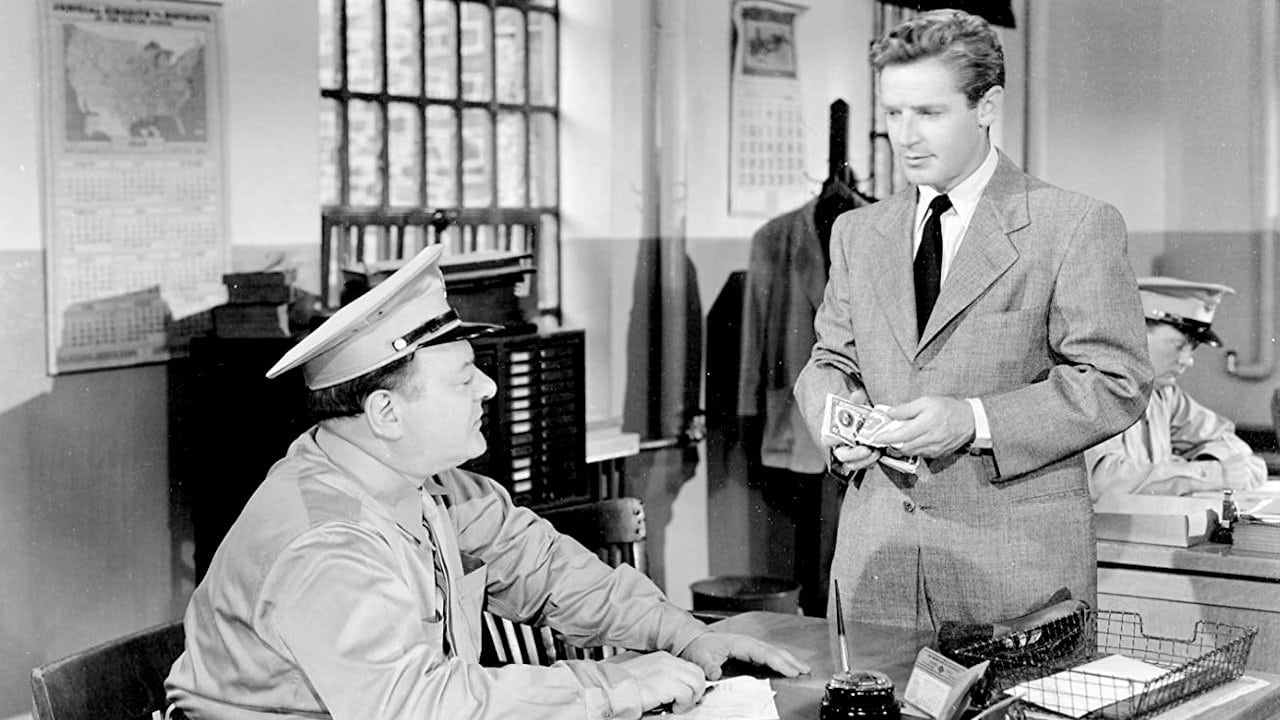
Larry Nelson (Richard Basehart) is released from prison after serving a twelve-year sentence for a crime committed in his youth. He emerges not hardened but disoriented, carrying the institutional habits of confinement into a society that regards him with suspicion by default. A sympathetic prison physician arranges a position for him at a tuberculosis sanatorium in a small coastal town, a setting that offers routine and the semblance of a fresh start. There Larry encounters a narrow world of contained lives: Celia Bentner (Signe Hasso), a composed and quietly principled nurse who sees something recoverable in him, and Charlotte Maynard (Marilyn Maxwell), a wealthy patient whose restlessness and appetite for excitement make her a far more dangerous proposition.

Charlotte draws Larry into her orbit with the ease of someone accustomed to getting what she wants, and what she wants is complicated by her connection to Red Chaney (Lloyd Gough), a career criminal whose claim on her is possessive and threatening. Larry, who has spent twelve years learning caution, finds himself sliding back toward the criminal world he thought he had left behind, pulled by Charlotte's combination of desire and manipulation. Gus Wormser (Joseph Pevney), a small-time operator, and the cold-blooded Garth (Harry Morgan) tighten the net around Larry as the sanatorium's ordered calm gives way to blackmail, violence, and the exposure of Charlotte's true allegiances. Celia watches from a cautious distance, her feelings for Larry sharpening her awareness of how close he is to making the choice that will define the rest of his life.

Outside the Wall positions the ex-convict's reentry narrative as a moral contest between two competing visions of what a man freed from institutional life can become. The sanatorium functions simultaneously as refuge and trap, its pastoral remove from the city offering the illusion of escape while the criminal world intrudes with methodical inevitability. The film belongs to the postwar cycle of noir that interrogated the gap between rehabilitation rhetoric and social reality, placing Basehart's characteristic inwardness against a plot that tests whether individual will can hold against structural pressure and human weakness.
Classic Noir

Outside the Wall is a minor entry in Universal International's postwar noir output, yet it earns its place in the catalogue on the strength of Richard Basehart's performance and a premise that takes seriously the social mechanics of recidivism. Crane Wilbur directs with functional economy rather than visual ambition, keeping the sanatorium setting in productive tension with the criminal plot that invades it. The film's real subject is the sociology of the second chance: how institutions that claim to rehabilitate men simultaneously mark them for suspicion, and how that marking makes them legible prey for the criminal world. Signe Hasso brings to Celia a moral intelligence that the script does not always fully honour, while Marilyn Maxwell's Charlotte operates as a precise genre instrument – the woman whose seductiveness is inseparable from her capacity for harm. The film does not transcend its B-picture constraints, but it uses them with a discipline that prevents waste. In the context of 1950, it registers as a credible, unsentimental examination of freedom's limits.

– Classic Noir
3 ★★★☆☆ Notable
Credits

The Crew

DirectorCrane Wilbur
ScreenplayCrane Wilbur
CinematographyIrving Glassberg
MusicLloyd Akridge
EditingEdward Curtiss
Art DirectionBernard Herzbrun
CostumesRosemary Odell
ProducerAaron Rosenberg
Performances

The Cast

Close Reading

The Signature Scene

Outside the Wall – scene
The Sanatorium Corridor, Late Night Light Through a Closing Door

Larry moves through a long institutional corridor in near-darkness, the overhead fixtures reduced to pools of weak light separated by stretches of shadow. Irving Glassberg frames him in a medium shot that keeps the walls close on either side, compressing the space without resort to overt expressionist distortion. As a door at the far end opens briefly, a wedge of harsher light cuts across the floor and catches Basehart's face in three-quarter profile before the door swings shut and the corridor returns to its baseline grey. The camera holds steady rather than tracking, letting the figure move through the light rather than pursuing him, which gives the moment an impersonal quality – as though the environment is indifferent to whether he passes safely or not.

The scene crystallises the film's central argument about the nature of Larry's freedom. The corridor is neither the prison he has left nor the open world he was promised; it is an intermediate space governed by institutional rules and intermittent visibility, where the light is controlled by others and withdrawn without warning. That a criminal contact is waiting beyond the door Larry is approaching makes the geometry moral as well as spatial: he is walking, of his own volition, back into a darkness that will require active effort to escape.

Visual Language

The Cinematography

🎞️
Irving Glassberg – Director of Photography

Irving Glassberg, who shot a number of Universal International's mid-budget productions during this period, brings to Outside the Wall a visual approach calibrated to the film's social realism rather than its genre mechanics. He avoids the severe chiaroscuro that noir cinematography is often reduced to in retrospect, preferring instead a controlled grey scale that suits the sanatorium setting – a place of clinical surfaces and diffused natural light – while allowing shadow to accumulate in the sequences where the criminal plot takes hold. Glassberg uses the locations with practical efficiency, letting the geometry of corridors and exterior paths generate unease without imposed optical distortion. His lens choices stay in the conventional range; there are no wide-angle distortions or extreme low angles deployed for their own sake. The result is a visual register that earns its darker moments by contrast: when the shadows do close in, they feel like a genuine change in the protagonist's condition rather than a standing stylistic posture.

In the Catalogue

Themes & Motifs

Availability

Where to Watch

Also in the Directory

See Also