Joe Norson is a part-time letter carrier in postwar New York, struggling to support his pregnant wife Ellen on wages that barely cover rent. Decent by instinct but worn thin by financial pressure, Joe makes a spontaneous decision that will define everything that follows: rifling through an unlocked office, he steals what he believes is a modest sum of cash. The envelope contains thirty thousand dollars – money belonging to a blackmail operation run by the smooth, dangerous George Garsell.
Before Joe can return the money or simply disappear, Garsell's world collapses into murder, and the stolen funds tie Joe directly to the killing. Captain Walter Anderson and Detective Stan Simon close in from one direction while Garsell and his associates, including the brittle, knowing Harriette Sinton, press from the other. Joe's attempts to extricate himself only deepen his exposure, and Ellen, unaware of the full extent of his situation, becomes both motivation and vulnerability.
Side Street belongs to a cycle of postwar noirs built around ordinary men whose moral lapse is modest but whose consequences are disproportionate. Mann and his collaborators use New York's actual streets and architecture as both setting and argument, with the city functioning less as backdrop than as a system from which escape is structurally difficult. The film is less interested in crime as spectacle than in the mechanics of entrapment – how quickly the distance between a respectable life and ruin can be measured in a single impulsive act.
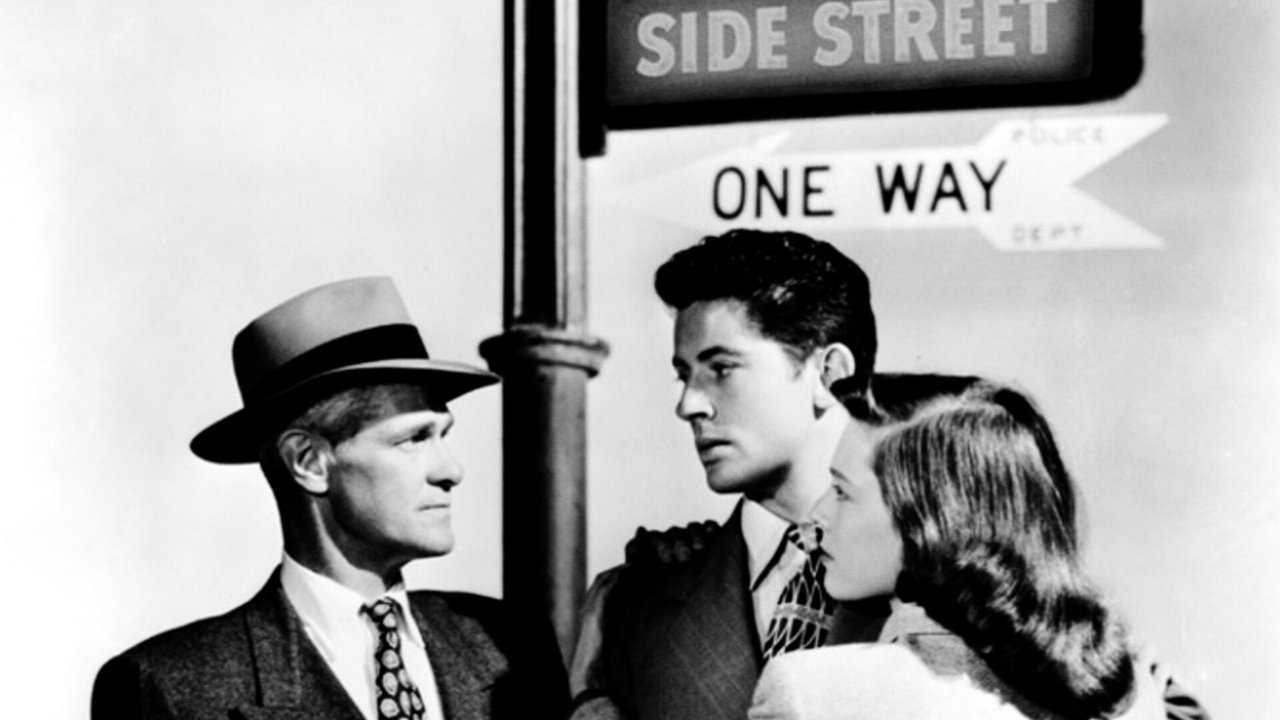
Side Street occupies a precise but undervalued position within the MGM noir cycle, which tended toward polish and restraint compared to the harder edges of Columbia or RKO product. Anthony Mann, who had already demonstrated his command of location-driven, morally spare noir with Raw Deal and Border Incident, brings that same spatial intelligence to Manhattan, turning the city's actual geography into a diagram of Joe Norson's narrowing options. Farley Granger, who had recently played a similar weakling-by-circumstance in Rope and They Live by Night, understands the precise emotional register the role demands: not villainy, not heroism, but the particular paralysis of a man who knows exactly how he arrived at his situation. The film's final chase through New York traffic is frequently cited, but Mann's more considered achievement is the sustained middle section, in which the screws tighten through conversation and proximity rather than action. At eighty-three minutes, Side Street wastes nothing.
– Classic Noir
Ruttenberg's camera moves with documentary authority through actual Manhattan streets as Joe's car cuts against traffic, the frame kept wide enough to register the surrounding city as indifferent mass rather than dramatic backdrop. The footage is cut tight, but Mann resists accelerating the rhythm into pure sensation – the surrounding pedestrians and vehicles remain present, ordinary, which makes Joe's trajectory feel desperate rather than heroic. Low angles place the car against the canyon walls of the financial district, emphasizing vertical compression, and the available urban light – reflected off wet asphalt, filtered through elevated rail structures – does the work that studio fills would ordinarily perform.
The sequence argues that the city is not an arena for Joe's story but a system operating entirely without reference to it. His flight and its outcome are proportionate not to his guilt or innocence but to the geometry of the streets themselves. It is a conclusion consistent with the film's central proposition: that the postwar city makes very little room for the correction of small mistakes.
Joseph Ruttenberg's work on Side Street represents one of the more disciplined applications of location photography within the MGM noir output. Where the studio's default instinct ran toward controlled lighting environments, Ruttenberg and Mann pushed exterior shooting through much of the New York footage, using existing architectural shadow and ambient street illumination to produce a texture the backlot could not replicate. Ruttenberg modulates between these location sequences and the more conventionally lit interior scenes without rupture, using the tonal shift itself to register Joe's movement between public exposure and the enclosed world of Garsell's operation. Shadow is deployed less expressionistically than in German-influenced noirs and more structurally – it indicates available escape or its absence. Lens choices favor the middle focal range, keeping Joe readable within his environment rather than abstracted from it, which reinforces the film's insistence that his situation is produced by the city rather than imposed upon it from outside.
TCM holds Side Street in regular rotation as part of its classic MGM library programming and is the most reliable source for a clean, uncut broadcast print.
Amazon Prime VideoSubscriptionSide Street has appeared in the Prime Video catalogue in a serviceable transfer; availability varies by region and should be confirmed before seeking.
Archive.orgFreePublic domain or freely uploaded copies may exist on Archive.org, though print quality is not guaranteed and versions should be checked against known running times.