In a mid-sized American city, Haven D. Allridge (Walter Pidgeon) is a newspaper editor who has long maintained a comfortable arrangement with the local political machine, trading silence for stability. When reporter Chick Johnson (John Hodiak) arrives at the paper, ambitious and unwilling to look the other way, he begins pulling at threads that Allridge has spent years keeping tightly bound. The city's entrenched power belongs largely to Nelson S. Tarsson (Everett Sloane), a fixer whose influence extends from precinct houses to city hall, and whose relationship with Allridge runs deeper than either man would care to admit.
Johnson's investigation draws him into contact with Cleo Bethel (Audrey Totter), a woman with her own uncertain loyalties, and toward the orbit of Sheriff Casey Burke (Thomas Gomez), a lawman navigating the narrow ground between honest instinct and institutional compromise. Captain Buck Maxwell (Karl Malden) occupies a similar fault line within the police department. As Johnson pushes further, Allridge is forced to reckon with the distance between the editor he presents to the public and the accommodations he has quietly made over years of professional survival. The arrival of Randy Stauton (Cameron Mitchell) and his wife Peggy (Paula Raymond) adds a more volatile, personal dimension to the corruption already in motion.
Sellout belongs to the civic noir cycle of the early 1950s, a group of films that trained the genre's characteristic pessimism not on criminal underworlds but on the institutions nominally charged with preventing them. The film's central question is not whether wrongdoing will be exposed but whether exposure, once it arrives, can survive the machinery designed to absorb and neutralize it. Gerald Mayer keeps the moral accounting rigorous, and the cast – assembled from MGM's reliable stable of character actors – ensures that compromise registers as something earned rather than assumed.
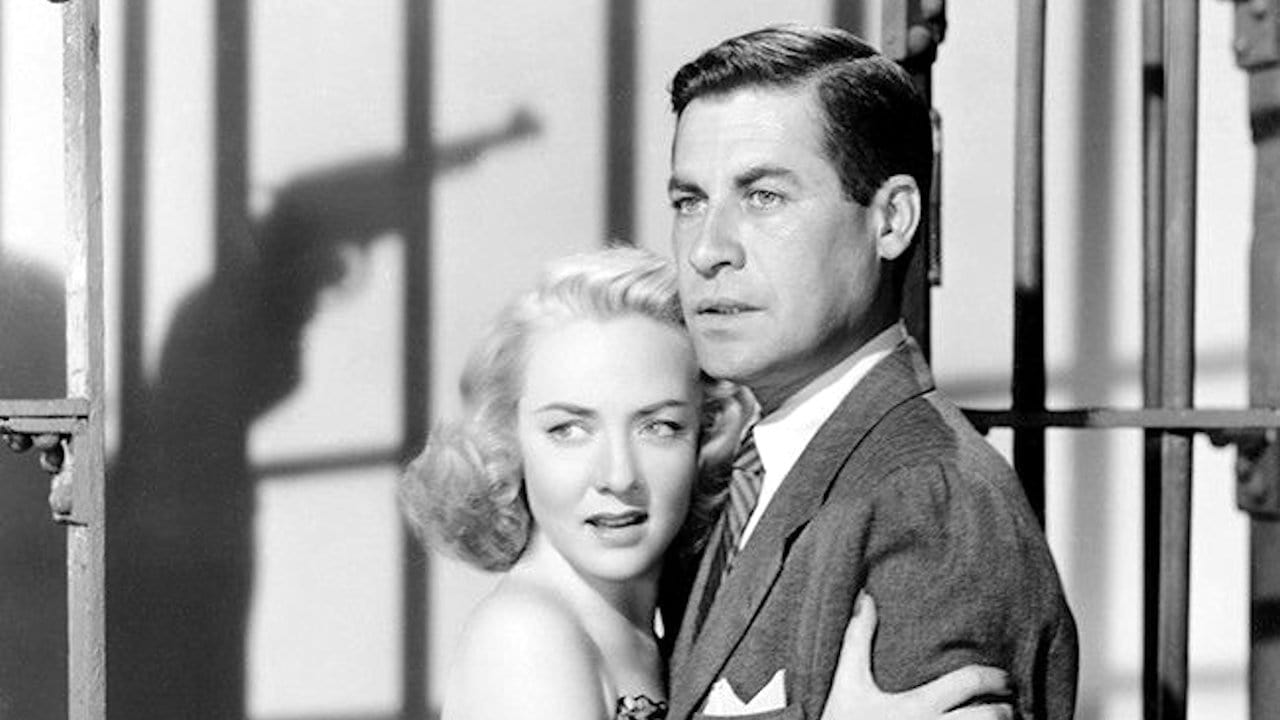
Sellout arrives at the intersection of two postwar currents: the procedural crime film and the civic corruption expose, a combination that studios found commercially reliable in the wake of the Kefauver hearings. Gerald Mayer, a journeyman director whose career never quite found a defining work, handles the material with competence and occasional precision, extracting from his cast performances that carry genuine weight. Walter Pidgeon is the film's quiet center – not a noir protagonist in the conventional sense but a figure of institutional complicity, which is finally more interesting. His Allridge represents the banal face of corruption: not the man who takes bribes but the man who decides not to ask questions. Everett Sloane, characteristically, finds menace in understatement. Hodiak does honest work in a role that asks him to embody journalistic integrity without tipping into the sanctimonious. At 83 minutes the film does not overstay itself, and its view of civic life – in which decency requires active, costly effort – feels less like formula than like reportage from a specific American moment.
– Classic Noir
Paul Vogel frames Allridge behind his desk with the geometry of a man who has organized his world to keep threats at a managed distance. The desk is wide, the room is lit from a single practical source above and to the left, throwing Allridge's face into a half-shadow that is not melodramatic but administrative – the shadow of a man who has learned to conduct his compromises in partial light. When Johnson enters and leans across the frame's foreground, Vogel does not cut but holds the two-shot, letting the spatial tension between the seated editor and the standing reporter carry the argument the dialogue has not yet made explicit.
The scene is a study in positional power and its limits. Allridge controls the room but not the frame's moral center, which has shifted to the younger man without fanfare. What Vogel and Mayer communicate here – and what the film returns to throughout – is that corruption does not announce itself through violence or spectacle but through the accumulation of arrangements, each of them deniable, until the desk itself becomes a kind of evidence.
Paul Vogel, whose work spans everything from MGM musicals to the stark geometry of Lady in the Lake, brings to Sellout a restrained but purposeful visual intelligence. Working primarily on studio sets with occasional location inserts, Vogel favors mid-range lenses that keep faces and environments in legible relationship rather than using shallow focus to aestheticize moral complexity. His lighting setups consistently employ a single dominant source modified by practical fixtures, producing shadows that feel earned by the architecture rather than imposed by convention. The effect is a city that looks lived-in, where corruption is embedded in ordinary rooms rather than exotic spaces. Vogel reserves his most deliberate shadow work for scenes involving Tarsson and Allridge, where the chiaroscuro becomes a visual index of concealment. In sequences involving Johnson or Burke, the light opens slightly – not to signify heroism, but to indicate the exposure that comes with transparency. It is cinematography in service of the film's moral argument rather than in excess of it.
TCM holds deep MGM library rights and remains the most reliable venue for Sellout to surface in a clean print; check schedules or the Max bundle for on-demand access.
Archive.orgFreePublic domain or freely uploaded prints occasionally appear here; quality varies and verification of the transfer is advisable before use.
TubiFree (Ad-Supported)Tubi has carried MGM-adjacent noir titles from this period; availability for this title is unconfirmed and should be checked directly on the platform.