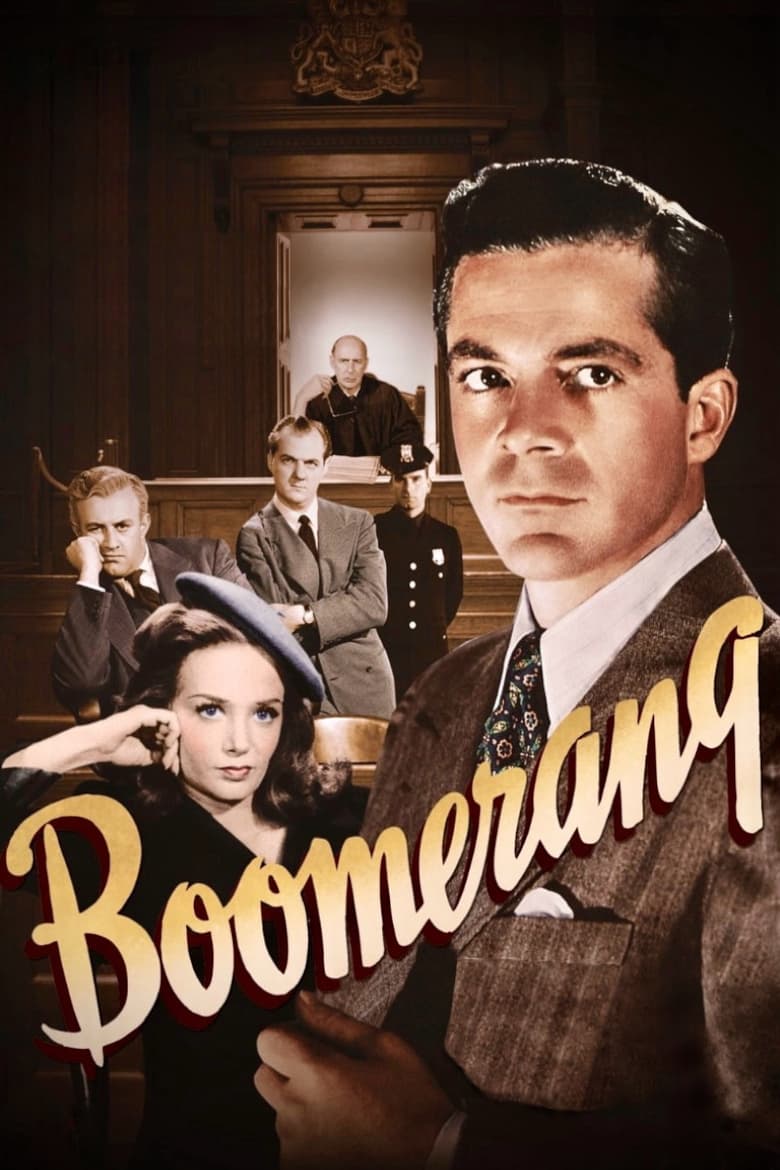
In the small Connecticut city of Stamford, a beloved priest is shot dead on a quiet street. The murder sends the community into a panic, and under mounting political pressure, police chief Harold Robinson arrests a drifter named John Waldron. State's Attorney Henry L. Harvey, a cautious and methodical man, is handed what appears to be an open-and-shut case – eyewitnesses, a suspect with a weapon, and a city desperate for closure.
As Harvey prepares the prosecution, he begins to notice fractures in the evidence. The ballistic record does not align, the witnesses contradict one another in ways that cannot be reconciled, and Waldron's own account carries an interior logic that the prosecution's theory cannot accommodate. Behind Harvey, the machinery of local politics – represented by the calculating T.M. Wade and a press corps hungry for resolution – applies steady pressure to secure a conviction regardless of what the facts actually support.
Boomerang! uses the procedural form as a moral pressure chamber, placing its protagonist not in pursuit of a killer but in resistance to the forces that have already decided who the killer must be. It occupies a particular corner of postwar noir where institutional corruption is less a matter of individual villainy than of collective convenience, and where the right action and the expedient one pull in opposite directions.
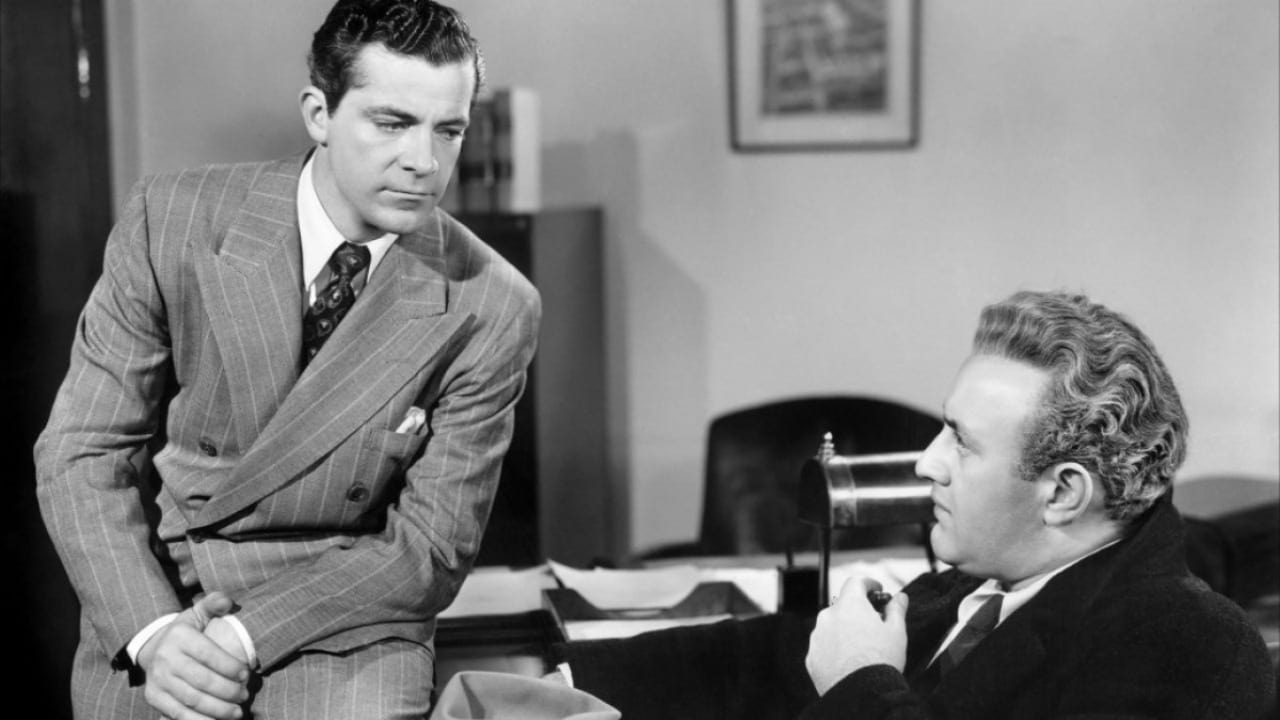
Boomerang! belongs to the semi-documentary cycle that 20th Century Fox pursued with some consistency in the late 1940s, a mode in which location shooting, procedural detail, and the rhetoric of factual record were used to lend noir anxieties the weight of civic journalism. Elia Kazan, working from a screenplay by Richard Murphy, is less interested in the murder itself than in what the murder reveals about the community surrounding it – the press, the party machinery, the police department, the electorate. Dana Andrews, characteristically understated, carries the film on a performance built from hesitation and suppressed conscience rather than action. What Boomerang! achieves is a portrait of institutional pressure that feels neither melodramatic nor naive: the corruption it depicts is bureaucratic, almost polite, which makes it more corrosive than the outright venality found in harder-edged noirs of the same period. The film's refusal to resolve every thread is its most honest gesture.
– Classic Noir
Kazan and cinematographer Norbert Brodine frame the courtroom not as a theater of spectacle but as a space of institutional geometry – rows of faces arranged in shallow depth, the bench a dark horizontal weight at the rear of the frame. When Harvey turns from the prosecution table to dismantle the state's own case, Brodine moves the camera into a series of tight two-shots and close singles that isolate each witness within their own pocket of flat, institutional light. There is no dramatic chiaroscuro here; the lighting is almost deliberately ordinary, which is the point.
The scene's force comes from the inversion of expectation it performs in plain sight. Harvey's methodical destruction of the eyewitness testimonies does not read as triumph – his face registers something closer to professional grief. What the sequence argues is that the adversarial system can accommodate honesty only when one participant chooses it against self-interest, and that such a choice exists outside the system's normal logic entirely.
Norbert Brodine, whose work on the Fox semi-documentary cycle also included Kiss of Death and 13 Rue Madeleine, brings to Boomerang! a visual strategy calibrated to the film's moral argument. Shooting extensively on location in Stamford and Bridgeport, Connecticut, Brodine uses wide lenses and deep focus to embed the characters within recognizable civic architecture – the actual streets, the actual courthouse, the ordinary interiors of offices and apartments. This is not the noir city of expressionist shadow but a plausibly mundane world, and that mundanity is the point: the corruption depicted has nowhere exotic to hide. Interior scenes use flat, overlit sources that drain glamour from the frame and suggest the fluorescent logic of bureaucratic space. Where shadow does appear – in the margins of the interrogation sequences and in the edges of crowd compositions – it functions less as atmosphere than as residue, the things the frame cannot quite illuminate even when it tries.
The most reliable source for a clean print with contextual programming; check current availability as catalogue rotates.
TubiFreeA free ad-supported option that has carried the film periodically; print quality varies and availability is not guaranteed.
Archive.orgFreeA public domain version is available for streaming or download, though transfer quality is inconsistent across uploads.