Bill Jones, a disillusioned World War II veteran, drifts into the orbit of the American Communist Party after a bureaucratic betrayal leaves him bitter and without recourse. The cell he joins presents itself as a sanctuary of solidarity, populated by true believers and calculating operators in equal measure. Among them are Greta Bloch, a Party enforcer operating under the alias Yvonne Kraus, and Nina Petrovka, a young émigré whose loyalty to the movement is already beginning to fracture.
As Bill moves deeper into the cell's inner workings, the Party's surface idealism gives way to surveillance, coercion, and the casual destruction of anyone who questions its authority. Henry Solomon, an intellectual recruit, becomes an object lesson in what happens when doubt is voiced aloud. Nina's growing attachment to Bill places both of them in the Party's crosshairs, and Greta, whose commitment to the cause reads as something closer to appetite for control, tightens the cell's grip around them.
Red Menace belongs to the cycle of anti-Communist pictures that Republic Pictures and other studios produced in the late 1940s, films shaped as much by the political climate of HUAC-era Washington as by any strictly artistic ambition. Working within those constraints, director R.G. Springsteen finds room for a recognizably noir portrait of institutional manipulation, ideological entrapment, and the difficulty of reclaiming an autonomous self once the machinery of a closed system has taken hold.
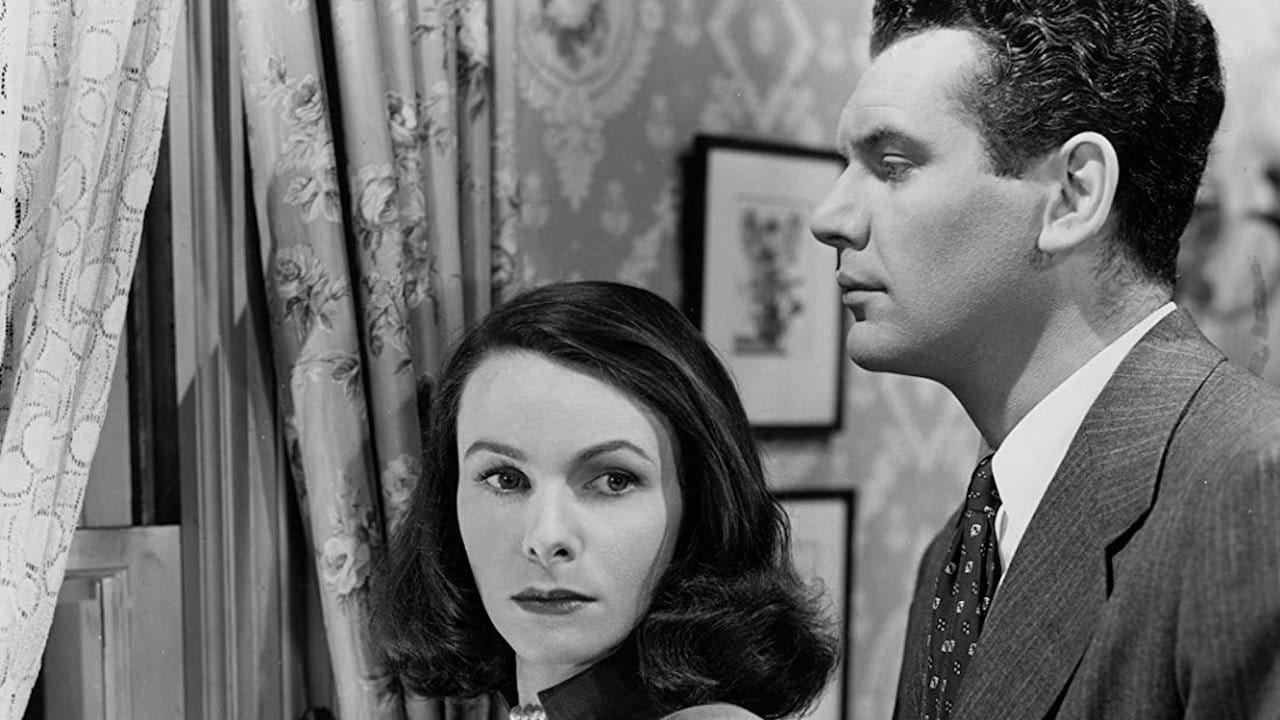
Red Menace is a document as much as it is a film – a product of the late-1940s convergence between studio commerce, government anxiety, and the cold logic of the blacklist era. Springsteen, a Republic contract director whose background was largely in Westerns, handles the material with a functional competence that, in its restraint, sometimes serves the story better than a more flamboyant hand might have. What the film understands, perhaps inadvertently, is that the machinery of ideological coercion and the machinery of noir entrapment are structurally identical: both depend on the slow narrowing of a protagonist's options until personal freedom becomes a theoretical concept. Betty Lou Gerson's Greta Bloch is the most fully realized figure in the film, a femme fatale whose danger is bureaucratic rather than sexual, which makes her, in some respects, more genuinely cold than the genre's more conventional sirens. The film does not transcend its propaganda assignment, but it uses the assignment to illuminate something real about institutional power and the cost of belonging to any closed world.
– Classic Noir
MacBurnie lights the scene with a single practical source positioned behind Greta, casting her face into partial shadow while the faces of the other cell members remain in full, flat exposure. The camera holds at a medium distance, refusing the close-up that would soften her into a conventionally readable villain. When she moves to close the door, the frame compresses slightly, the walls pressing in from the edges of the composition, and the remaining figures are arranged in a rough semicircle that reads less as a meeting than as a tribunal.
The scene establishes the film's central argument: that the threat Greta embodies is not passion or seduction but procedure. The door closing is not a melodramatic gesture; it is an administrative one, and that distinction is what gives the moment its unease. For Bill, watching from the periphery of the frame, it marks the point at which the organization he joined for refuge becomes the thing he must escape.
John MacBurnie, who spent the bulk of his career at Republic on B-pictures and serials, brings a disciplined economy to Red Menace that suits its subject. Working primarily on studio sets, he constructs interiors that feel deliberately claustrophobic – low ceilings implied through tight framing, windows that admit light only as harsh diagonal cuts rather than sources of relief. His shadow work is applied selectively: the Party's meeting spaces are rendered in flat, institutional grey rather than the expressionist chiaroscuro of more overtly stylized noirs, a choice that codes the danger as systemic rather than lurid. Exteriors, used sparingly, are handled in a harder, more documentary-adjacent register that borrows from the semi-procedural style that films like Canon City had recently established. The overall visual grammar reinforces the film's moral logic – this is a world where darkness is not theatrical but structural, built into the walls and the light fittings of ordinary rooms.
Red Menace is in the public domain and available for free streaming and download here; the print quality varies but represents the most accessible version currently online.
TubiFreeTubi has carried the film as part of its classic Hollywood catalog; availability may shift, so confirm before seeking.
Amazon Prime VideoRentalA cleaned-up digital transfer has appeared through third-party sellers on the platform; check current listings as catalog availability changes.