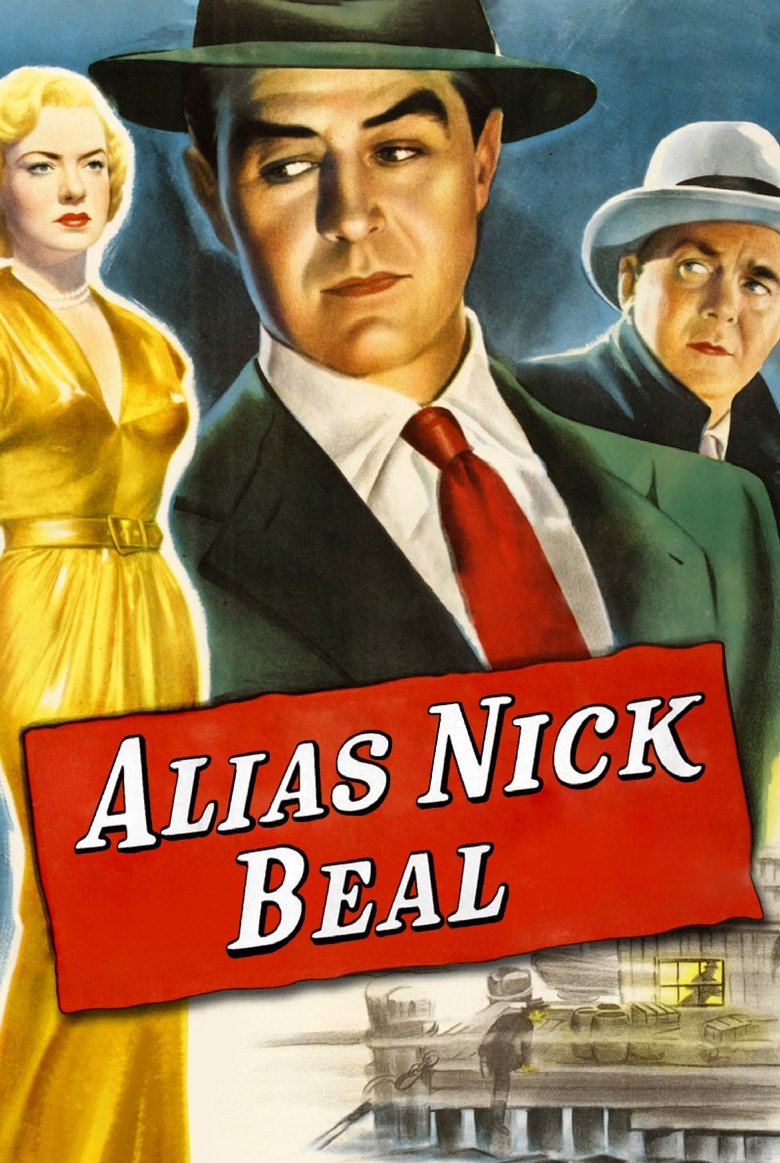
Joseph Foster is a district attorney of genuine principle, a man whose reputation for integrity has made him a natural candidate for governor. When a case against a powerful racketeer collapses for lack of evidence, Foster's frustration reaches a point of moral crisis. Into that moment steps Nick Beal, a smooth and inscrutable stranger who produces the missing evidence with no apparent motive beyond goodwill. Donna Allen, a woman Beal keeps close, is drawn into Foster's orbit as part of an arrangement whose terms remain unstated but deeply felt.
As Foster's political rise accelerates, the cost of Beal's assistance becomes clearer. Garfield, a corrupt party operative, serves as intermediary between Foster's ambitions and the machinery of compromise. Each concession Foster makes narrows the distance between the man he was and the man Beal seems to be fashioning him into. Donna, caught between loyalty to Beal and a nascent conscience of her own, becomes the thread most likely to unravel the entire arrangement. Foster's wife Martha and his young associate Larry Price watch the transformation with mounting dread.
Alias Nick Beal operates at the intersection of political noir and supernatural allegory, using the conventions of the corruption drama to stage something closer to a morality play. The film is less concerned with the mechanics of crime than with the architecture of temptation, asking what a man surrenders when he decides that ends justify means. Its tone is cool and deliberate, and the fog-laden harbor settings give the narrative a quality of moral atmosphere that lingers well beyond its plot.
Alias Nick Beal occupies an unusual position in the noir canon, one that serious genre study has not always known how to place. John Farrow directs with the measured control he brought to Where Danger Lives and The Big Clock, keeping the supernatural premise grounded in the textures of political realism. The film is, at its core, a Faustian parable transposed into the postwar American landscape of machine politics and civic decay, and it gains considerable force from that transposition. Ray Milland, fresh from his Oscar-winning work in The Lost Weekend, brings to Nick Beal a quality of civilized menace that never tips into caricature. Thomas Mitchell, as Foster, plays moral deterioration with gradual conviction. What the film reveals about its era is the anxiety that integrity in public life was itself a kind of vulnerability, something that could be exploited by those patient enough to wait for the right moment of doubt. Franz Waxman's score and Lionel Lindon's photography collaborate to give that anxiety a physical form.
– Classic Noir
Lindon frames the scene with the docks receding into impenetrable fog, the light source reduced to a single lamp that catches the moisture in the air and throws everything beyond its narrow radius into soft erasure. Milland stands at the edge of the frame rather than its center, his silhouette partial and ambiguous, as if the image itself is refusing to fully constitute him. The camera holds at a slight distance, denying the audience the intimacy of a close-up and keeping Beal in the register of phenomenon rather than person.
The scene functions as the film's visual thesis statement. Beal is most himself at the margins of legible space, in the zone where solid ground gives way to water and light gives way to nothing. The fog is not atmosphere for its own sake but a moral condition made visible: the point where Foster's world and Beal's world overlap is precisely the point where clarity becomes impossible. What the scene argues is that corruption does not announce itself; it arrives quietly, at the edge of what can be seen.
Lionel Lindon's work on Alias Nick Beal is among the more disciplined exercises in expressionist lighting produced at Paramount in this period. Lindon, who had shot Going My Way for Farrow's regular collaborators and would later bring a harder edge to The Manchurian Candidate, works here with a palette defined by selective illumination and deliberate spatial ambiguity. The fog-bound exterior sequences are constructed on studio soundstages, but Lindon refuses to let the controlled environment produce tidiness; the light behaves as if it has been interrupted rather than placed. Interior scenes use deep shadow to bisect characters across the frame, so that political conversations carry a visual grammar of division. Nick Beal is frequently lit from below or from sources just outside the frame's logic, a technique that separates him perceptually from the naturalistic lighting applied to Foster and the other human characters. The effect is not supernatural in a lurid sense but ontological: Beal simply does not inhabit the same photographic world as everyone else, and Lindon's setups make that distinction legible without underlining it.
Criterion Channel periodically programs Paramount noir titles and is the most reliable streaming source for a properly transferred print of this film.
TCMSubscriptionTCM has broadcast Alias Nick Beal as part of its classic noir and Ray Milland retrospective programming; check schedule or the TCM app for on-demand availability.
Archive.orgFreeA public domain or transferred print may be available on Archive.org, though video quality is not guaranteed to match commercial sources.