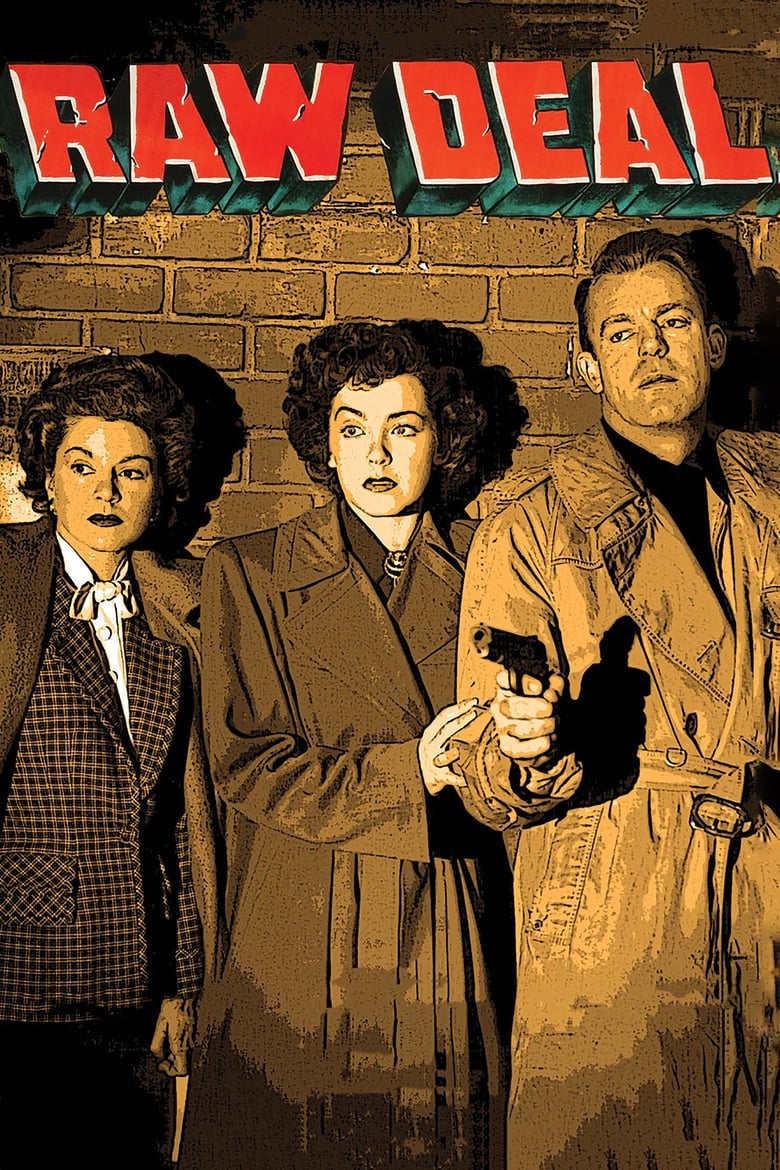
Joe Sullivan breaks out of prison with the help of his loyal girlfriend Pat Cameron, banking on a $10,000 debt owed to him by syndicate boss Rick Coyle – money Coyle has no intention of paying. Pat has planned the escape meticulously, driven by devotion to Joe and a quiet dread that once he is free, he will no longer need her. During the breakout, Joe and Pat take social worker Ann Martin hostage, a woman whose idealism and composure begin to unsettle the carefully maintained emotional order between the fugitives.
As the three move through fog-bound cities and narrow safe houses, Joe finds himself drawn to Ann's decency in ways he cannot fully articulate or resist. Pat watches this shift with a clarity that is almost clinical, narrating the film in voiceover with a fatalism that doubles as self-knowledge. Rick Coyle, sadistic and contemptuous of everyone beneath him, dispatches his lieutenant Fantail to track the fugitives while enjoying his own cruelties at leisure – burning a woman with a flaming dish at a party in one of the film's most coldly observed scenes.
Raw Deal works as a fugitive thriller but operates just as persistently as a study in misplaced loyalty and the arithmetic of who pays for whose ambitions. The woman who loves without illusion, the man who wants rescue without admitting it, and the woman who represents a life foreclosed by circumstance form a triangle the genre rarely articulates so honestly. Mann and Alton render the moral geometry in shadow and smoke, building toward a conclusion the film's own narration has been preparing us for from the opening frame.
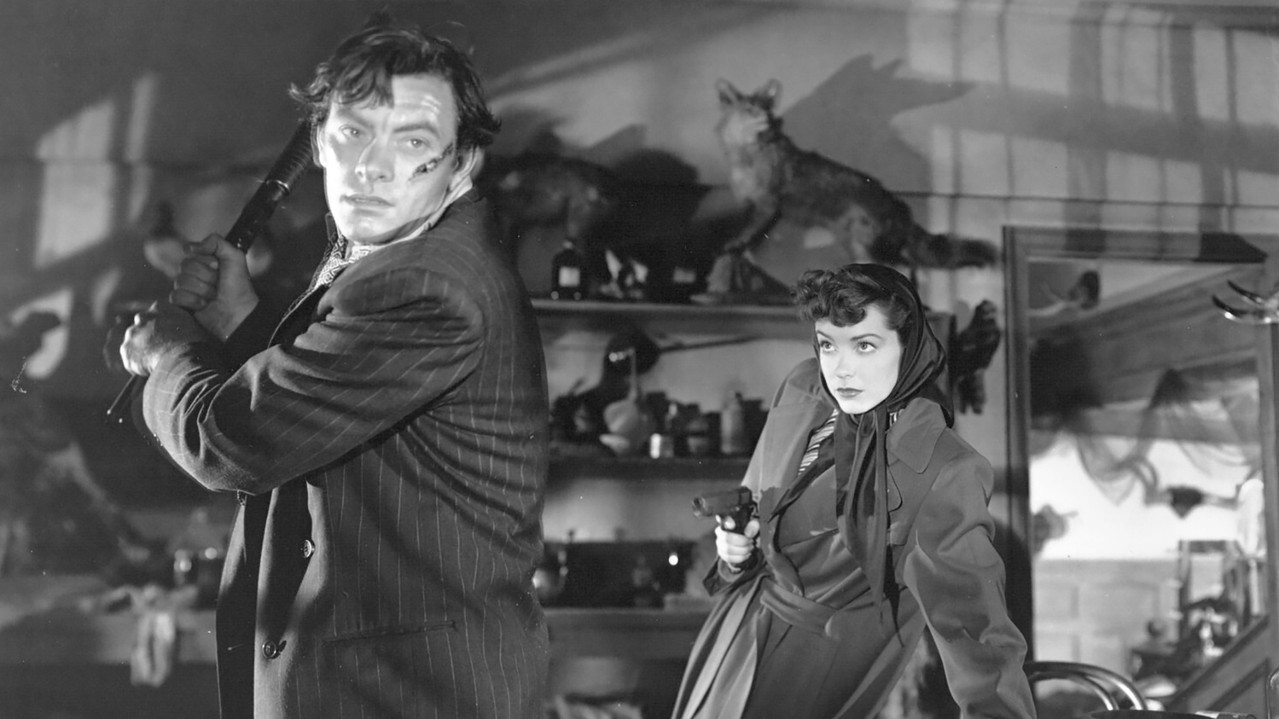
Raw Deal occupies a precise position in the 1948 cycle of American noir: it arrives after Mann and Alton had already refined their visual partnership on T-Men and He Walked by Night, and it applies that partnership to material with an unusual emotional register. The film is not primarily interested in crime mechanics. It is interested in the psychology of devotion – specifically, in what a woman will do for a man who will never fully choose her. Claire Trevor's Pat Cameron is one of the more honestly written women in the genre, given both the narration and the film's structural sympathy, which does not mistake sentiment for endorsement. Raymond Burr's Rick Coyle is sadism rendered as aesthetic preference rather than mere villainy, a figure whose violence is casual in a way that implicates the world that produced him. What the film reveals about its era is the persistence of a certain male passivity at the center of noir – Joe Sullivan is reactive, pulled, never quite the agent of his own story – and the women who orbit that passivity paying the costs.
– Classic Noir
Alton lights the penthouse sequence from below and within, using practical sources – candles, the flaming chafing dish – to throw unstable light across faces that register everything except surprise. The frame holds Burr in a medium shot that gives him room to move without making the space comfortable; his bulk occupies the center of the composition while the woman he burns is positioned at its edge, half in shadow before the flame finds her. The camera does not cut away at the moment of violence. It holds, registering the act with the same unhurried attention it gives to the decor around it.
The scene argues that Coyle's cruelty is not exceptional – it is social, performed for witnesses who absorb it as entertainment. By staging it in a penthouse among people who do nothing, Mann locates organized crime's violence not in back alleys but in the comfort of those who benefit from it. It also establishes the film's moral stakes economically: Joe Sullivan is trying to escape a world whose full dimensions this scene makes visible in under two minutes.
John Alton's work on Raw Deal is among the most disciplined expressions of his method. Working in studio interiors designed to function as noir environments rather than representations of actual spaces, Alton consistently underexposes his mid-tones so that shadow is not accent but atmosphere – the default condition of the world these characters inhabit. His use of single-source hard light, often from angles that flatten faces into planes of contrast, denies the performers conventional glamour without making them grotesque. The fog sequences that punctuate the fugitive sections – fog that arrives in volumes too heavy for naturalism – operate as a visual externalisation of the characters' moral visibility: they can see one another, barely, but the world beyond the frame has dissolved. Alton's lens choices favor moderate wide angles that keep characters in relation to their environments without the expressionist distortion that lesser noir cinematography reached for; his restraint is what gives the darkness weight.
The most reliable current home for the film, presented in a clean transfer that preserves Alton's deep shadow graduation.
TubiFreeAvailable as of recent cataloguing; transfer quality varies, but the film is complete and accessible without a subscription.
Archive.orgFreePublic domain availability makes this a consistent fallback, though source print quality is inconsistent across uploaded versions.