Films People Pull a Fast One Night Beat Reading Room On TV Shop
Monsieur Verdoux 1947
1947 Charles Chaplin Productions
★★★☆☆ Notable
Film Noir · 124 minutes · Black & White

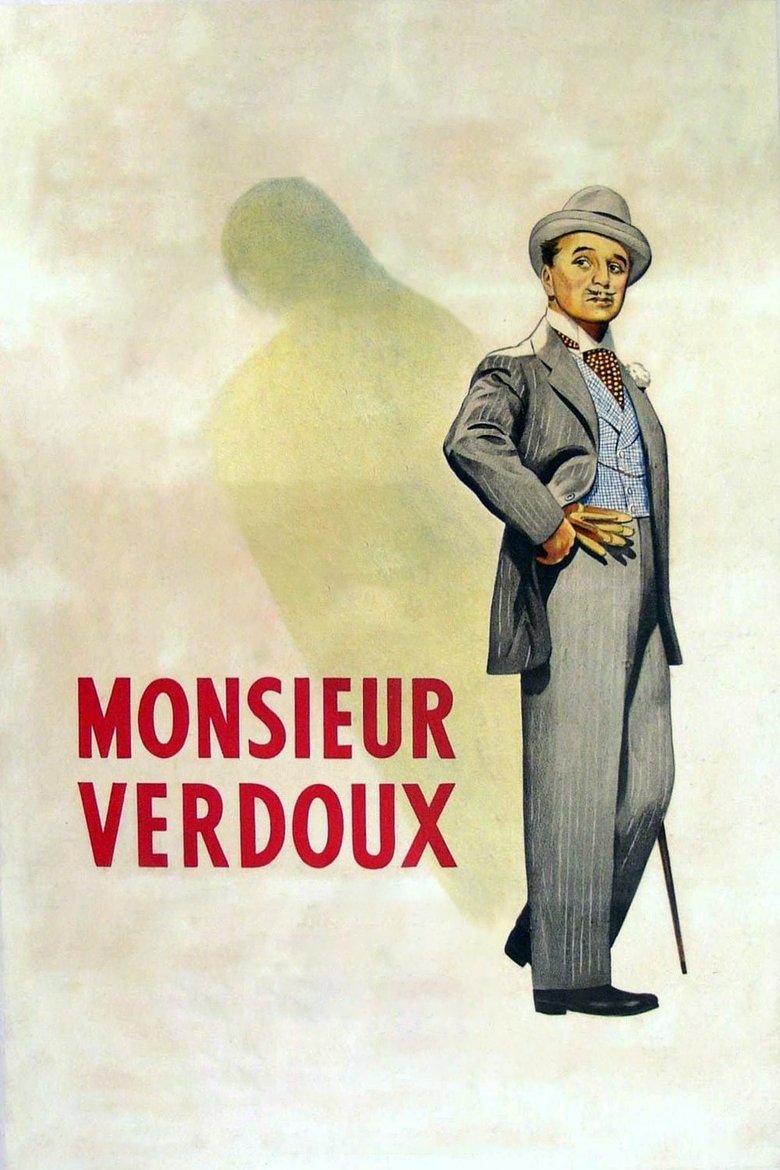
Monsieur Verdoux

Directed by Charlie Chaplin
Year 1947
Runtime 124 min
Studio Charles Chaplin Productions
TMDB 7.7 / 10
"A banker of modest means finds a more efficient business model in matrimony and murder."

In postwar France, Henri Verdoux is a meticulous, soft-spoken man who tends his garden, dotes on his crippled wife Mona and their young son Peter, and maintains a precise domestic routine. What his family does not know is that Henri, having lost his position at a bank after thirty years of service, has turned to a parallel career: courting and marrying wealthy women under assumed names, liquidating their assets, and then liquidating them. He moves between households with the punctuality of a comptroller, his ledger balanced in cash and silence.

The system functions until it strains at its edges. Annabella Bonheur, a brash and indestructible widow played with anarchic energy by Martha Raye, proves maddeningly resistant to every disposal method Henri attempts. Meanwhile, a chance encounter with a destitute young woman draws out something that complicates his tidy moral arithmetic: genuine sympathy. Henri uses her, then reconsiders, and the contradiction between his capacity for tenderness and his capacity for killing begins to surface in ways the film refuses to resolve cheaply.

Chaplin frames the story as a dark comedy that gradually sheds its comedy, arriving at a courtroom reckoning where Henri Verdoux delivers what amounts to a prosecutorial brief against capitalism and war. The film belongs to a strain of noir that locates evil not in the criminal underworld but in the structures of respectable society, and it asks, with cold patience, whether the man who murders for money is meaningfully different from the civilization that does the same at scale.

Classic Noir

Monsieur Verdoux occupies an uncomfortable position in the noir canon precisely because it refuses the genre's usual consolations. There is no femme fatale to absorb blame, no detective to restore order, and no suggestion that Verdoux's crimes are aberrations from a functioning moral world. Chaplin draws on the real Landru case but transposes it into a vehicle for systematic social critique, one that cost him dearly with American audiences and critics in 1947, a moment when such argument read as subversion. The film's structural looseness – its tonal swings between farce and philosophy – has long been held against it, but that instability is also its argument: the distance between laughter and horror is the distance Verdoux himself navigates daily. Seen from the vantage of the genre, it is the rare noir that names its true villain not as a man but as an economic logic, and it delivers that verdict through a character the audience has been encouraged, uncomfortably, to find charming.

– Classic Noir
3 ★★★☆☆ Notable
Credits

The Crew

DirectorCharlie Chaplin
ScreenplayCharlie Chaplin
CinematographyCurt Courant
MusicCharlie Chaplin
EditingWillard Nico
Art DirectionJohn Beckman
ProducerCharlie Chaplin
Performances

The Cast

Close Reading

The Signature Scene

Monsieur Verdoux – scene
The Lakeside Boat, Late Afternoon Oars Shipped, No Witnesses

Chaplin and Raye are in a small rowboat on a glassy lake, the light flat and sourceless, the shoreline soft and indistinct in the background. The camera holds at a middle distance, refusing close-up intimacy, so that what unfolds reads less as drama than as procedure. Verdoux's movements are deliberate – he ships the oars, adjusts his coat, positions himself – and Courant's framing keeps both figures in frame simultaneously, granting the audience no privileged angle from which to look away.

The scene's function is to expose the gap between Henri's self-image as a rational professional and the brute physicality that his profession requires. Every time Annabella disrupts the plan through sheer oblivious vitality, the comedy that results is not relief but evidence: the world will not cooperate with Verdoux's tidy system, and that resistance, rather than conscience, is what keeps him from completing the act. The scene argues, quietly, that survival is sometimes simply a matter of being too loud to be disposed of neatly.

Visual Language

The Cinematography

🎞️
Curt Courant – Director of Photography

Curt Courant, whose European credits included work with Renoir and Hitchcock, brings to Monsieur Verdoux a lighting grammar rooted in continental studio classicism rather than the deep-shadow expressionism of American noir. The interiors of Henri's various domestic establishments are rendered in a high-key, almost bourgeois light that refuses to signal danger – there are no venetian-blind shadows across Verdoux's face, no chiaroscuro to externalize his guilt. That choice is itself an argument: the film insists that murder conducted as business looks like ordinary domestic life. Courant uses shallow studio sets and controlled three-point lighting to keep the world looking orderly and prosperous, and the effect is more disquieting than shadow work would be. Where shadow is deployed – the final walk to the guillotine, the spare geometry of the prison corridor – it arrives without flourish, as simple fact rather than atmospheric commentary, which is exactly the moral register the film has been building toward.

In the Catalogue

Themes & Motifs

Availability

Where to Watch

Also in the Directory

See Also