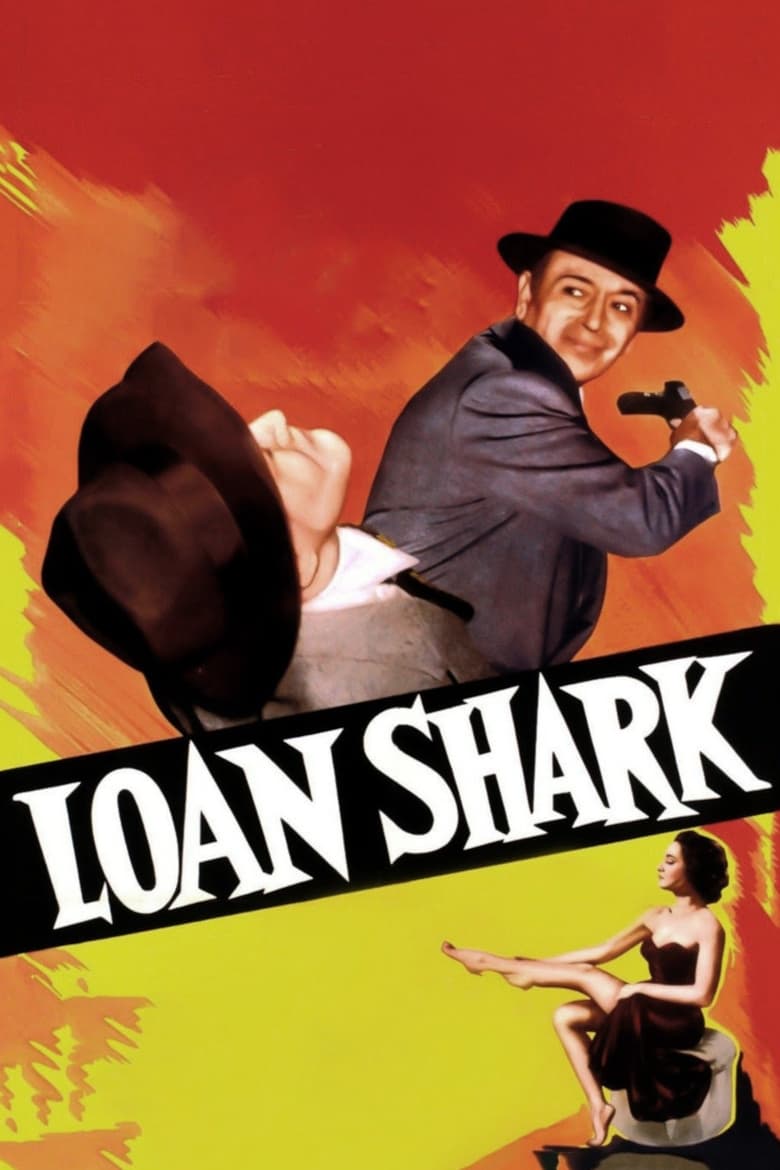
Joe Gargen is a former convict who returns to civilian life after serving time for a crime connected to the loan shark underworld. When his brother-in-law is killed by enforcers working for the syndicate's tire-plant operation – a front used to bleed working men dry through predatory lending – Gargen volunteers to go undercover for federal investigators. He takes a job at the plant, positioning himself inside the network run by the cold, methodical Lou Donelli and his superior, the lawyer Vince Phillips.
As Gargen works his way deeper into the organization, his personal and professional lives become entangled. He falls for Ann Nelson, whose own brother Paul is being crushed by syndicate debt, giving him both motive and vulnerability. The operation demands that Gargen maintain his cover while those around him are threatened, coerced, or eliminated. Donelli grows suspicious, and Phillips – a man who prefers to keep his hands clean – begins to recalibrate the risk that Gargen represents.
Loan Shark belongs to the cycle of procedural noir films that dominated the early 1950s, in which the machinery of organized crime is exposed from within rather than investigated from without. The film uses the tire factory as a concrete, working-class milieu, grounding its violence in economic exploitation rather than glamour, and framing the syndicate not as exotic criminality but as a parasite on ordinary American labor.
Loan Shark is a modest but purposeful entry in the semi-documentary crime cycle that flourished in the years following The House on 92nd Street and T-Men. Seymour Friedman keeps the film moving at a pace that suits its 79-minute frame, never lingering where the material is thin. George Raft, by this point in his career a figure whose weathered stoicism carried its own freight of association, is well cast as a man who knows the criminal world from the inside and brings no illusions to his undercover work. Paul Stewart's Donelli is the film's most calibrated performance – menacing through understatement rather than display. What the film achieves, at its best, is a convincing portrait of the syndicate as an economic system preying on wage earners, which gives the standard infiltration plot a specific social grounding. It does not transcend its B-picture means, but it uses them honestly, and Joseph Biroc's efficient, shadow-conscious cinematography ensures that even the factory floor carries a low-level moral dread.
– Classic Noir
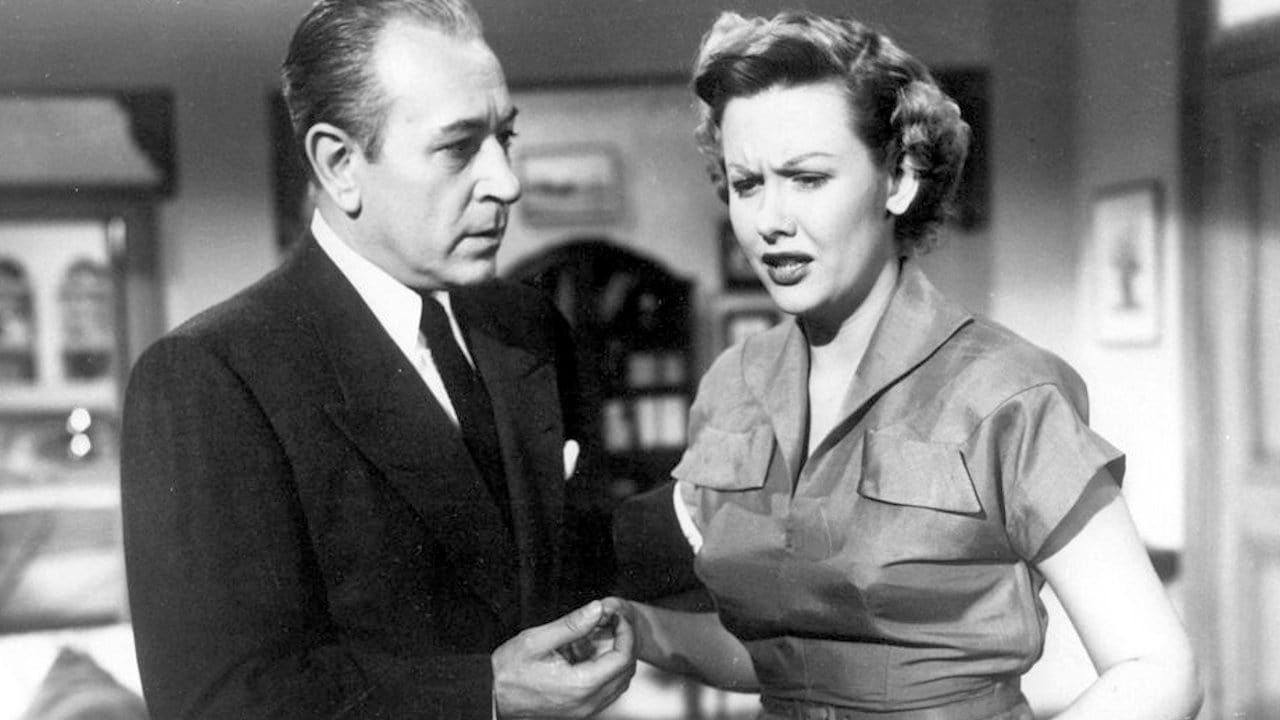
Biroc frames the sequence among the industrial presses and conveyor lines of the tire plant, using the machinery as a grid of hard verticals and diagonals against which the human figures are dwarfed. Overhead industrial lighting casts strong top-down shadows, leaving the lower half of each face in partial darkness. The camera holds a medium distance, reluctant to move closer, as if the space itself enforces a kind of surveillance. When Donelli steps into the frame, he is placed slightly deeper than Gargen, a compositional choice that gives him an easy dominance without overstating it.
The scene works as a crystallization of the film's central anxiety: that the undercover man and the criminal operate according to identical logics of concealment, reading each other across a shared grammar of deception. Gargen's stillness here is not confidence – it is the calibrated stillness of a man who knows that any movement, any excess of expression, could collapse the fiction that is keeping him alive. The factory, which should be a site of legitimate work, has become a theater of mutual surveillance.
Joseph F. Biroc, who would go on to a distinguished career extending from It's a Wonderful Life to later Hollywood productions, brings a disciplined low-key sensibility to Loan Shark that suits its B-picture budget and semi-documentary aspirations. Working largely in studio-constructed environments that approximate real industrial and office spaces, Biroc relies on hard sources – practical overheads, single-side key lights – to generate the contrast ratios associated with the period's crime films without tipping into expressionist excess. His shadow work is functional rather than decorative: shadows define the geometry of a room and the status of the figures within it, rather than serving as atmospheric ornament. Lens choices favor a moderate focal length that keeps backgrounds in readable focus, reinforcing the procedural logic of a story in which environment and social context carry as much weight as individual psychology. The result is a visual language that treats moral ambiguity as a matter of spatial organization – who stands in light, who occupies the margin, who controls the frame.
Tubi regularly carries independent B-noir titles of this era and is the most likely free streaming home for Loan Shark; confirm availability before viewing.
Archive.orgFreeAs a 1952 Encore Productions release with uncertain copyright renewal, Loan Shark may be in the public domain and accessible via Archive.org in a watchable if variable-quality transfer.
Amazon Prime VideoRentalDigital rental through Amazon typically offers a cleaner encode than public domain sources; availability varies by region.