Films People Pull a Fast One Night Beat Reading Room On TV Shop
Sirocco 1951
1951 Santana Pictures Corporation
★★★☆☆ Notable
Film Noir · 98 minutes · Black & White

Sirocco

Directed by Curtis Bernhardt
Year 1951
Runtime 98 min
Studio Santana Pictures Corporation
TMDB 6.0 / 10
"In Damascus, a man without loyalties discovers the price of having none."

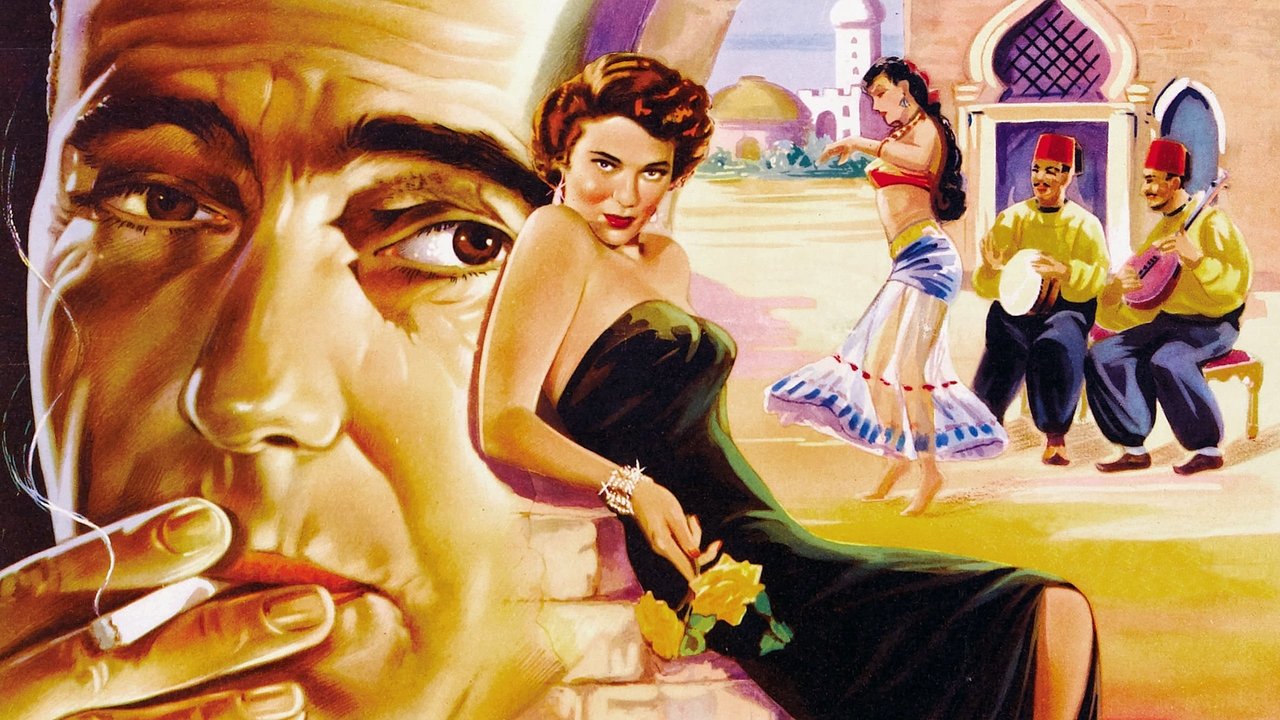
Damascus, 1925. French colonial forces are locked in a grinding conflict with Syrian nationalist rebels, and the city hums with suspicion, black-market commerce, and barely suppressed violence. Into this atmosphere Harry Smith (Humphrey Bogart) moves with practiced indifference – an American arms smuggler who supplies weapons to the insurgents not out of conviction but for money, angling for survival in a city that rewards neither sentiment nor principle. Colonel Feroud (Lee J. Cobb) of the French military intelligence is closing in on Smith's operation, while Violette (Märta Torén), a woman attached to Feroud, drifts into Smith's orbit with consequences neither man can fully control.

As Feroud's pursuit tightens, Smith finds himself caught between the competing pressures of the French command, represented by the weary General LaSalle (Everett Sloane), and the Syrian intermediaries – among them the nervous fixer Balukjiaan (Zero Mostel) and the emir Hassan (Onslow Stevens) – who have their own claims on his services. Allegiances fracture and re-form along lines of self-interest rather than ideology. Violette complicates Smith's calculations without sentimentalizing them; she is not a salvation figure but another negotiation. When Feroud proposes a clandestine arrangement that requires Smith to cross into enemy territory, the film's central transaction becomes explicit: what does a man with no stated principles ultimately owe anyone?

Sirocco belongs to a strand of postwar noir set in colonial or politically unstable foreign territory, where the moral ambiguity intrinsic to the genre finds a literal geography. Smith is recognizably descended from Rick Blaine – Casablanca's reluctant expatriate – but the film refuses that predecessor's redemptive arc. What emerges instead is a cooler, more disenchanted portrait of complicity: a man whose neutrality is itself a choice, and whose choices carry a weight the film insists on reckoning without resolving cleanly.
Classic Noir

Sirocco arrived the same year as The African Queen and was produced by Bogart's own Santana Pictures, giving it an independent latitude that studio product rarely allowed. It is not among the actor's celebrated vehicles, and critical reception has consistently ranked it a tier below his canonical noir work. That assessment is fair but incomplete. Curtis Bernhardt directs without flourish, which is both the film's limitation and its honest quality: the colonial setting is never romanticized, the politics are presented as squalid and irresolvable, and Bogart's Harry Smith is permitted to remain genuinely unsympathetic in ways that Rick Blaine was not. Lee J. Cobb brings his characteristic density to Feroud, making the colonel's eventual vulnerability feel earned rather than convenient. What the film reveals about its era is instructive: produced during the early years of the Cold War, with American foreign policy pivoting between intervention and alliance with fading European powers, Sirocco's portrait of a man profiting from someone else's colonial war carried an irony its audiences may have registered obliquely. It is a minor film that repays serious attention.

– Classic Noir
3 ★★★☆☆ Notable
Credits

The Crew

DirectorCurtis Bernhardt
ScreenplayA.I. Bezzerides
CinematographyBurnett Guffey
MusicGeorge Antheil
EditingViola Lawrence
Art DirectionRobert Peterson
ProducerRobert Lord
Performances

The Cast

Close Reading

The Signature Scene

Sirocco – scene
The Nighttime Exchange Two Men, One Arrangement

The scene unfolds in close interior shadow, Burnett Guffey's camera holding both men in a frame that refuses to grant either a dominant position. Light enters from a single lateral source – the practical logic of a lamp or filtered window – casting one half of each face into darkness. The composition is tight without being theatrical: no extreme angles, no expressionist distortion, just a steady insistence on proximity and the discomfort that proximity between two wary men produces. When the camera does move, it is minimal, tracking slightly to reframe as the power dynamic shifts across the dialogue.

What the scene establishes is the film's central argument: that transactions between men in morally compromised positions are always negotiations of survival, and that the language of principle is a convenience both parties understand to be false. Feroud needs Smith; Smith needs an exit. Neither pretends otherwise. The absence of pretense is, paradoxically, the film's most honest gesture – and it is in scenes like this one, stripped of sentiment, that Sirocco makes its quietly corrosive case.

Visual Language

The Cinematography

🎞️
Burnett Guffey – Director of Photography

Burnett Guffey's work on Sirocco operates within constraints – primarily studio-built sets dressed to evoke the streets and interiors of 1925 Damascus – and he turns that limitation into a consistent visual grammar. Guffey, who would later shoot In Cold Blood and Bonnie and Clyde, was already a precise technician with a preference for motivated light: sources that belong to the scene's physical world rather than imposed from outside it. Here, that approach produces interiors of concentrated shadow interrupted by harsh pools of practical illumination, a setup that keeps characters morally suspended between visibility and concealment. He avoids the deep-focus compositions that might lend the film an epic quality it does not earn or seek. Instead, lenses stay relatively tight, compressing space and enforcing the film's sense of constriction – of men caught in a city, a conflict, and a set of choices from which there is no clean egress. The cinematography serves the story's moral logic precisely: nothing is fully illuminated, and nothing is meant to be.

In the Catalogue

Themes & Motifs

Availability

Where to Watch

Also in the Directory

See Also