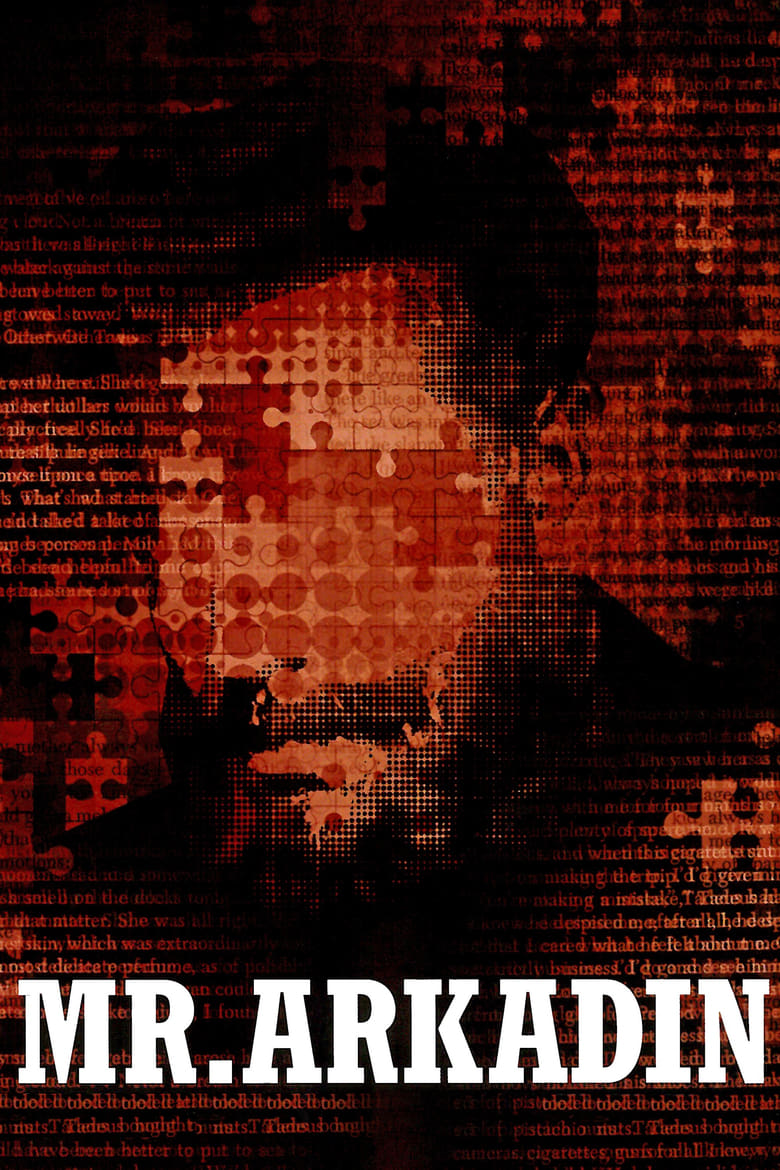
In post-war Europe, small-time American smuggler Guy Van Stratten witnesses a dying man murmur two words: Gregory Arkadin. Following the thread of that name, Van Stratten maneuvers his way into the orbit of Arkadin himself – a colossal, fur-coated financier of obscure origin who commands entire governments and moves through European high society like a sovereign without a country. Arkadin commissions Van Stratten to investigate his own past, claiming a convenient amnesia that has left the years before 1927 a deliberate blank.
Van Stratten accepts, sensing leverage, and begins tracking down the scattered survivors of Arkadin's buried history – black marketeers, forgers, and petty criminals dispersed across Spain, Germany, and Mexico. Each witness he locates soon dies. The pattern becomes clear: Arkadin is not paying for a history to be uncovered but for one to be permanently erased, and Van Stratten, having served his purpose as a finder, is moving toward the same disposal. His ally and sometime lover Mily grows increasingly entangled, and allegiances shift with the speed of the film's own restless geography.
Mr. Arkadin belongs to the tradition of the noir investigation that destroys the investigator, but Welles enlarges that structure into something approaching a parable about power and self-invention. The film's deliberate fragmentation – its competing edit versions, its carnival-mask prologue, its refusal of a stable narrative center – mirrors the unreliability of every account within the story itself. It is a film about the violence required to sustain a fabricated identity, set against a Europe still visibly scarred by the fabrications of recent history.
Mr. Arkadin sits uneasily in the Welles canon precisely because it refuses to be tidy, and that refusal is the point. Released in multiple versions across different territories – the so-called Corinth, Comprehensive, and Valentia cuts remain distinct objects – the film enacts textually what it argues thematically: that no authoritative account of a powerful man can be trusted. Welles, playing Arkadin beneath an operatic false beard, constructs a character who is Citizen Kane's mirror image; where Kane is excavated posthumously by others, Arkadin engineers his own excavation to control what surfaces. Jean Bourgoin's cinematography, shooting on location across Spain and Germany rather than studio backlots, gives the film a ragged authenticity that Welles then distorts with extreme wide-angle lenses and canted frames. The result is a European noir made by an American exile, examining the mythology of self-made men at the moment that mythology was most visibly exhausted. It is not a comfortable film, nor an entirely successful one, but its failures are more interesting than most noir's achievements.
– Classic Noir
Arkadin's costume party is staged in a medieval Spanish castle, and Bourgoin's camera moves through it as though uncertain of its own footing. Guests in grotesque carnival masks crowd the foreground while Arkadin, himself masked, recedes into shadow and reappears at unexpected angles. The wide-angle lens distorts peripheral figures into something monstrous, and the available torchlight creates pools of exposure surrounded by dense, unpredictable dark. The frame is never still; Welles uses low angles that make the vaulted ceilings press down, and the geography of the space becomes deliberately illegible.
The sequence establishes the film's central argument in purely visual terms: identity in this world is costumed, the powerful man is most present when most obscured, and the social performance of wealth is indistinguishable from concealment. Van Stratten moves through the crowd seeking information and finds only performance. The masks are not metaphor here so much as operational fact – every figure in Arkadin's world has adopted a face that serves a function, and the ball simply makes that condition visible.
Jean Bourgoin's work on Mr. Arkadin is defined by the tension between location realism and expressionist distortion. Shooting across Spanish castles, a German Christmas market, and a Mexican cantina, Bourgoin could not rely on the controlled studio environment that conventional noir lighting demanded, and the solutions he and Welles arrived at are consistently unorthodox. The film uses extremely wide-angle lenses – 18mm and shorter in several sequences – that bend architectural space and push faces at the extreme edges of the frame into caricature. This is not merely stylistic: the distortion serves the story's moral logic, in which every account is warped by the perspective of the teller. Shadow work is deployed not as atmosphere but as erasure; characters are frequently lit so that their faces fall half into darkness precisely when they are being most candid. The location photography denies the film the glossy control of classic Hollywood noir and replaces it with something more contingent and unstable, which is exactly what the material requires.
The Criterion Channel offers the Comprehensive version, which represents the most complete and editorially coherent cut available for general audiences.
MUBISubscriptionMUBI has carried Mr. Arkadin in rotation as part of its European art cinema and Welles retrospective programming; availability rotates, so check current listings.
Archive.orgFreeA public domain print of the Corinth version circulates on Archive.org; picture quality is variable but the film is legally and freely accessible.