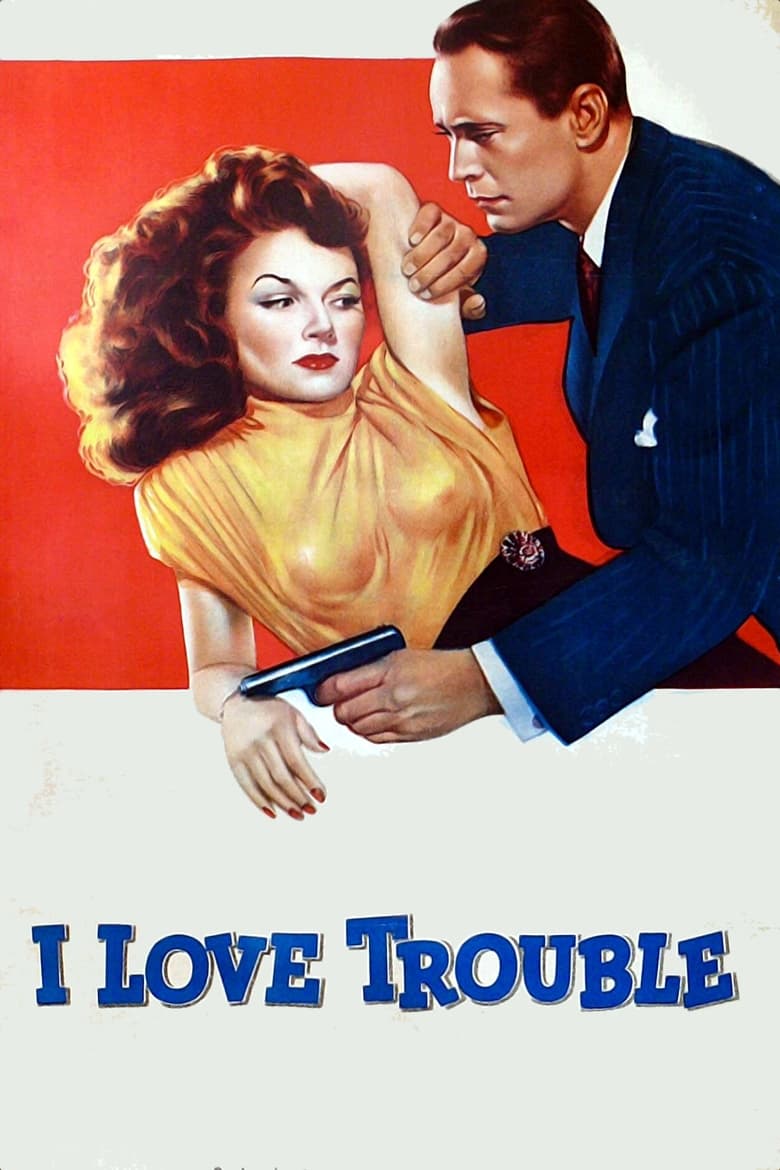
Stuart Bailey (Franchot Tone) is a Los Angeles private detective hired by Ralph Johnston (Tom Powers) to locate his first wife, a woman who has disappeared under circumstances Johnston declines to explain in full. Bailey is the kind of operative who works alone, talks too much, and trusts almost no one – qualities that serve him well once he begins pulling at the threads Johnston has handed him and finds that each one connects to something darker than a domestic matter.
The investigation draws Bailey into a web of women with interchangeable identities: Mrs. Caprillo, also known as Jane Breeger, also known as Janie Joy (Janis Carter), surfaces as a figure who has reinvented herself more than once and for reasons that carry a body count. Hazel Bixby (Glenda Farrell), a sharp-tongued acquaintance from Bailey's past, and the calculating Boots Nestor (Adele Jergens) add further layers of misdirection, while Norma Shannon (Janet Blair) complicates Bailey's judgment in ways he does not fully acknowledge. The case's geography expands from city offices to back-room dealings, and Johnston's own motives grow less sympathetic with each disclosure.
I Love Trouble operates within the wisecracking private-eye tradition codified by Raymond Chandler and Dashiell Hammett while tilting toward the more transactional, morally blurred terrain that defines mid-period noir. The film is less interested in the solution to its mystery than in the cost of pursuing it – the professional detachment Bailey performs and the human entanglements that undermine it at every turn.
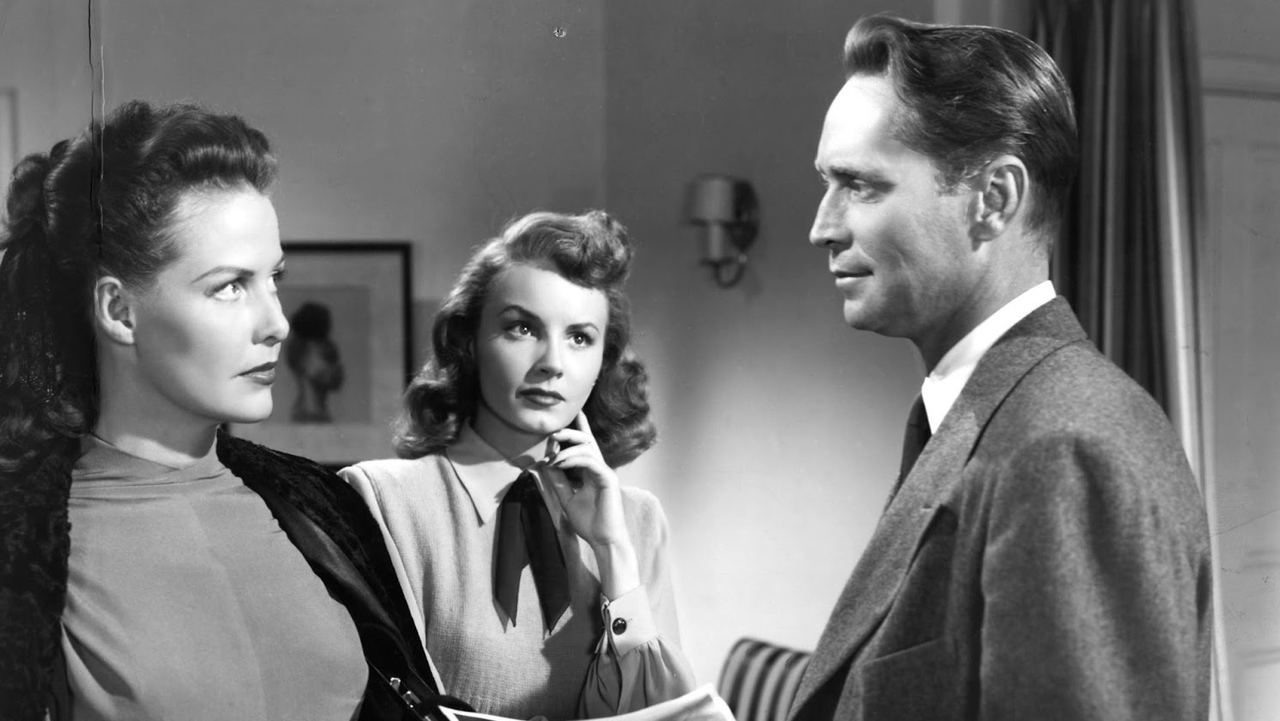
I Love Trouble arrives in the immediate postwar cycle of private-detective pictures riding the commercial wake of The Big Sleep and Murder, My Sweet, and it is honest enough to know its own position in that hierarchy. What S. Sylvan Simon and screenwriter Roy Huggins – adapting his own novel – bring to the material is a particular attention to female agency as obstruction and motivation simultaneously. The women in this film are not ornaments to Bailey's investigation; they are its architecture. Janis Carter's multi-aliased figure is the most fully realized of them, a woman whose identity is a professional instrument, and the film treats that fact with something approaching respect. Franchot Tone plays Bailey with an irony that never quite becomes detachment, and his performance keeps the film from sliding into the self-satisfied knowingness that afflicts lesser entries in the cycle. Charles Lawton Jr.'s cinematography gives the Los Angeles locations a functional darkness rather than an expressionist one, which suits a story more concerned with information than atmosphere. The film does not transcend its formula, but it works within it with precision.
– Classic Noir
The camera holds at a measured distance as Bailey corners Mrs. Caprillo in a hotel room that is furnished to suggest transit rather than habitation – a single lamp, venetian blinds cutting the window light into parallels across the wall behind her. Charles Lawton Jr. keeps the light source low and lateral, so that Carter's face is partially in shadow while Tone's remains readable, a compositional choice that assigns epistemological advantage to the audience rather than either character. The room's geometry is tight; the frame does not allow either figure room to move without acknowledging the other.
What the scene argues is that identity, in this film's world, is not a fixed property but a strategy, and that Bailey's habit of naming things – of pinning down aliases and addresses – is a form of power that the woman he is interrogating has practiced far longer than he has. She is not frightened. That absence of fear is the scene's real disclosure, and it repositions Bailey not as a man extracting the truth but as someone being managed, which colors every exchange that follows.
Charles Lawton Jr. photographs I Love Trouble in a style that might be called functional noir – shadows are deployed for psychological emphasis rather than decorative effect, and the Los Angeles settings are allowed to register as actual places rather than studio approximations of menace. Lawton favors a middle-focal-length lens that keeps faces and their immediate environments in equal focus, refusing the distortions of the wider angles that contemporaries such as John Alton were using to more flamboyant ends. Interior scenes use a high-contrast single-source setup that isolates characters within pools of light without pushing the image toward expressionist abstraction; the effect is of a world that is dark because darkness is operationally useful, not because the universe is indifferent. When the narrative requires spatial ambiguity – a corridor, a doorway, a room entered from the wrong angle – Lawton tightens the frame and lets shadow do the architectural work. The cinematography serves a story whose moral logic is procedural: truth is obscured not by fate but by people who have professional reasons to obscure it.
Tubi has carried mid-tier Columbia noir from this period and is the most likely free streaming option, though availability should be confirmed before viewing.
Archive.orgFreeIf the film has entered the public domain, Archive.org provides a no-cost streaming and download option, though print quality varies.
TCMBroadcast / Subscription (Max)TCM's rotation of late-1940s Columbia productions makes it a reliable source for a properly presented print with original aspect ratio.