Films People Pull a Fast One Night Beat Reading Room On TV Shop
G Men 1935
1935 First National Pictures
★★★☆☆ Notable
Film Noir · 83 minutes · Black & White

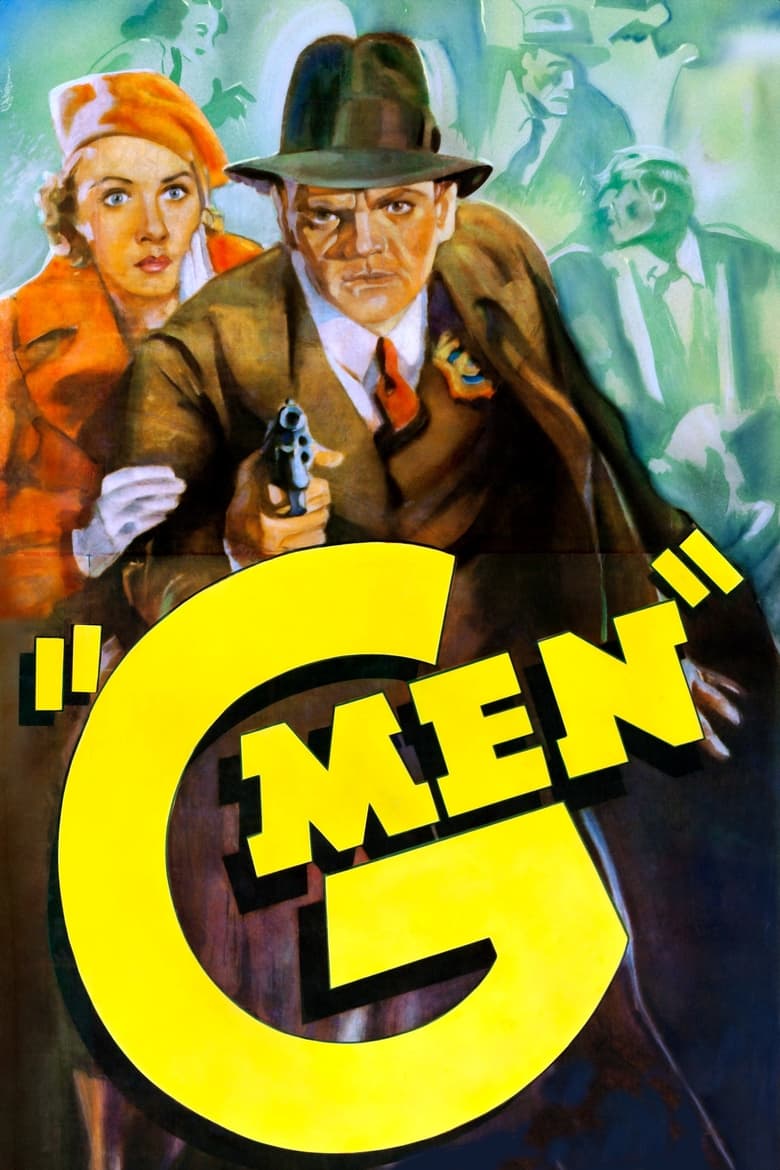
G Men

Directed by William Keighley
Year 1935
Runtime 83 min
Studio First National Pictures
TMDB 6.6 / 10
"A law degree bought with dirty money sends a man back to the streets he came from – this time carrying a badge."

James 'Brick' Davis grew up in a tenement neighborhood under the shadow of organized crime, his education financed by a local racketeer named McKay who saw something worth cultivating in the boy. Years later, Brick emerges as a lawyer with no clients and a restless conscience, and when a close friend – a federal agent – is killed in a gangland ambush, he enlists in the FBI under the sponsorship of veteran agent Jeff McCord. The bureau is shown as an institution under strain, outgunned and often outmaneuvered by syndicate operations that reach across state lines.

Brick's entry into federal law enforcement is complicated from the start by his origins. His loyalty to McKay's world and his obligation to the bureau pull against each other, while his relationships with two women – Jeff's sister Kay, steady and skeptical, and Jean Morgan, a nightclub singer entangled with the gang – trace the film's emotional fault lines. When Collins, a brutal syndicate enforcer played by Barton MacLane, escalates his campaign of murder and intimidation, the film presses Brick toward a reckoning that his background makes genuinely ambiguous.

G Men occupies an interesting transitional position in the Warner Bros. crime cycle, redirecting the familiar energy of the early gangster picture toward a nominally institutional framework without surrendering the street-level violence that defined the genre. The film asks whether the line between the lawman and the criminal is a matter of conviction or circumstance, and it never quite answers the question in the tidy terms its surface narrative seems to promise.

Classic Noir

G Men arrived at a moment when the Production Code had begun to constrain the outright celebration of criminal protagonists, and Warner Bros.' solution was pragmatic: put Cagney in a federal badge without materially altering the kinetic tempo of his earlier work. The gambit is transparent and largely effective. Cagney brings to Brick Davis the same coiled impatience he brought to Tom Powers in The Public Enemy, and the film's sympathies remain stubbornly personal rather than institutional – the FBI functions less as a moral framework than as a new arena for the same territorial violence. Director William Keighley moves the material efficiently, and Sol Polito's photography gives the studio-bound sequences a hard, credible texture. What the film inadvertently documents is the genre's ideological instability in 1935: the criminal energy had to go somewhere, and routing it through federal authority only displaced rather than resolved the underlying tensions the cycle had been exploring since the early sound era. Ann Dvorak's Jean Morgan, underdeveloped by the script, nonetheless carries traces of the more complex female figures that populated the pre-Code films, and her presence registers as a quiet remainder of what the new dispensation was suppressing.

– Classic Noir
3 ★★★☆☆ Notable
Credits

The Crew

DirectorWilliam Keighley
ScreenplaySeton I. Miller
CinematographySol Polito
MusicBernhard Kaun
EditingJack Killifer
Art DirectionJohn Hughes
CostumesOrry-Kelly
Performances

The Cast

Close Reading

The Signature Scene

G Men – scene
The Lakeside Ambush Headlights Through the Trees

Polito frames the sequence with the lake behind and dense treeline pressing in from both sides, reducing the road to a narrow corridor of exposure. Headlights cut the darkness in flat, hard beams rather than diffused pools, and the camera holds at a distance that makes the vehicles look small and isolated against the geography. When the shooting begins, the cuts are short and the angles low, placing the audience at ground level with the chaos rather than above it.

The scene crystallizes the film's central argument about institutional vulnerability. The bureau's agents are caught in open terrain with no cover and inadequate firepower, and the framing communicates this not through dialogue but through spatial pressure – too much dark space, too little margin. It is the sequence in which the film's procedural optimism is most openly contradicted by the visual evidence, and it gives Brick's subsequent drive toward confrontation an emotional logic that the script alone does not fully earn.

Visual Language

The Cinematography

🎞️
Sol Polito – Director of Photography

Sol Polito, who shot a significant share of Warner Bros.' most important crime productions through the thirties, brings to G Men a direct, functional visual intelligence suited to the material's pace. Working primarily on studio-built sets augmented by occasional location inserts, Polito uses hard-source lighting to anchor scenes in physical specificity – office interiors are lit from practical fixtures that leave the room's edges in compression, and nightclub sequences rely on footlights and overhead practicals that flatten the faces of singers while leaving the crowd murky and undifferentiated. There is little of the expressionist shadow-play that would come to define the postwar noir aesthetic; Polito's approach here is more in the tradition of the Warner crime picture, where clarity of action takes precedence over atmosphere. The lens choices favor a middle-range focal length that keeps several figures in the frame simultaneously, reinforcing the film's interest in group dynamics over individual interiority. Where shadow does appear – in the lakeside ambush and in the climactic pursuit – it functions instrumentally, marking the point at which institutional order gives way to something older and more personal.

In the Catalogue

Themes & Motifs

Availability

Where to Watch

Also in the Directory

See Also