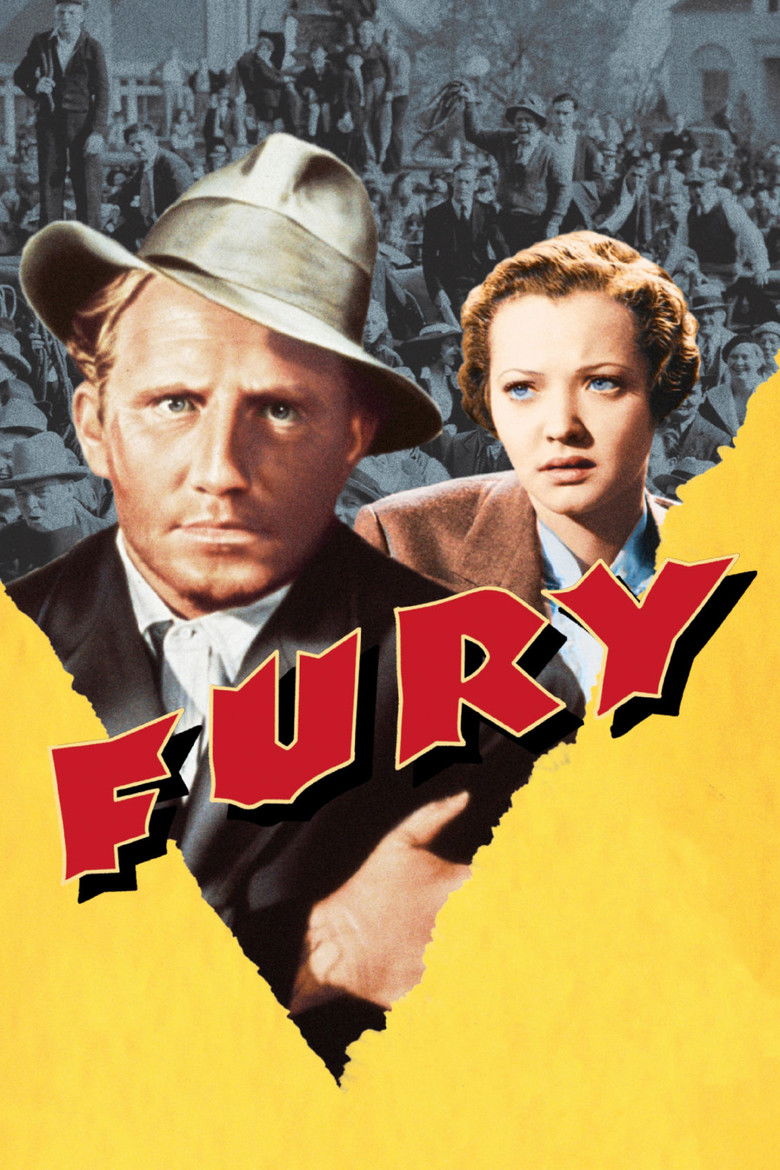
Joe Wilson (Spencer Tracy) is a working-class garage owner saving money to marry his fiancée Katherine Grant (Sylvia Sidney). While driving to meet her, he is detained in a small town on a flimsy suspicion of kidnapping. Before the law can establish his innocence, a mob gathers outside the county jail, whipped to a frenzy by rumor and crowd psychology, and burns the building to the ground.
Joe escapes, but the town believes him dead. His two brothers, Charlie and Tom, urge him to reveal himself and let justice proceed through the courts. Joe refuses. Consumed by what was done to him, he orchestrates a scheme to have the twenty-two ringleaders tried for murder – using newsreel footage of the riot as evidence – while remaining hidden and allowing the prosecution to proceed as though his death were an established fact. Katherine, who does not know he survived, is drawn into the trial's moral undertow.
Fury operates at the intersection of the social-problem film and the revenge narrative, a structure that allows Lang to interrogate not only mob violence but the corrosive interior damage that a legitimate grievance can inflict on the person who carries it. The courtroom becomes a theater of irony, and the film's final movement refuses to settle comfortably into either condemnation or exoneration.
Fritz Lang's first American film announces itself immediately as the work of a director who understood that Hollywood's genre machinery could carry serious moral freight. Fury is not simply an indictment of lynch mob violence – though it is that, with a documentary precision that made MGM uneasy – it is an examination of how victimhood can metabolize into something indistinguishable from the crime it suffered. Spencer Tracy gives one of the era's most controlled performances, tracking Joe Wilson's transformation from ordinary decency into a cold instrument of legal vengeance. Lang, fresh from Weimar Germany and acutely conscious of how collective hysteria functions, stages the riot sequence with a sociological coldness that implicates the audience in the crowd's excitement before punishing them for it. The film appeared three years before the Supreme Court's first significant federal anti-lynching debate and draws from documented American incidents, giving its genre scaffolding a historical weight that most studio pictures of the period could not or would not sustain. It remains one of the few Hollywood films of its decade to hold two moral positions simultaneously without flinching from either.
– Classic Noir
Lang and cinematographer Joseph Ruttenberg construct the riot sequence through an accumulation of discrete framings rather than a single sustained spectacle. Close-ups of individual faces in the crowd – women laughing, men shouting, a child perched on shoulders – are intercut with medium shots of the jail's exterior and reaction shots of Joe inside his cell. When the fire takes hold, Ruttenberg's camera holds on the barred window with the flames reflected in the glass, Joe's silhouette pressed against the iron while the crowd outside becomes a wall of light. The compositional choice is precise: the bars are never removed from the frame, and the fire that the mob intends as instrument of death becomes also a visual cage of their own making.
The sequence performs the film's central argument in purely visual terms. Joe is not shown as a passive martyr; his face registers fury before it registers fear, and Lang cuts away before we see him escape, preserving for a long stretch the crowd's – and the audience's – assumption that the worst has occurred. The scene establishes that the film's real subject is not the event itself but the residue it leaves in everyone who witnesses, participates in, or survives it.
Joseph Ruttenberg's work on Fury is defined by its refusal to aestheticize what it shows. Shooting primarily on MGM studio sets designed to evoke an anonymous Midwestern town, Ruttenberg employs flat, even lighting for the film's early domestic scenes – the ordinariness is deliberate, withholding any expressionist shadow that might signal threat before the narrative warrants it. As the mob forms, the lighting schema shifts incrementally: harder sources, deeper shadows cast by torchlight and practical fire elements, faces partially obscured by crowd geometry. The newsreel footage incorporated into the trial sequence introduces a deliberately rougher grain, an early and sophisticated use of mixed image texture to create legal and moral authenticity within a fiction film. Lang and Ruttenberg reserve the film's most conventionally noir compositions – oblique angles, high-contrast interiors – for the scenes in which Joe plans his revenge, visually aligning the survivor's scheming with the darkness he survived. The camera does not flatter his righteousness.
TCM holds deep MGM catalog rights and airs Fury periodically; the broadcast and streaming-via-Max version represents the most reliable licensed source for this title.
MaxSubscriptionAvailable through the TCM hub on Max, where MGM classic titles surface on rotation; availability may vary by region and period.
Archive.orgFreePublic domain status of this title is uncertain – verify before relying on Archive.org uploads, as some circulating copies are of compromised quality.