Films People Pull a Fast One Night Beat Reading Room On TV Shop
Fourteen Hours 1951
1951 20th Century Fox
★★★☆☆ Notable
Film Noir · 92 minutes · Black & White

Fourteen Hours

Directed by Henry Hathaway
Year 1951
Runtime 92 min
Studio 20th Century Fox
TMDB 7.3 / 10
"A man stands on a ledge, and the city watches itself unravel below."

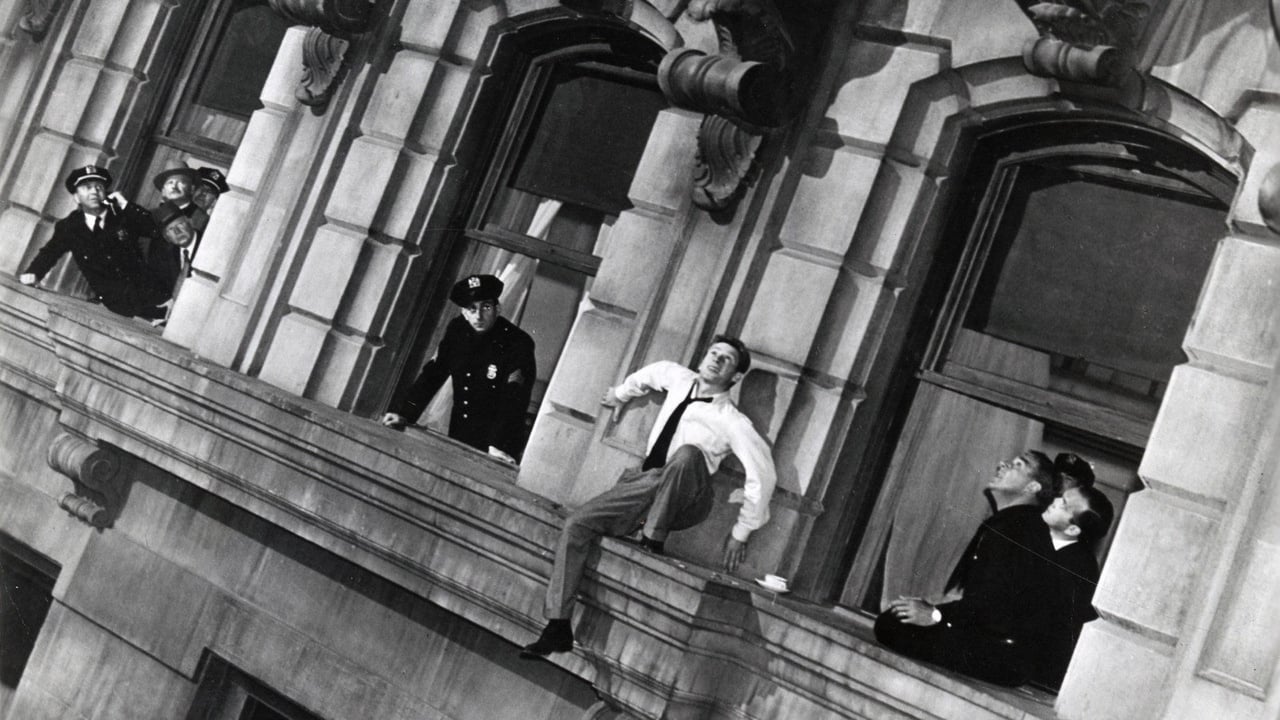
On a Manhattan morning, a young man named Robert Cosick steps out onto the ledge of a hotel window fifteen floors above the street. He refuses to come in. Patrolman Charlie Dunnigan, a plainspoken cop with no particular gift for psychology, is the first officer to reach him and becomes, by circumstance rather than design, the one man Cosick will speak to. As the hours pass and a crowd assembles on the pavement below, the city's emergency apparatus grinds into motion around a single, immovable fact: a disturbed man who has chosen a ledge over whatever waits inside.

Dunnigan works slowly, trading words with Cosick while psychiatrists, deputy chief Moskar, and a growing bureaucracy of officials press in from behind. Cosick's mother, Christine – cold, precise, domineering – arrives and her presence clarifies what drove her son to the window. His father, Paul, ineffectual and guilty, offers a different kind of damage. On the street, life continues in strange counterpoint: a young woman named Virginia Foster watches from a nearby office and finds herself reconsidering her own stalled engagement, while Ruth, a stranger in the crowd, is drawn into the vigil in ways she cannot explain.

Fourteen Hours operates at the intersection of the procedural and the psychological, using the physical fact of the ledge as a means of excavating the private failures that precede public crisis. The film belongs to a cycle of postwar American pictures that locate catastrophe not in crime or violence but in the ordinary pressures of family, ambition, and emotional suppression. It asks, without sentimentality, what a city owes the individual standing at its edge.
Classic Noir

Fourteen Hours occupies an instructive position within the Fox semi-documentary cycle that Hathaway had been refining since Call Northside 777. The film is drawn from a real 1938 incident – John Warde's fatal stand on the Gotham Hotel ledge – and Hathaway treats the material with the same fidelity to physical detail and urban texture that marks his best work of the period. What separates it from the procedural mainstream is its psychological seriousness: the ledge is less a crime scene than a symptom, and the film spends its considerable running time diagnosing the domestic conditions that produced it. Agnes Moorehead's performance as the mother is the film's darkest and most precisely rendered element, a portrait of maternal control delivered without a single overplayed note. Paul Douglas provides ballast as Dunnigan, a man who succeeds not through insight but through patience and decency. Seen now, the film reads as an unusually candid document of postwar anxiety about conformity, parental authority, and the limits of the therapeutic state. It does not entirely escape the genre's tendency toward resolution, but it earns its ambiguities.

– Classic Noir
3 ★★★☆☆ Notable
Credits

The Crew

DirectorHenry Hathaway
ScreenplayJohn Paxton
CinematographyJoseph MacDonald
MusicAlfred Newman
EditingDorothy Spencer
Art DirectionLeland Fuller
CostumesEdward Stevenson
ProducerSol C. Siegel
Performances

The Cast

Close Reading

The Signature Scene

Fourteen Hours – scene
The Hotel Ledge, Mid-Afternoon The Ledge and the Drop

MacDonald shoots the ledge sequences with a vertical logic that refuses comfort. The camera positions itself at angles that emphasize the sheer face of the building rather than the street below, so the drop is felt as absence rather than spectacle. Cosick is pressed against stone and sky, the frame giving him neither room nor exit. When Dunnigan leans out the window to talk, the composition places the two men in a diagonal tension – one man grounded, one man suspended – with the city's geometry cutting across the background as an indifferent grid.

The scene's argument is about what connection costs. Dunnigan has no professional authority over Cosick, no leverage, no therapeutic training; he has only persistence and the willingness to occupy the same uncomfortable space. The camera's refusal to cut away from Cosick's face during these exchanges turns the ledge into a confessional, and what is confessed is not crime but the simpler, more damaging truth that no one in his life has spoken to him without an agenda. Dunnigan, for one afternoon, is the exception.

Visual Language

The Cinematography

🎞️
Joseph MacDonald – Director of Photography

Joseph MacDonald's work on Fourteen Hours extends the semi-documentary aesthetic he had developed alongside Hathaway on Call Northside 777, but the constraints of a single location push him toward a more pressurized visual grammar. Shooting on location in New York as well as on constructed Fox sets, MacDonald uses the architecture of the hotel facade to generate depth and dread – long lenses compress the space between Cosick and the crowd below, collapsing the distance into something claustrophobic rather than vertiginous. Interior lighting in the hotel room is kept deliberately flat and institutional, the light arriving from practical sources that emphasize the room's failure to hold anyone. On the street, MacDonald opens the aperture to the chaotic ambient light of a New York crowd scene, creating a visual contrast between the controlled geometry of the ledge and the formless energy beneath it. The cinematography's moral logic is consistent: clarity belongs to the ledge, where everything is exposed; the street and the family scenes are darker, more cluttered, harder to read.

In the Catalogue

Themes & Motifs

Availability

Where to Watch

Also in the Directory

See Also