Films People Pull a Fast One Night Beat Reading Room On TV Shop
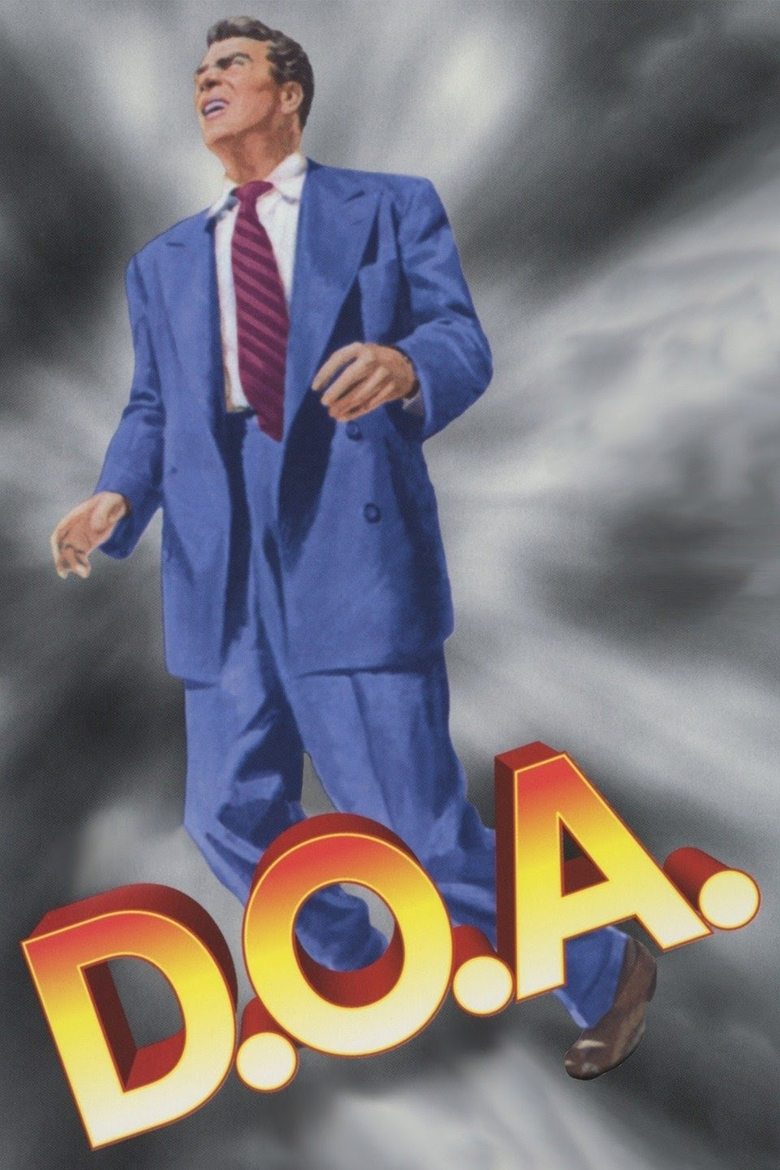
D.O.A. 1949
1949 Cardinal Pictures
★★★★☆ Recommended
Film Noir · 83 minutes · Black & White

D.O.A.

Directed by Rudolph Maté
Year 1949
Runtime 83 min
Studio Cardinal Pictures
TMDB 6.9 / 10
"A man walks into a police station to report his own murder."

Frank Bigelow, a small-town notary public from Banning, California, arrives at a San Francisco homicide bureau and informs the detectives on duty that he wants to report a murder – his own. What follows is an extended flashback that reconstructs the final days of a man already condemned. Bigelow had come to San Francisco alone, partly to escape the quiet domestic pressure of his devoted secretary Paula Gibson, and partly out of an undefined restlessness. Within hours of arriving, he finds himself drawn into the jazz-saturated nightlife of the city, and by the following morning a physician delivers the verdict: Bigelow has ingested a luminous poison for which there is no antidote. He has, at most, a few days to live.

Bigelow retraces his movements with mounting desperation, attempting to identify who poisoned him and why. The trail leads back to a iridium shipment he had unwittingly notarized, a transaction connecting a dead man named Philips to a syndicate operation controlled by the cold, precisely mannered Majak. Around this central axis rotate several figures whose loyalties remain opaque – Halliday, a smooth intermediary; Mrs. Philips, a widow with her own interest in suppressing the truth; and Chester, Majak's enforcer, whose menace is barely contained. Bigelow pursues the case with the furious energy of a man who has nothing left to protect except the fact of his own death.

D.O.A. is structured as one long inquest, a form that places the question of guilt ahead of any possibility of survival. The film belongs to the postwar cycle of noirs in which ordinary men find themselves overtaken by forces larger and more institutional than personal passion or greed. Rudolph Maté, working from a script by Russell Rouse and Clarence Greene, strips the genre down to its logical extreme: the investigation is not a search for justice but a dying man's effort to give his death a name.
Classic Noir

D.O.A. achieves something few noirs attempt with such structural rigor: it removes suspense about the protagonist's fate entirely and redirects that energy toward causality. Edmond O'Brien's performance carries the film's central tension, not through charm or cunning but through a kind of bewildered animal persistence. The film was made at a specific postwar moment when bureaucratic institutions – the notary, the pharmaceutical syndicate, the impersonal machinery of commerce – had become plausible sources of anonymous death, and Maté exploits that anxiety without sentimentalizing it. The script's tight economy prevents the picture from becoming an exercise in gimmickry; the framing device is earned rather than merely clever. Where the film is weakest is in its romantic subplot, which Paula Gibson represents with more script function than dramatic weight. But as a study in the noir proposition that guilt and innocence are categories that outlast the bodies they attach to, D.O.A. remains one of the period's more disciplined achievements.

– Classic Noir
4 ★★★★☆ Recommended
Credits

The Crew

DirectorRudolph Maté
ScreenplayRussell Rouse
CinematographyErnest Laszlo
MusicDimitri Tiomkin
EditingArthur H. Nadel
Art DirectionDuncan Cramer
CostumesMaria P. Donovan
ProducerLeo C. Popkin
Performances

The Cast

Close Reading

The Signature Scene

D.O.A. – scene
The Jazz Club Pursuit Luminous Poison on the Bar

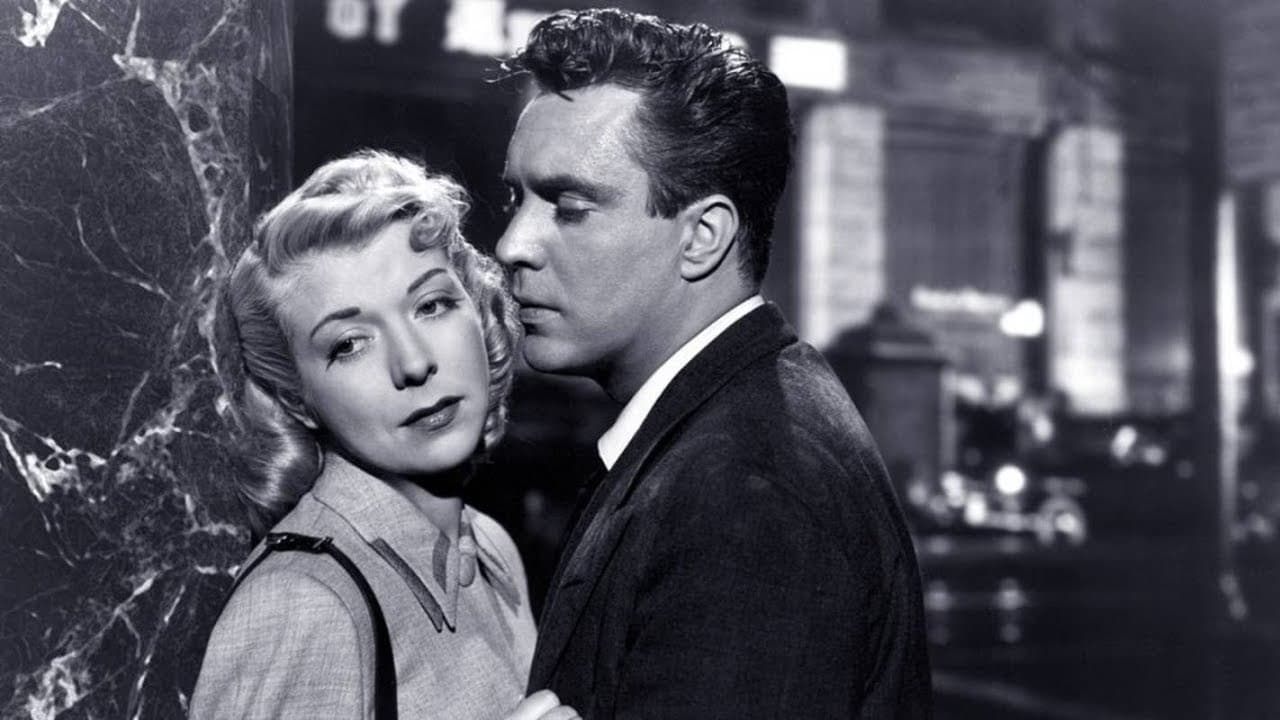
In the sequence at the Fisherman, the jive club where Bigelow spends his first San Francisco evening, Ernest Laszlo's camera works in tight, destabilizing cuts, the frame crowded with bodies and cigarette smoke, light sources fractured across brass instruments and wet glass surfaces. When an unknown figure substitutes one drink for another, Laszlo holds the moment in a medium shot of unremarkable banality – there is no expressionist distortion, no shadow thrown across the act. The poison enters the frame looking exactly like everything else.

The scene's understated visual grammar is the argument. Bigelow does not recognize the moment that kills him because it presents itself as ordinary pleasure. This is the film's central claim rendered in pure staging: in the postwar world, lethal contingency arrives without ceremony, disguised as a night out. The subsequent medical scene, where a doctor describes luminous poison with clinical detachment, gains all of its horror from this contrast.

Visual Language

The Cinematography

🎞️
Ernest Laszlo – Director of Photography

Ernest Laszlo shoots D.O.A. with a deliberate tension between two registers. The San Francisco location footage – Powell Street, the waterfront, Bunker Hill in Los Angeles standing in for other interiors – carries the rough grain and spatial openness of semi-documentary work, a style Laszlo had developed on Port of New York and which suited the postwar vogue for procedural realism. Against this, the studio sequences deploy harder, more conventional noir lighting, with shadow cutting across faces at angles that signal moral entrapment. The effect is a slow constriction: as Bigelow moves from the open city into the closed world of the syndicate, the image itself tightens. Laszlo uses wide-angle lenses to make corridors and hotel rooms feel both larger and more inescapable, and he consistently places Bigelow in frames where the exits are visible but the path to them is blocked by figures or shadow. The visual language enacts the plot's logic of a man who can see exactly where he needs to go and cannot get there in time.

In the Catalogue

Themes & Motifs

Availability

Where to Watch

Also in the Directory

See Also