Films People Pull a Fast One Night Beat Reading Room On TV Shop
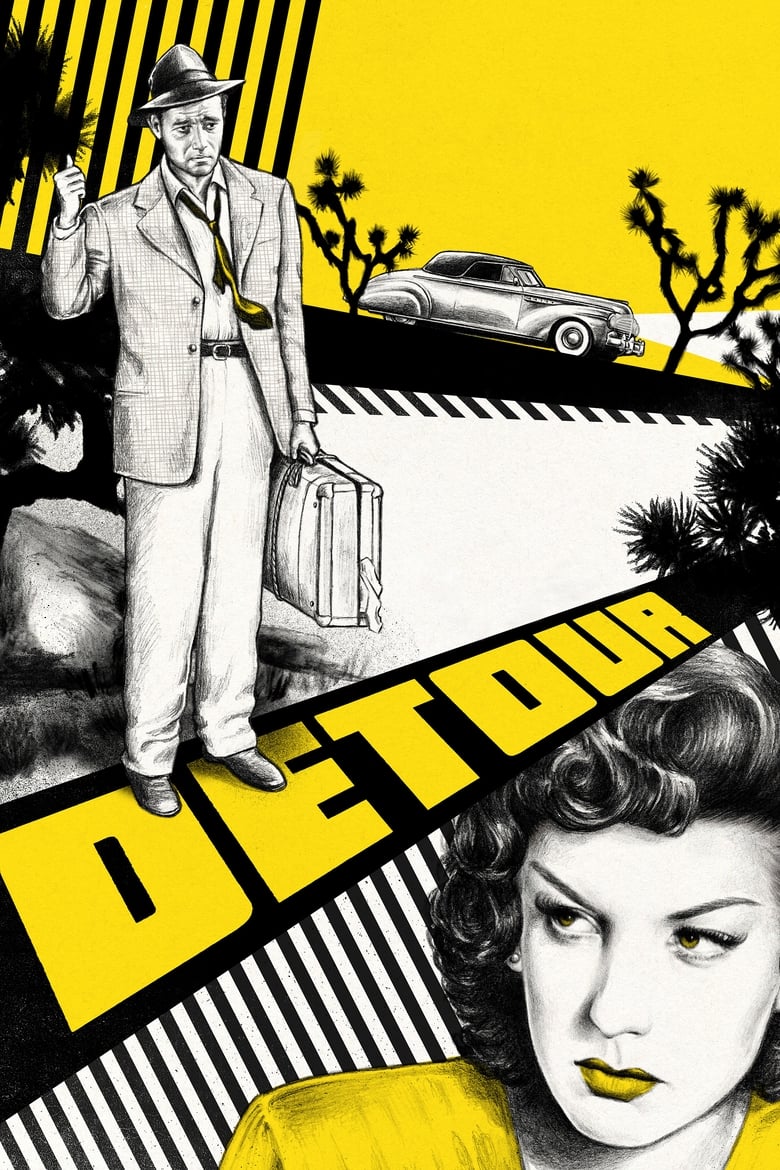
Detour 1945
1945 PRC
★★★☆☆ Notable
Film Noir · 68 minutes · Black & White

Detour

Directed by Edgar G. Ulmer
Year 1945
Runtime 68 min
Studio PRC
TMDB 7.2 / 10
"A man on the road learns that luck, in this world, runs only one direction."

Al Roberts is a piano player in a New York nightclub, unremarkable in every respect except his certainty that fate has singled him out for punishment. When his girlfriend Sue Harvey heads west to try her luck in Hollywood, Al eventually follows, hitchhiking across the country with little money and less hope. Outside Arizona, he catches a ride with Charles Haskell Jr., a garrulous drifter with scratch marks on his hand and a story he is not eager to tell.

Haskell dies under ambiguous circumstances during the drive, and Al, convinced no one will believe his account, assumes the dead man's identity and takes his car. The decision locks Al into a trap he cannot think his way out of. When he picks up Vera – a woman who knew Haskell and recognizes the car – the film's already narrow margins close further. Vera is not interested in Al's explanations. She holds his secret and intends to use it, steering the two of them toward a scheme that suits her purposes alone.

Detour belongs to the lowest rung of the noir world, a place where ambition has long since curdled into grievance and where the femme fatale operates not from glamour but from sheer economic desperation. The film compresses the genre's fatalism to its barest elements: a weak man, a dangerous woman, a dead man's name, and a highway that leads nowhere redemptive.
Classic Noir

Shot in six days on a budget that precluded almost every conventional resource, Detour has accumulated a reputation that far exceeds its production circumstances. Edgar G. Ulmer works within the constraints of PRC's Poverty Row operation not by disguising them but by converting them into a visual and psychological argument. The film's claustrophobia is structural: rear-projection doubles for the open road, a handful of sets stand in for a continent, and Tom Neal's flat, inward performance reads less as limitation than as the correct register for a man who has already surrendered to his own narrative. Ann Savage's Vera remains one of the genre's sharpest portraits of desperation weaponized into aggression – a woman who has nothing but leverage and applies it without sentimentality. As a document of 1945 America, the film captures an undercurrent of postwar anxiety before the war had technically ended: the sense that mobility promises nothing, that identity is fungible, and that the machinery of fate operates independently of moral desert.

– Classic Noir
3 ★★★☆☆ Notable
Credits

The Crew

DirectorEdgar G. Ulmer
ScreenplayMartin Goldsmith
CinematographyBenjamin H. Kline
MusicLeo Erdody
EditingGeorge McGuire
Art DirectionEdward C. Jewell
ProducerLeon Fromkess
Performances

The Cast

Close Reading

The Signature Scene

Detour – scene
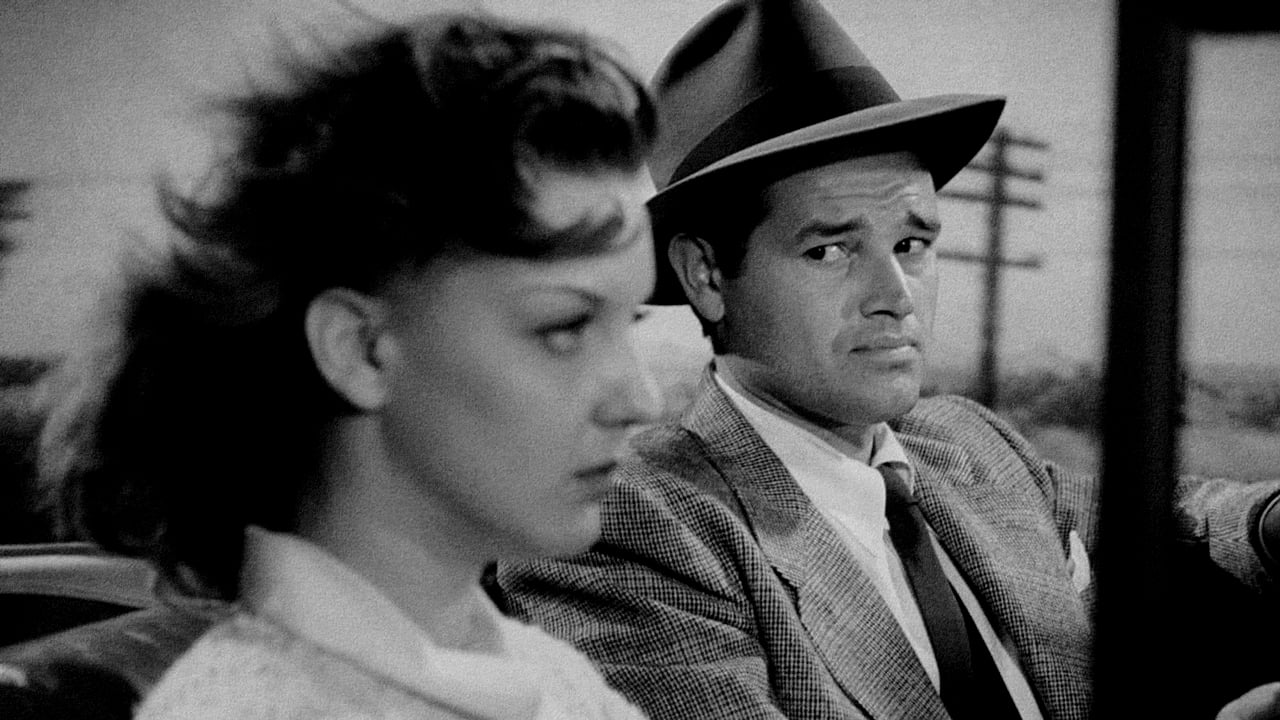
The Roadside Pickup Vera Steps Into the Car

Ulmer and cinematographer Benjamin H. Kline frame Vera's entrance with a minimum of ceremony that makes it more unsettling than any dramatic flourish could. Al pulls over; Vera opens the door; the camera holds on her face in a tight two-shot as she settles into the passenger seat. The lighting is flat and unforgiving, sourced from a hard key with no visible fill, pressing every line of fatigue into her features. The rear-projection highway scrolls indifferently behind them. There is no atmospheric shadow play here – only a face in bright, merciless light.

The scene's argument is entirely about knowledge and the transfer of power. The moment Vera speaks Haskell's name, the film's geometry shifts permanently. Al has been narrating his own victimhood in voiceover; Vera's arrival exposes the voiceover as self-serving fiction. She is not cruel by temperament but by calculation, and the scene establishes that her calculation is sounder than his. From this point the film belongs to her, not to him, and the lighting – refusing to flatter either of them – confirms that no one in this car is going to come out ahead.

Visual Language

The Cinematography

🎞️
Benjamin H. Kline – Director of Photography

Benjamin H. Kline's work on Detour is a study in doing the necessary and nothing more, which, given the budget, was the only available approach – and which turns out to be exactly right for the material. Shooting on studio interiors with minimal equipment, Kline relies on hard single-source lighting that eliminates the expressionist shadow geometry common to better-funded noir productions. The effect is not darkness but a kind of bleached exposure, as though the characters are too small and too ordinary to merit atmosphere. Rear projection, standard practice at PRC, becomes under Kline's handling a visual correlative for Al's unreliable narration: the world scrolling behind the windshield is obviously artificial, and the film makes no effort to disguise this. The lens choices favor close and medium framings that deny the road any romantic scale. What Kline achieves, within severe constraints, is a visual language in which poverty of means reinforces the film's moral logic: there is no escape, no depth of field worth pursuing, no horizon that amounts to anything.

In the Catalogue

Themes & Motifs

Availability

Where to Watch

Also in the Directory

See Also