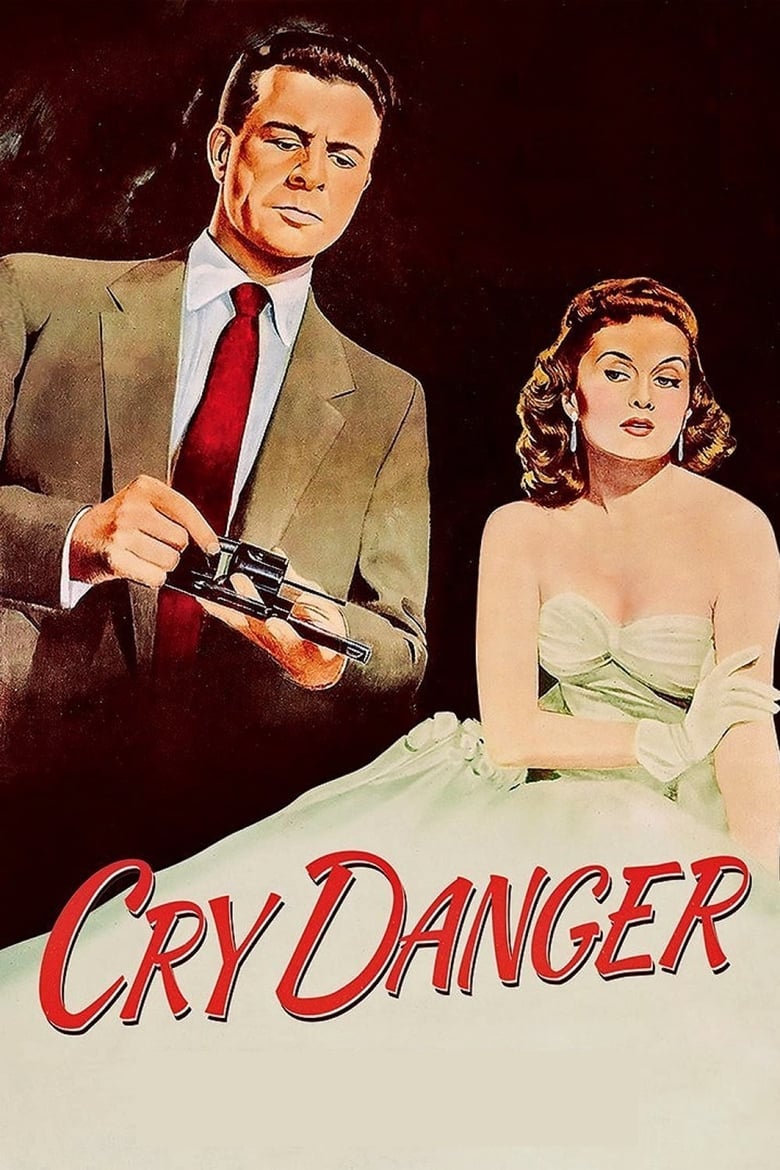
Rocky Mulloy (Dick Powell) walks out of San Quentin after serving five years for a robbery and murder he insists he did not commit. His alibi arrives late, in the form of a one-legged carnival veteran named Delong (Richard Erdman), whose account is thin enough to raise suspicions even as it secures Rocky's release. Rocky returns to Los Angeles with two things on his mind: finding the $100,000 from the original job and clearing his name permanently. He locates Nancy Morgan (Rhonda Fleming), the wife of his still-imprisoned partner, living in a trailer court and surviving on what little the neighborhood affords. The attraction between them is immediate and compromised from the start.
Rocky begins pressing the local machinery – a racketeer named Louie Castro (William Conrad) and a tame police detective, Gus Cobb (Regis Toomey) – looking for the man who actually committed the crime and pocketed the money. Delong, proving more liability than asset, attaches himself to Darlene (Jean Porter), a sharp-tongued woman from the same trailer park, while Rocky maneuvers through threats and evasions. Allegiances shift under pressure: Nancy's loyalties are divided between a husband in prison and a man from that husband's past, and the missing money exerts its own gravitational pull on nearly everyone Rocky trusts.
Cry Danger belongs to the cycle of postwar noirs built around the wrongly convicted man who returns from confinement to find the world has rearranged itself in his absence. It shares that preoccupation with institutional failure – the law convicts the wrong man, releases him imperfectly, and offers no restoration. Powell, who had already reshaped his screen identity with Murder, My Sweet seven years earlier, carries Rocky with a worn-down wariness that suits the material: a man who has already been through the worst the system can do and expects no favors from what follows.
Robert Parrish's feature debut is a compact, efficient piece of work that earns its place in the noir canon not through stylistic excess but through discipline. At 79 minutes, the film wastes nothing. Powell's performance is notable for what it withholds: Rocky Mulloy is not a romantic protagonist hunting justice, but a pragmatic man working a limited set of options. William Conrad, so often cast as blunt muscle, brings unusual texture to Castro – menacing without theatrics. The film's moral architecture is characteristically noir in its refusal to distinguish cleanly between the guilty and the exonerated. Rocky's freedom is a technicality, and Parrish keeps that instability in frame throughout. Rhonda Fleming is used more carefully here than in much of her genre work, the script allowing Nancy a conflict of loyalty that is genuinely unresolved rather than decorative. Cry Danger is a film that trusts economy over elaboration, and the result holds up as a precise document of a cycle at the height of its formal confidence.
– Classic Noir
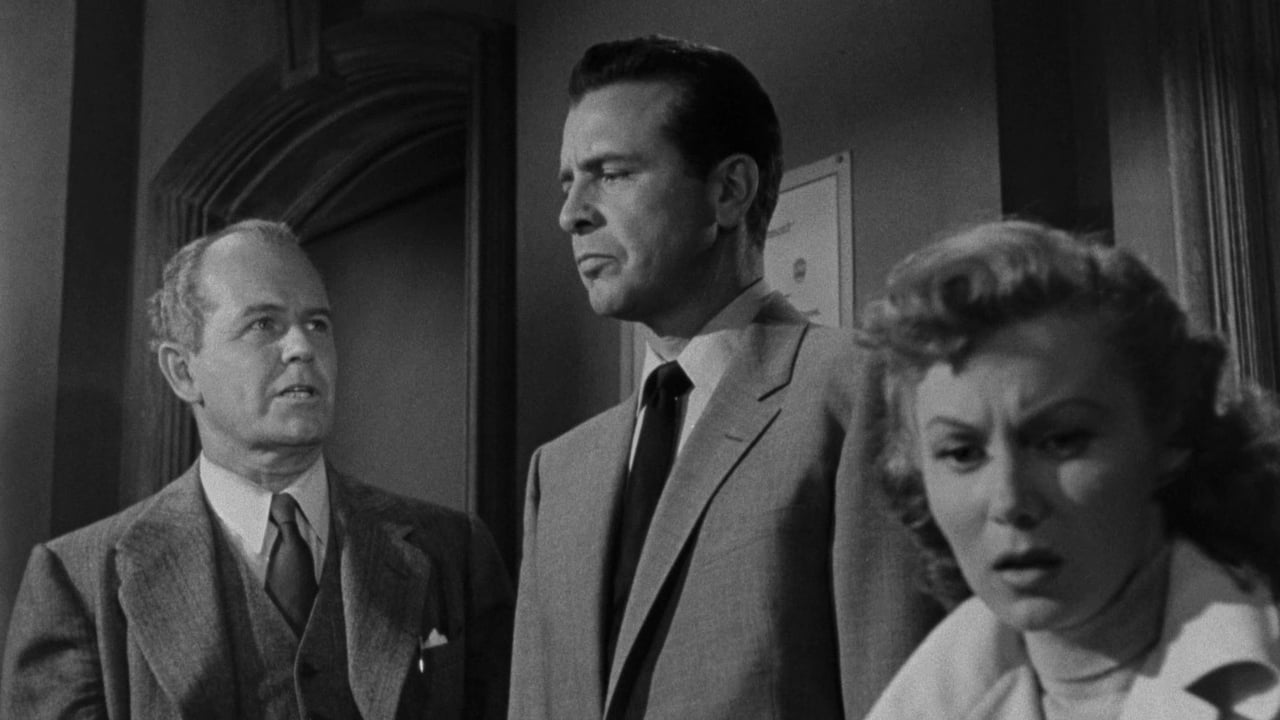
Biroc frames the scene at a low angle, making Conrad's Castro fill the narrow trailer doorway and compress the already cramped interior space. Light enters from a single practical source behind him, throwing his face into partial shadow and reducing Powell's Rocky to a figure caught in a pocket of dim, flat illumination. The geometry of the space – thin walls, low ceiling, furniture crowding the edges – leaves no room for movement, which is the point. The camera holds on medium shots rather than cutting to close-ups, preserving the physical dynamic rather than releasing tension through editing.
What the scene establishes is the difference between freedom and safety. Rocky is out of prison but he is not free: the trailer is another enclosure, Castro another authority with the power to foreclose options. The blocking makes this argument spatially – there is nowhere for Rocky to go, and Biroc's lens records that fact without commentary. The confrontation ends without violence, which is its own kind of threat, and the sustained low-key lighting refuses to resolve into anything that might read as relief.
Joseph F. Biroc shoots Cry Danger with the controlled economy the film demands, working largely on location around the Los Angeles trailer courts and streets that give the production its texture of unglamorous authenticity. Biroc favors tight compositions that exploit the constriction of real spaces – low ceilings and narrow doorways do work that a studio set would have to manufacture artificially. His lighting setups lean on a single dominant source, usually positioned to keep one face illuminated and the other in graduated shadow, enforcing the film's consistent visual argument that nobody in this story is fully visible or fully known. He avoids the expressionist extremes of high-contrast chiaroscuro that mark some contemporaries, preferring a grayer, flatter register that suits a narrative about institutional failure rather than individual doom. The night exteriors are handled with restraint: neon and streetlight provide motivation without becoming ornamental. Biroc's work here anticipates the location-heavy visual grammar he would develop across a long career, and it serves Parrish's spare, unsentimental approach precisely.
Cry Danger has circulated on Tubi as part of its public-domain noir holdings; picture quality varies but the film is complete and the price is right.
Archive.orgFreeMultiple transfers are available for streaming or download; check upload dates for the cleanest available source.
Amazon Prime VideoSubscriptionAvailability shifts with licensing cycles – confirm current status before seeking it here, as the title moves in and out of the catalog.