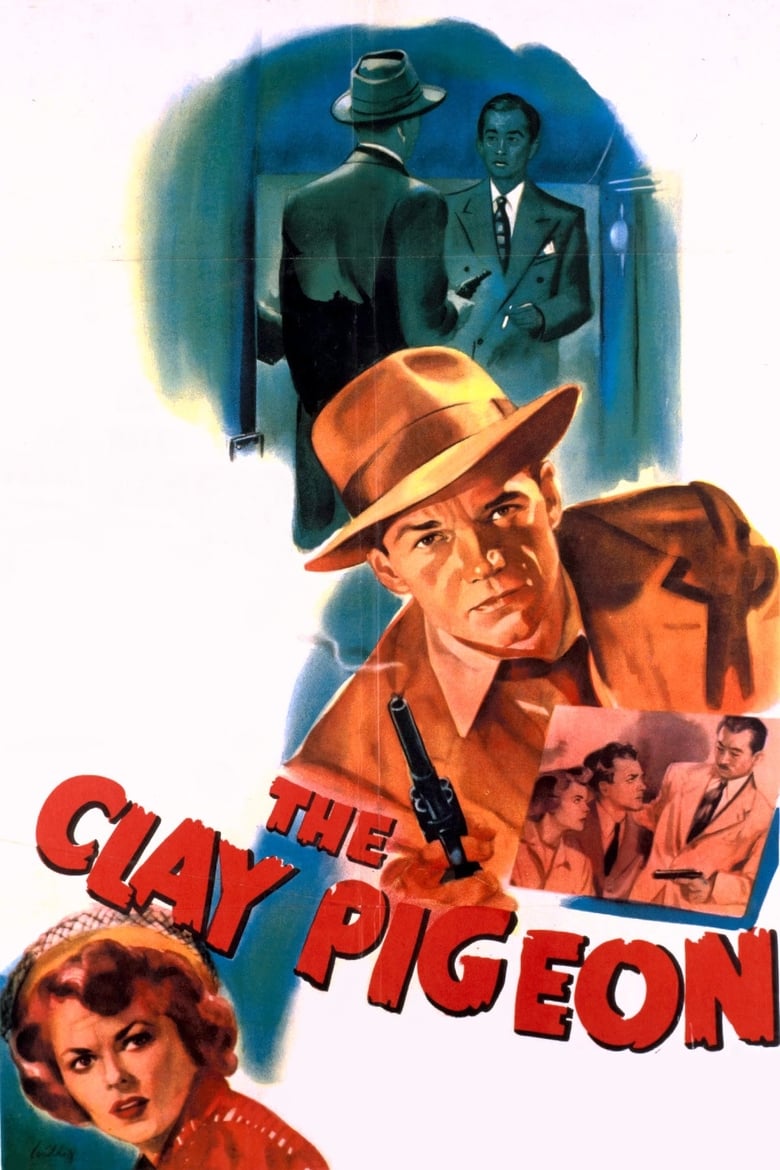
Navy veteran Jim Fletcher wakes in a military hospital with no memory of the past two years. The doctors inform him that he has been unconscious since a Japanese POW camp, but the Navy has other news: he is to be court-martialed for treason, accused of betraying fellow prisoners to the enemy, a betrayal that cost lives. Fletcher remembers nothing that could condemn or exonerate him, and the institutional machinery of military justice moves indifferently around his bewilderment.
Before the court-martial can proceed, Fletcher escapes the hospital and seeks out Martha Gregory, the widow of the man he allegedly betrayed. Rather than the hostility he expects, Martha becomes an uneasy ally, and the two trace a thread of evidence back toward Ken Tokoyama, a Japanese-American whose wartime loyalties remain ambiguous, and toward a black-market racket that offers a more earthly motive for the accusations against Fletcher than ideology ever could.
Clay Pigeon operates as a tight procedural dressed in the anxieties of the postwar moment – the returning veteran whose reliability is in question, the institutions that judge before they understand, and the civilian world that has reorganized itself in his absence. Richard Fleischer keeps the film lean and purposeful, using its sixty-three minutes to argue that guilt is a commodity as easily manufactured as innocence is difficult to prove.
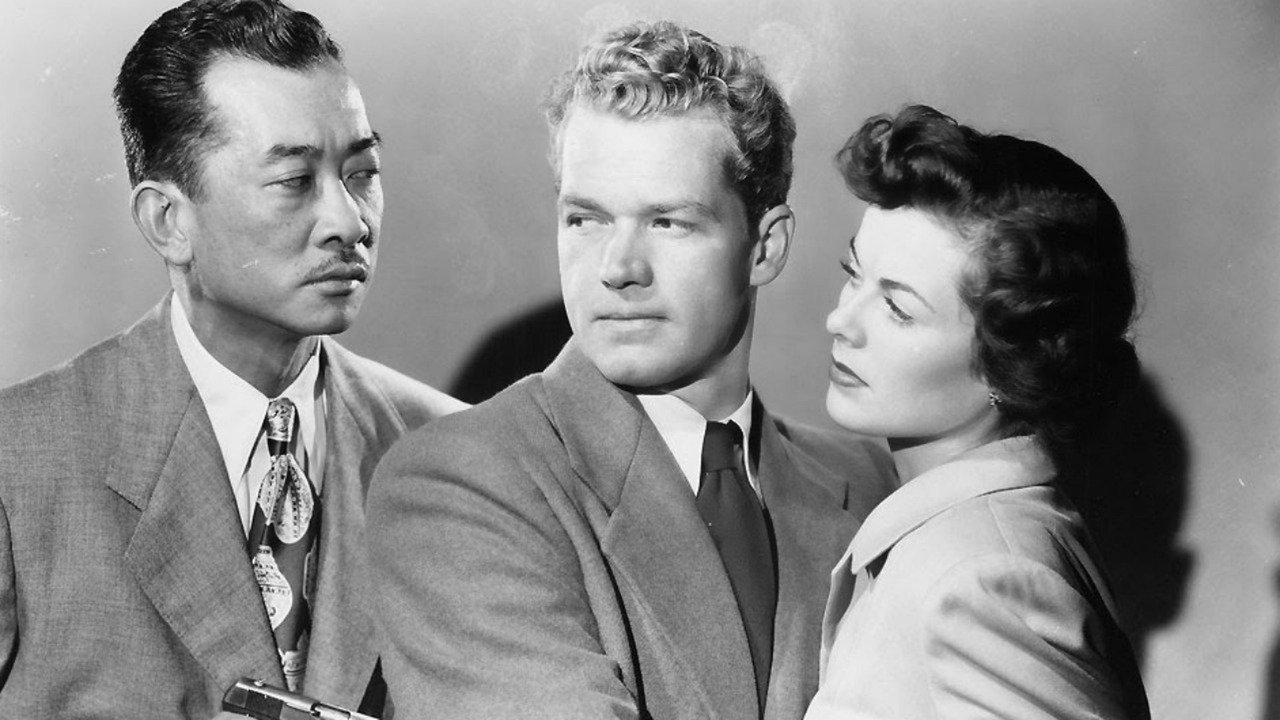
Clay Pigeon arrives the same year Fleischer made Follow Me Quietly, and both films demonstrate his facility with low-budget economy – the ability to generate genuine unease from restricted means and compressed time. The film belongs to a recognizable postwar subgenre in which the returned soldier discovers that the home front has its own battlefields, and that the bureaucratic machinery of the military is as indifferent to individual truth as the enemy ever was. Bill Williams gives Fletcher a convincing blankness that serves the amnesia premise without tipping into passivity; his confusion is functional rather than sentimental. What distinguishes the film within the RKO B-picture context is its willingness to place a Japanese-American character – Tokoyama, played by Richard Loo – at the moral center of its resolution, a choice that carries weight in 1949, four years after internment. The film does not fully reckon with that history, but its presence registers. Robert De Grasse's photography keeps the film from settling into flatness, and Sawtell's score stays out of the way. A compact, honest minor work.
– Classic Noir
De Grasse frames the sequence in tight medium shots that push the actors against industrial backgrounds – corrugated walls, stacked crates, water that catches no light. The key source is a single overhead lamp that throws hard shadows downward, carving the faces of both men into planes of clarity and obscurity in roughly equal proportion. The camera stays close enough that spatial disorientation becomes the viewer's condition as much as Fletcher's.
The scene distills the film's central argument: that identity under duress becomes provisional, that a man's guilt or innocence depends entirely on who controls the light. Fletcher is not the only one exposed here – the composition implicates his interlocutor with equal shadow, suggesting that moral culpability in this world is not the property of any single figure but is distributed across a system that rewards accusation and punishes uncertainty.
Robert De Grasse, who had shot some of RKO's more accomplished B-pictures through the 1940s, brings a disciplined economy to Clay Pigeon that suits both the budget and the material. Working predominantly on studio sets dressed to suggest Los Angeles exteriors and military interiors, De Grasse relies on high-contrast lighting with a single dominant source in many scenes, a setup that keeps costs low while generating the moral chiaroscuro the story requires. His lens choices favor the middle range – nothing wide enough to open the frame into comfort, nothing long enough to flatten it into abstraction. The result is a visual world that feels slightly compressed, slightly airless, which is precisely the psychological condition the film wants to induce. Shadow work is functional rather than decorative: darkness falls on characters at moments of moral ambiguity and lifts only when the narrative has settled a point of truth. It is cinematography in service of argument rather than atmosphere, and De Grasse executes it with quiet confidence.
Tubi has carried a number of RKO B-pictures from this period and is the most likely free option for domestic viewers, though availability shifts; verify before visiting.
Archive.orgFreeAs a 1949 RKO production whose copyright status warrants checking, Archive.org may host a public domain print – quality varies but access is immediate and free.
Amazon Prime VideoRental / PurchaseA digital rental or purchase is likely available through Prime Video's classic film catalogue, offering a more stable option than public domain streams.