In the labyrinthine Casbah district of Algiers, Pepe Le Moko lives as a king among thieves. Wanted by French authorities for crimes committed across Europe, he cannot leave the quarter's tangle of alleys and rooftops without facing arrest. His world is managed by the calculating informer Slimane, who waits with patient menace for Pepe to make the mistake that will deliver him, and sustained by the loyalty of his lieutenant Louvain and the devotion of Inez, the local woman who loves him without reservation.
The arrival of Gaby, a Parisian tourist of cool beauty and expensive jewelry, disturbs the equilibrium Pepe has constructed. She represents everything the Casbah cannot offer – the boulevards, the cafés, the Paris he left behind – and his obsession with her begins to corrode his judgment. Omar, a street-level operator, senses opportunity in Pepe's distraction, while Slimane, ever watchful, recognizes that a man in love is a man who can be moved. Inez understands the shift in Pepe's attention and is left to choose between loyalty and self-preservation.
Casbah is the third American retelling of the Pépé le Moko story, this time rendered as a musical with songs by Harold Arlen, a decision that softens the material's fatalism without entirely neutralizing it. The film sits at the intersection of the exotic-locale thriller and the noir of entrapment – a man defined not by what he pursues but by what he cannot escape, and by the particular cruelty of desire arriving precisely when it can do nothing but destroy.
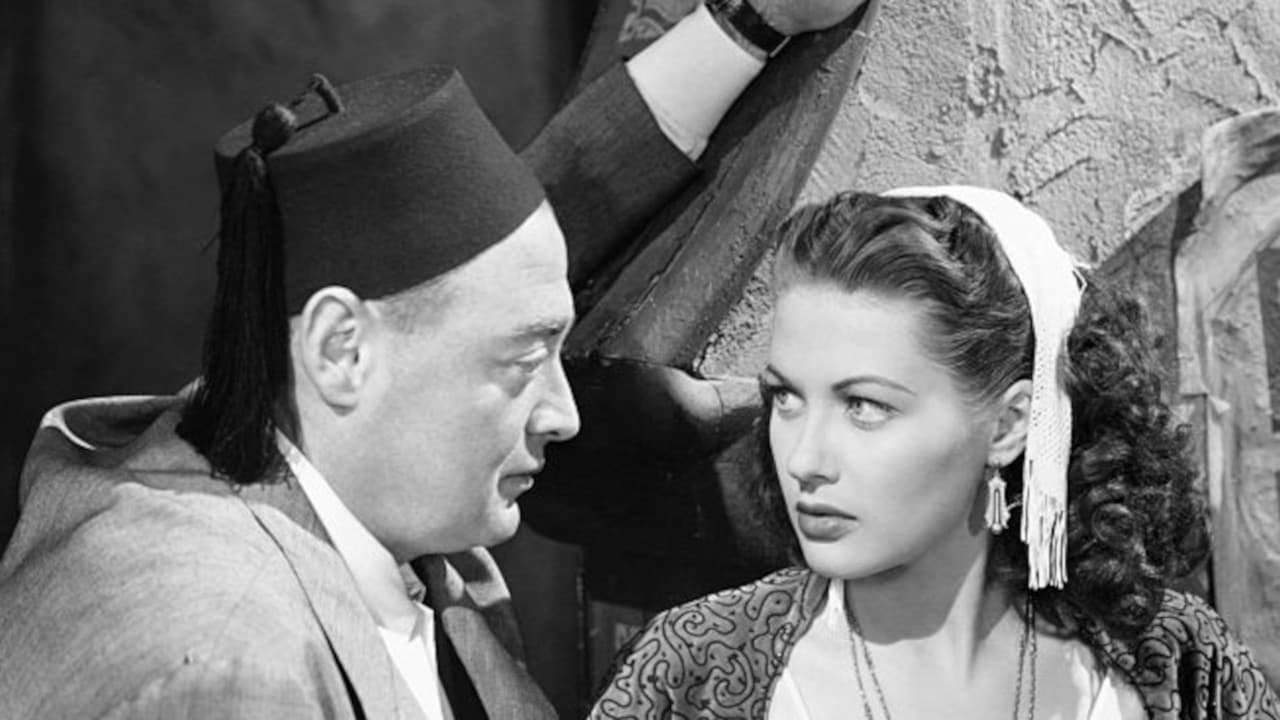
Casbah occupies an uneasy position in the noir canon – neither the fully committed fatalism of Julien Duvivier's 1937 French original nor the lean urgency of John Cromwell's Algiers from 1938, but something more hybrid and, in its way, more revealing of its cultural moment. John Berry directs with a craftsman's competence, and the casting of Peter Lorre as Slimane is the film's single most astute decision: his Slimane is patient, almost affectionate, a man who understands that surveillance is its own form of intimacy. Tony Martin lacks the dangerous magnetism the role demands, and the Harold Arlen songs, however accomplished as compositions, interrupt the moral geometry that the story requires. Yet the film's portrait of the Casbah as a gilded trap – a sanctuary that is also a sentence – retains genuine resonance. Produced by Marston Productions in the postwar years when Hollywood was still negotiating the meaning of confinement and complicity, Casbah registers the period's anxiety about men who cannot return to the world they knew, even when that world sends emissaries to retrieve them.
– Classic Noir
Irving Glassberg frames Pepe at the edge of the Casbah's boundary, the gate separating the quarter's dense shadow from the open light beyond. The camera holds at a middle distance, neither intimate nor detached, placing the architecture of confinement in dialogue with the man's posture – one foot forward, body angled toward departure, yet rooted. The light beyond the gate is bright and undifferentiated, the kind of exposure that offers no shelter, while the Casbah behind him falls into layered darkness that, however confining, at least defines the body within it.
The scene concentrates the film's central argument: that freedom, for Pepe, is not a destination but a condition he can only observe from a distance. Gaby has passed through that gate and returned to the city he mythologizes; what stands between them is not distance but visibility. To step into the light is to become legible to the law. The threshold is not a passage but a definition of who he has become, and the stillness with which he stands there suggests he already knows what crossing it will cost.
Irving Glassberg, who spent much of his career at Universal where he developed a reliable command of low-key studio lighting, brings to Casbah an approach that uses the Casbah's constructed geography as a moral diagram. The alleys and stairwells of the studio-built quarter are lit to emphasize depth and compression – narrow sources placed to throw hard shadows that segment the frame, isolating characters within corridors of light that suggest surveillance even when no observer is present. Glassberg favors medium focal lengths that maintain spatial legibility while keeping the mise-en-scène from opening into the kind of airy compositions that would undercut the story's claustrophobia. The contrast between the Casbah's chiaroscuro interior and the flatter, more evenly lit sequences involving Gaby is purposeful: she arrives from a world without shadows, and her luminosity is precisely what makes her dangerous. The cinematography does not aestheticize entrapment so much as make it architecturally concrete.
Tubi has carried Casbah as part of its classic Hollywood library and represents the most accessible no-cost option, though print quality may vary.
Archive.orgFreeA public domain print is available on Archive.org, suitable for study purposes, though it is advisable to verify the current upload for completeness.
Amazon Prime VideoRentA rental option on Amazon typically offers a cleaner transfer than public domain sources and is worth the cost for a more stable viewing experience.