Films People Pull a Fast One Night Beat Reading Room On TV Shop
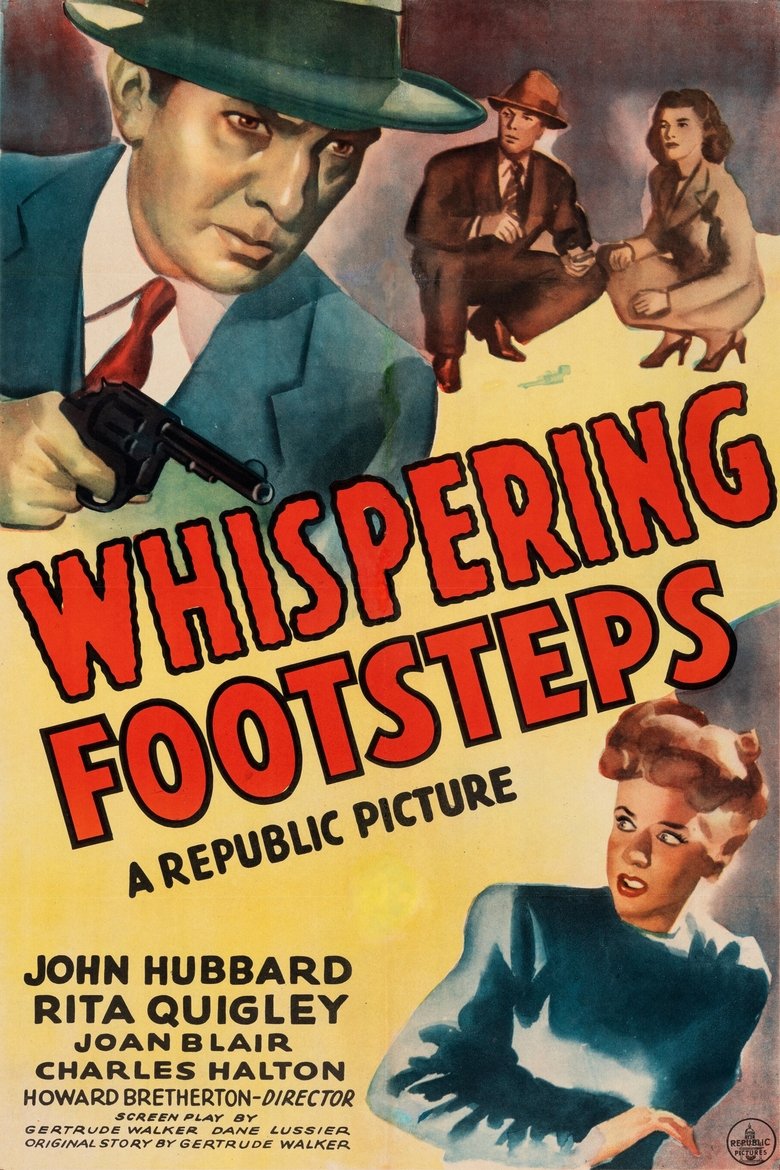
Whispering Footsteps 1943
1943 Republic Pictures
★★★☆☆ Notable
Film Noir · 54 minutes · Black & White

Whispering Footsteps

Directed by Howard Bretherton
Year 1943
Runtime 54 min
Studio Republic Pictures
TMDB 5.2 / 10
"A quiet man in a small town becomes the shape that fear takes."

In a modest midwestern community, Marcus Aurelius 'Mark' Borne lives a deliberately unremarkable life – soft-spoken, solitary, known to his neighbors chiefly for his habit of walking alone after dark. When a series of murders begins to terrorize the town, the circumstances surrounding Mark draw unwanted attention: his nightly routes correspond too neatly with the times and locations of the killings. Brook Hammond, the young woman who boards at the same rooming house run by Ma Murphy, watches him with equal measures of sympathy and unease.

As Detective Brad Dolan tightens his investigation, the community's suspicion hardens into something close to verdict. Mark's landlord Harry Hammond grows hostile, and even those inclined to defend him find their loyalty tested by the accumulating coincidences. The film is careful to distribute doubt rather than resolve it – Helene LaSalle, a figure from Mark's past, surfaces at a moment that complicates the picture further, and the small house on the edge of town becomes a pressure chamber in which allegiances shift under the weight of fear.

Working within the constraints of Republic Pictures' B-unit and a running time of fifty-four minutes, Whispering Footsteps belongs to a cycle of early 1940s noirs that locate dread not in the city but in the ordinary American neighborhood – the wrong-man picture stripped of glamour, played out in boarding-house parlors and lamplit streets. The film's interest lies less in detection than in the social mechanics of suspicion: how a community constructs a guilty man from fragments of the inexplicable.
Classic Noir

Whispering Footsteps occupies an instructive position in the lower registers of wartime noir – a film that achieves more through restraint than its budget would seem to permit. Howard Bretherton, a director whose career ran largely through Westerns and serials, handles the material with a functionalism that suits it: there is no wasted atmosphere, no decorative menace. John Hubbard's performance as Mark Borne is the film's genuine asset – he renders passivity as something ambiguous rather than innocent, so that the audience's discomfort mirrors the town's. The wrong-man premise, well-worn even by 1943, is used here not to generate suspense in the Hitchcock sense but to examine the social corrosion that suspicion produces. The boarding-house setting, recurrent in B-noir of this period, serves as a compressed social world in which class proximity breeds surveillance. At fifty-four minutes the film cannot afford digression and does not attempt it. Its limitations are also its discipline.

– Classic Noir
3 ★★★☆☆ Notable
Credits

The Crew

DirectorHoward Bretherton
ScreenplayDane Lussier
CinematographyJack A. Marta
MusicMort Glickman
EditingRalph Dixon
Art DirectionRussell Kimball
CostumesAdele Palmer
ProducerGeorge Blair
Performances

The Cast

Close Reading

The Signature Scene

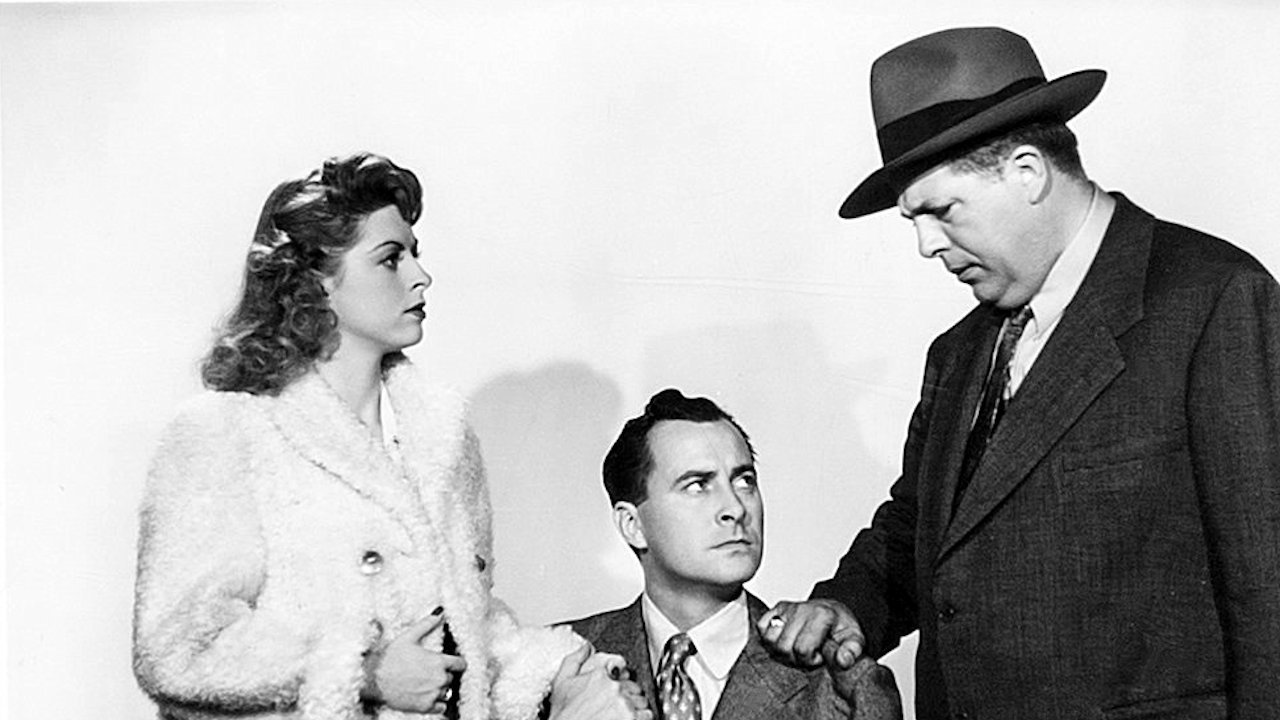
Whispering Footsteps – scene
The Evening Street Mark Walks Alone Again

Jack A. Marta frames the sequence with the camera set low and back, allowing the empty street to assert itself before the figure enters it. The light source is a single practical lamp at the far end of the block, and Marta uses it to pull a long shadow ahead of Mark as he walks – the shadow arriving at each pool of darkness before the man does. The frame is held steady; there is no tracking movement, only the figure crossing from right to left while the town's dark windows press in from above.

The scene encapsulates the film's central problem: a man defined by what others project onto him. Mark is not shown doing anything, and that absence of action is precisely what the camera examines. His walk is unremarkable; the shadow is not. The composition externalizes the town's fear and makes it visible as a formal element – the darkness the community has already decided he carries.

Visual Language

The Cinematography

🎞️
Jack A. Marta – Director of Photography

Jack A. Marta, a Republic Pictures house cinematographer who worked across genres throughout the 1940s, brings a controlled economy to Whispering Footsteps that punches above the production's modest means. Working almost entirely on studio-built sets dressed to approximate small-town domesticity, Marta relies on high-contrast single-source lighting to introduce moral instability into interiors that would otherwise read as neutral. The boarding-house parlor is lit from a single practical window, throwing one half of nearly every two-shot into partial shadow – a compositional habit that literalizes the film's preoccupation with partial knowledge. For exterior sequences, Marta uses wet-down pavement and raked sidelight to stretch shadows across the frame, a technique borrowed from the German émigré tradition but applied here without ostentation. The lens work is tight in confrontational scenes and deliberately wide in crowd configurations, so that Mark's isolation within a group registers spatially. The cinematography does not call attention to itself; it serves the story's argument that ordinary spaces become threatening when perception is distorted by collective fear.

In the Catalogue

Themes & Motifs

Availability

Where to Watch

Also in the Directory

See Also