In a small American community, retired attorney Luke Ellis finds his past reaching back to claim him when organized crime infiltrates local business and politics. His daughter June, now married to ambitious young prosecutor Bob Keeler, occupies the uneasy middle ground between her father's compromised history and her husband's determination to dismantle the syndicate's hold on the town. The principal threat arrives in the form of Duke Martella, a syndicate enforcer whose methods are methodical and whose patience is finite.
As Bob Keeler builds his case against the Martella operation, the lines of loyalty inside the Ellis family fracture. Luke's past dealings – never fully disclosed, never entirely buried – give Duke leverage that neither June nor Bob can easily counter. Hazel, a woman with her own entanglement in the syndicate's affairs, complicates the investigation further, while peripheral figures like the laconic Slim Pickett and the quietly observant Emily Parsons suggest a community that has learned to look away. Walter Pritchard, a civic figure with influence and ambition, operates in the shadows between law and corruption.
When Gangland Strikes belongs to the cycle of mid-fifties B-pictures produced by Republic Pictures that addressed organized crime as a systemic rather than individual failure – films less concerned with the lone criminal than with the institutions that accommodate him. The film's domestic setting and its focus on a family divided by complicity place it within a strain of noir preoccupied less with fatalism than with the corrosive arithmetic of compromise.
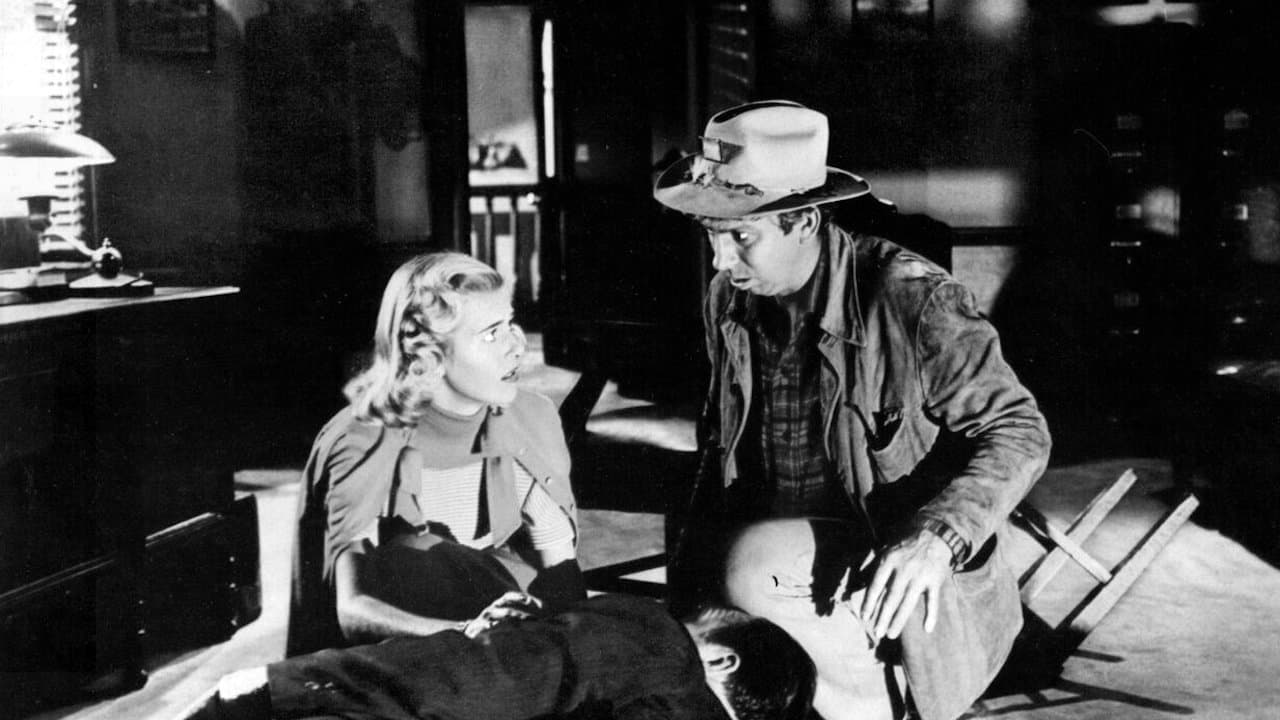
Directed by R.G. Springsteen – a Republic Pictures journeyman whose competence rarely drew critical attention but whose efficiency shaped dozens of the studio's mid-decade programmers – When Gangland Strikes is a modest but coherent entry in the civic-corruption noir cycle that proliferated after the Kefauver hearings brought organized crime into American living rooms. The film understands that the syndicate's real power lies not in violence but in the willingness of respectable people to transact with it. Raymond Greenleaf, reliably cast in roles of authority undercut by moral equivocation, gives Luke Ellis the weight of a man who knows exactly what he traded away. Anthony Caruso's Duke Martella operates with the bureaucratic calm of someone who has never needed to raise his voice. At seventy minutes the film moves without waste, and its domestic frame – a prosecutor's marriage as the fulcrum of institutional corruption – anticipates the suburban unease that would characterize the genre's late phase. It will not rewrite the canon, but it earns its place within it.
– Classic Noir
The camera holds on a medium two-shot as Duke Martella enters Luke Ellis's study, the room lit by a single practical lamp that falls across the desk and leaves the walls in deep shadow. Springsteen keeps the blocking tight – Martella never crosses to the centre of the room, remaining near the door as though departure is always his option and not Ellis's. The lamp throws Ellis's face into partial relief, one eye lit, the other absorbed by shadow, a compositional choice that externalises the divided moral state the screenplay has been constructing across the preceding reels.
What the scene establishes is the mechanics of institutional corruption: no threats are made explicitly, no violence is implied directly, yet the power relation is total. Martella speaks in the register of a business associate concluding a routine matter, and it is precisely that register – its courtesy, its ordinariness – that the film identifies as the syndicate's most durable weapon. Ellis's stillness is not dignity; it is the stillness of a man who understands that every exit was closed some time ago.
The cinematographer for When Gangland Strikes is not confirmed in surviving production records, a lacuna common to Republic's lower-budget productions of the period, where crew credits were inconsistently preserved. What the film's visual language suggests is a practitioner schooled in the studio's house style: high-contrast interior lighting built around single-source practicals, shadow work that maps moral condition onto physical space, and a reluctance to waste footage on establishing material that doesn't carry narrative charge. Location shooting is minimal; the film is largely a studio construction, and Springsteen uses that containment to generate a sense of closed social geography – the town as a set of rooms from which the characters cannot exit. Close-ups are deployed sparingly and therefore land with force when they arrive. The visual logic consistently ties darkness not to menace alone but to knowledge – those who know the most about the syndicate's reach are most fully absorbed into the frame's shadow zones, a moral geometry that the cinematography sustains with quiet consistency.
Tubi has carried a number of Republic Pictures B-titles from this period and is the most likely free streaming source, though availability should be verified as catalogues shift.
Archive.orgFreeRepublic Pictures productions from the 1950s with lapsed or unclear copyright have appeared on Archive.org; worth checking for a stable public-domain print.
Amazon Prime VideoSubscriptionClassic Republic titles have appeared in rotating catalogues on Prime Video; availability varies by region and should be confirmed at time of viewing.