Films People Pull a Fast One Night Beat Reading Room On TV Shop
Behind the High Wall 1956
1956 Universal International Pictures
★★★☆☆ Notable
Film Noir · 85 minutes · Black & White

Behind the High Wall

Directed by Abner Biberman
Year 1956
Runtime 85 min
Studio Universal International Pictures
TMDB 5.5 / 10
"A prison warden finds that the line between keeper and kept dissolves when the money is real."

Frank Carmichael is the warden of a state penitentiary, a man who has spent his career enforcing order from behind institutional walls. His life is modest, his reputation clean, and his marriage to the ailing Hilda defined by obligation and quiet exhaustion. When a prison break goes wrong and a convict named Kiley is recaptured in possession of a large sum of stolen money, Carmichael is placed in direct contact with something that tests every principle his career has been built upon.

Carmichael quietly appropriates a portion of the money, reasoning that circumstance has offered him the only exit from a life of diminishing returns. Around him, competing interests converge: Kiley, calculating and patient, understands exactly what the warden has done and what it is worth; Anne MacGregor, whose connection to one of the prisoners complicates the institutional chain of command; and Johnny Hutchins, a younger figure whose loyalties are not yet fixed. Each relationship pulls at the warden's composure in a different direction.

Behind the High Wall belongs to a strain of mid-decade noir in which the criminal act is not passion but arithmetic – a cold decision made by someone who has watched others profit while he stood guard. The film uses the prison setting not as a backdrop for violence but as a moral architecture, a structure whose logic the warden has internalized so completely that his transgression registers as a kind of corruption from within.
Classic Noir

Behind the High Wall is a minor but coherent entry in the institutional noir cycle that Universal International sustained through the mid-1950s. Abner Biberman, better known as a character actor, directs with economy rather than flair, keeping the camera close to faces and the drama rooted in situation. Tom Tully's performance anchors the film: he plays Carmichael not as a man undone by greed but as one corroded by patience, and the distinction matters. Sylvia Sidney, in a role that could have been merely functional, brings a specific gravity to Hilda that makes the domestic context feel genuinely trapped rather than expository. John Larch's Kiley is the film's coldest instrument, a convict who has reduced every human relationship to leverage. What the film reveals about its era is less about crime than about the bureaucratic imagination – the idea that institutional loyalty, sustained long enough, becomes its own form of imprisonment. It does not push far enough to be essential, but it does its work honestly.

– Classic Noir
3 ★★★☆☆ Notable
Credits

The Crew

DirectorAbner Biberman
ScreenplayRichard K. Polimer
CinematographyMaury Gertsman
EditingTed J. Kent
Art DirectionAlexander Golitzen
CostumesBill Thomas
ProducerStanley Rubin
Performances

The Cast

Close Reading

The Signature Scene

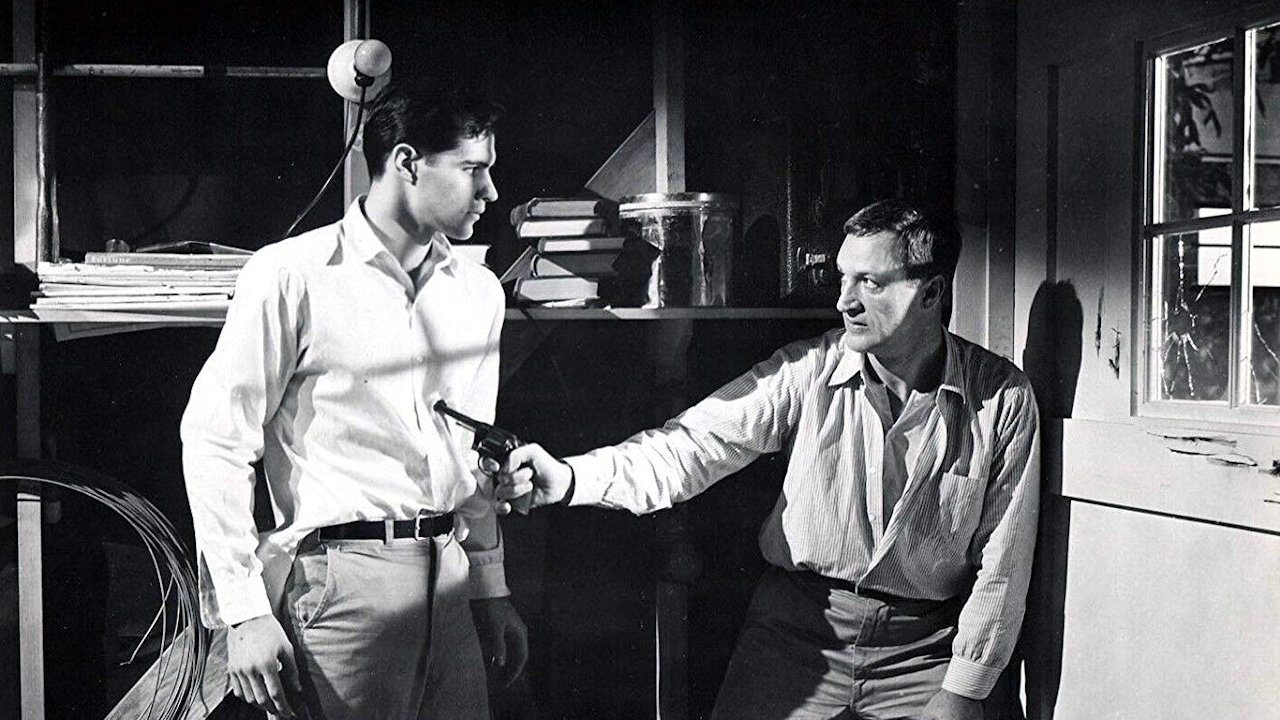
Behind the High Wall – scene
The Warden's Office, After Hours Counting What Cannot Be Returned

Maury Gertsman's camera holds on Carmichael at his desk, the money spread before him under a single overhead source that lights the bills and leaves the walls in gradation. The frame is tight enough to exclude the door, cutting the warden off from institutional space even as he sits inside it. Shadow collects at the edges of the composition, not dramatically but structurally, as though the room itself is contracting around the decision already made.

The scene does not stage temptation – that moment has passed before the camera arrives. What it records is the aftermath: a man organizing a transgression with the same methodical habit he brings to paperwork. This is the film's central argument rendered visually. Carmichael is not transformed by what he does; he is revealed. The money does not corrupt him so much as confirm what institutional life has already produced.

Visual Language

The Cinematography

🎞️
Maury Gertsman – Director of Photography

Maury Gertsman shoots Behind the High Wall in the restrained house style Universal International applied to its mid-budget programmers of the period – high-contrast interior lighting, a preference for medium shots that keep characters readable without expressionist distortion. The prison itself is used architecturally: bars and grilles appear in the middle distance of multiple compositions, creating a geometry of enclosure that functions independently of the narrative. Gertsman avoids the deep-focus showmanship of the previous decade, working instead with shallow planes that isolate characters from their environment, lending even corridor scenes a quality of psychological compression. Location work is minimal; the studio interiors are dressed with enough institutional specificity that confinement reads as texture rather than set. The lighting in domestic scenes – the Carmichael home in particular – is notably flatter than in the prison sequences, a reversal that quietly suggests the warden is more at ease inside the walls than outside them.

In the Catalogue

Themes & Motifs

Availability

Where to Watch

Also in the Directory

See Also