Films People Pull a Fast One Night Beat Reading Room On TV Shop
Shield for Murder 1954
1954 Camden Productions Inc.
★★★☆☆ Notable
Film Noir · 82 minutes · Black & White

Shield for Murder

Directed by Howard W. Koch
Year 1954
Runtime 82 min
Studio Camden Productions Inc.
TMDB 6.7 / 10
"A badge is just a license, if the man behind it has already crossed the line."

Detective Lieutenant Barney Nolan is a twenty-year veteran of the city force, and he is also a killer. When a small-time bookie named Packy Reed refuses to hand over fifty thousand dollars in stolen syndicate money, Nolan shoots him in a dark alley and reports it as a clean collar gone wrong. The money, he calculates, is his ticket out – enough to buy a house in the suburbs and marry Patty Winters, the young woman he has persuaded himself he loves.

The case refuses to close. Captain Gunnarson is not satisfied by Nolan's account, and Detective Sergeant Mark Brewster, Nolan's younger partner and something like his conscience, begins to sense that the story does not hold together. Meanwhile, the syndicate wants its money back and dispatches Fat Michaels to recover it by whatever means necessary, tightening the vice around Nolan from both sides of the law simultaneously.

Shield for Murder belongs to the cycle of postwar noirs in which the corrupt cop replaces the femme fatale as the story's engine of destruction. The film is less interested in suspense than in the methodical exposure of a man who has mistaken cunning for intelligence and desire for a plan, watching him negotiate the narrowing space between the institution that still protects him and the criminal world that wants him dead.
Classic Noir

Shield for Murder holds a specific position in the noir cycle as one of the earlier American films to place a corrupt, murderous policeman at the unambiguous center of the narrative – not as a peripheral menace but as the story's protagonist and its moral subject. Edmond O'Brien, who co-directed the film with Howard W. Koch and produced it through Camden Productions, understood that Nolan's tragedy is not passion but arithmetic: he has committed murder for a sum of money that cannot actually buy what he imagines it will. O'Brien plays the role without softening, and the film does not ask for sympathy it has not earned. What the film reveals about its era is the postwar suspicion that institutional authority – the badge, the rank, the department loyalty – could function as a screen behind which ordinary corruption operated freely. John Agar's Brewster functions as the procedural norm against which Nolan's deviation is measured, and the contrast, though schematically drawn, gives the film its moral architecture. At 82 minutes, it is economical to a fault, occasionally at the expense of character texture, but its central argument lands without equivocation.

– Classic Noir
3 ★★★☆☆ Notable
Credits

The Crew

DirectorHoward W. Koch
ScreenplayRichard Alan Simmons
CinematographyGordon Avil
MusicPaul Dunlap
EditingJohn F. Schreyer
ProducerAubrey Schenck
Performances

The Cast

Close Reading

The Signature Scene

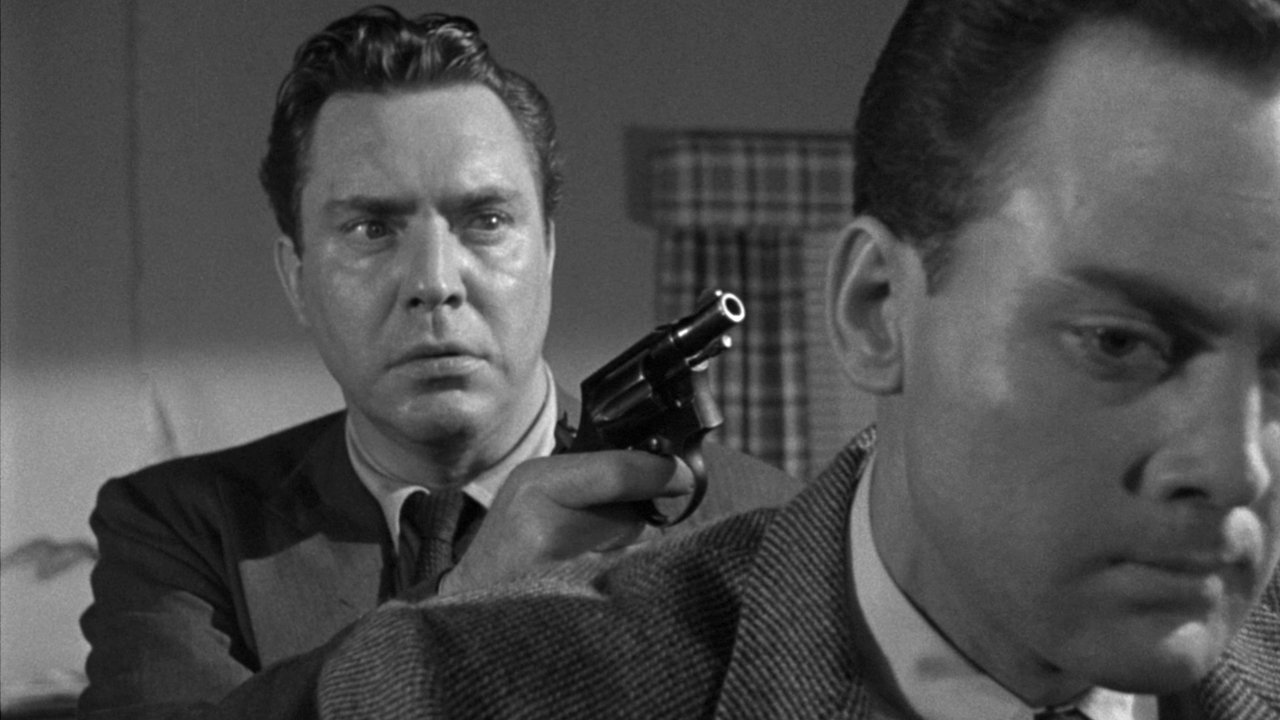
Shield for Murder – scene
The Swimming Pool Confrontation Money Buried, Man Cornered

Gordon Avil frames the sequence with lateral compression, using the geometry of the suburban pool – an aspirational object Nolan has not yet paid for – to trap the detective in the mise-en-scène before the narrative has finished trapping him. The light is hard and flat in the outdoor passages, offering none of the shadow cover that urban noir conventionally extends to its protagonists. Nolan has nowhere to dissolve into darkness; the setting itself is an accusation.

The scene crystallizes the film's central irony: the domestic future Nolan has killed to secure becomes the location of his exposure. The house, the pool, the respectable address – these are not rewards but evidence, and Avil's insistence on shooting them in unforgiving daylight refuses the man the cover of noir's usual night. What the scene argues is that Nolan's crime was never going to stay in the alley where he committed it; it was always going to follow him into the life he thought it would purchase.

Visual Language

The Cinematography

🎞️
Gordon Avil – Director of Photography

Cinematographer Gordon Avil works against the conventions that noir had by 1954 made familiar. Where the genre's visual grammar typically extends moral ambiguity through shadow, compressed focal lengths, and night-drenched exteriors, Avil frequently pushes Shield for Murder into daylight and interior fluorescence, denying Nolan the visual alibi that darkness provides. Studio interiors are lit with a bureaucratic flatness that makes the precinct feel less like a sanctuary than an exposure. When the film does move into night-for-night exterior work – the alley killing, the late pursuit sequences – Avil keeps the frame relatively open rather than resorting to expressionist distortion, which has the effect of making the violence feel procedural rather than operatic. Lens choices favor middle focal lengths that place the protagonist clearly in his environment rather than isolating him against abstracted backgrounds. The cumulative visual argument is that Nolan's guilt has no aesthetic refuge; the world around him simply continues to be legible, ordinary, and indifferent to his calculations.

In the Catalogue

Themes & Motifs

Availability

Where to Watch

Also in the Directory

See Also