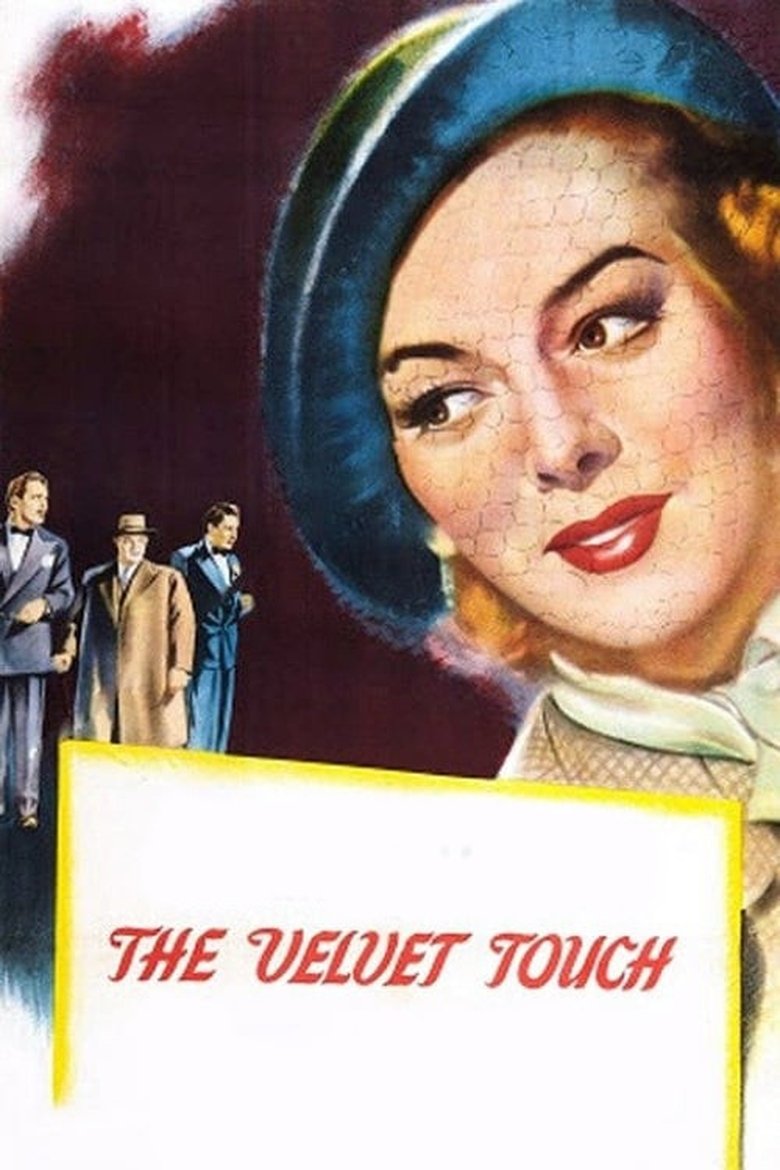
Valerie Stanton is a celebrated Broadway actress on the verge of the role she has always wanted – a serious dramatic part that would free her from the producer who made her a star. That producer is Gordon Dunning, her former lover, a possessive and manipulative man who refuses to release her from their professional and personal entanglement. When a confrontation in his office turns fatal and Dunning ends up dead, Valerie does not call the police. She walks back into the Manhattan night and lets another woman take the blame.
The other woman is Marian Webster, Dunning's current mistress, who had equal reason to wish him harm and who was seen near the scene. Presiding over the investigation is Captain Danbury, a methodical, unhurried detective whose deceptive placidity masks a formidable intelligence. Around Valerie orbits Michael Morrell, an attorney who loves her and whose faith in her innocence becomes its own kind of trap. As Danbury tightens his circle, Valerie's public composure and private guilt pull in opposing directions.
The Velvet Touch positions itself at the intersection of the noir thriller and the Broadway backstage melodrama, using the theatre world – its vanities, its hierarchies, its rituals of performance – as a moral landscape where guilt and artifice are genuinely difficult to separate. The film belongs to a strain of late-1940s noir centered on women of intelligence and ambition who are neither straightforwardly criminal nor straightforwardly sympathetic, and it earns its tension from that sustained refusal to simplify.
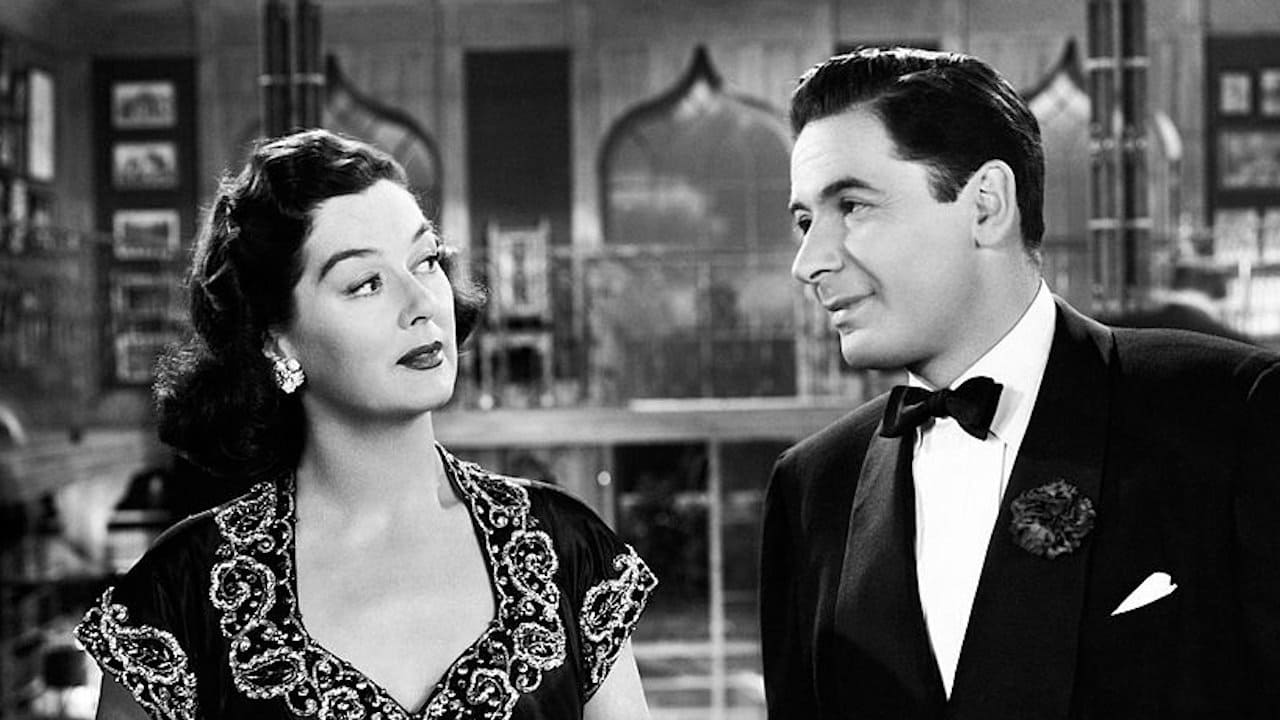
The Velvet Touch occupies an instructive position in the 1948 noir cycle, arriving at a moment when the genre was increasingly willing to place culpable, self-aware women at the center of the moral frame rather than at its periphery. Rosalind Russell, working through her Independent Artists production company, chose material that allowed her to inhabit guilt without sentimentality, and her performance sustains a register of controlled dread throughout. Sydney Greenstreet's Danbury is the film's structural counterweight – a figure whose theatricality rivals Valerie's own, and whose cat-and-mouse courtesy with the suspect is more unsettling than any direct accusation. Claire Trevor, in a role of compressed intensity, provides the film's sharpest moral edge. Jack Gage directs with efficiency rather than flair, and the Broadway milieu is rendered with enough specificity to function as genuine environment rather than backdrop. The film does not resolve its moral tensions cleanly, and that irreducibility is what gives it lasting interest beyond its period.
– Classic Noir
Joseph Walker frames Danbury and Valerie in a lobby that is emptying of its crowd, the receding figures of other theatregoers creating depth and isolation simultaneously. The light is warm and public on the surface – chandelier sources, polished floors catching their reflection – but Walker allows the background to fall into soft shadow so that the two figures occupy a pool of clarity that feels less like illumination than exposure. Danbury is shot slightly low, his bulk amplified; Valerie is upright but the frame edges press closer to her than to him.
The scene makes visible the film's central argument: that performance, the very skill that has made Valerie's career, cannot finally conceal what a patient observer is willing to wait for. Danbury is not conducting an interrogation; he is attending a performance he already understands. The space of the theatre lobby – a threshold between the artificial and the real, between role and self – becomes the precise location where Valerie's control begins its measurable erosion.
Joseph Walker, whose long collaboration with Frank Capra had made him one of Hollywood's most fluent studio cinematographers, brings a disciplined clarity to The Velvet Touch that serves the film's psychological design without announcing itself. Working on studio sets dressed to evoke Manhattan's theatre district, Walker favors medium shots and controlled two-person framings over the extreme low angles and chiaroscuro expressionism common to harder noir. His lighting setups are motivated and interior-realistic, with practical sources – stage lights, lobby chandeliers, desk lamps – anchoring the look in a legible world. Shadow work is reserved for moments of interiority or moral crisis rather than deployed as atmosphere throughout, which means it registers with proportionally greater force when it appears. The recurring contrast between the bright, watched spaces of public life and the darker geometries of private reckoning gives the film its visual argument: that guilt is not a condition of darkness but of the wrong kind of light.
TCM remains the most reliable broadcast source for this title and periodically makes it available through the Max bundle; check current scheduling.
Archive.orgFreeA public domain print has circulated on Archive.org, though picture quality varies and no restoration is currently available.
TubiFreeTubi has carried the film in its classic noir rotation; availability may change, but it is worth checking as a free and accessible option.