In a small Western town, frontier rancher John Garth stands trial for the shooting of his wife Valerie and her immigrant parents, the Horvats. The facts of the shooting are not in dispute – Garth pulled the trigger. What the court must determine is the motive, and each witness who takes the stand arrives with a version of the past shaped by self-interest, desire, or shame. Valerie herself survives, though barely, and her testimony is the most contested of all.
The film unfolds largely in flashback, with conflicting accounts offered by Garth, by his brother Herb, and by the Reverend Steven Blake, whose relationship with Valerie carries implications neither he nor Garth is willing to name directly. As the depositions accumulate, the portrait of the marriage shifts: what looked like a respectable frontier union reveals itself as a structure of coercion, jealousy, and barely suppressed violence. The Horvat family, newly arrived and vulnerable, become casualties of forces they could not have anticipated.
Valerie operates at the intersection of the courtroom procedural and the domestic noir, using the Rashomon device not as a formal exercise but as a way of examining how men construct narrative to preserve power. The film belongs to a strand of late-cycle noir in which the Western setting serves as a displacement – the frontier as a space where masculine grievance finds lethal expression with few institutional checks. Gerd Oswald keeps the register cool and the moral accounting deliberate throughout.
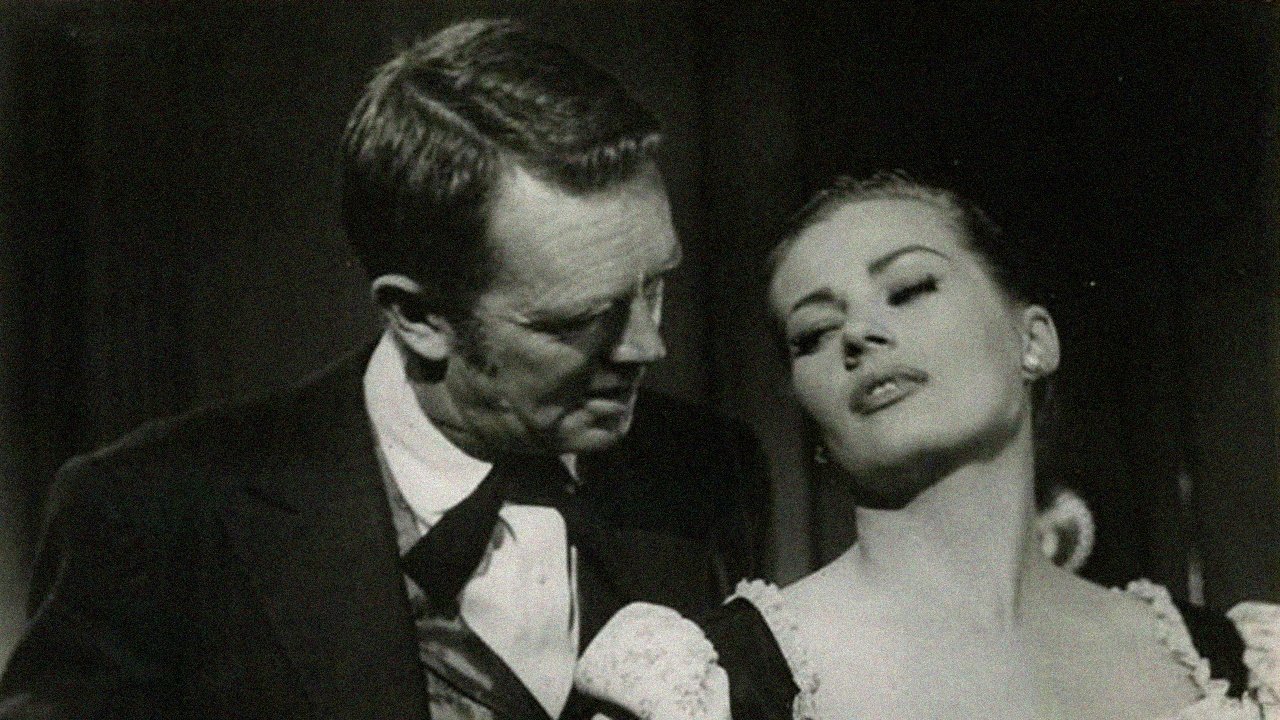
Valerie is a modest but purposeful entry in late 1950s noir, one that uses the contested flashback structure to ask a question the genre had been circling for years: who controls the story of a woman's suffering? Gerd Oswald, working a year after his more celebrated A Kiss Before Dying, handles the courtroom mechanics with economy, and the decision to set the film at the frontier's edge – somewhere between the Western and the noir proper – gives the familiar jealousy triangle an additional layer of social pressure. Sterling Hayden, an actor who rarely played small, is here deliberately contained, his Garth a man whose violence feels less explosive than systematic. Anita Ekberg, frequently reduced to spectacle elsewhere, is used more carefully: her Valerie is a figure around whom men construct competing fictions, and the film is alert to that dynamic. Ernest Laszlo's photography understands the distinction between the open landscape and the constricted interior, and it is in the interiors – the courtroom, the sickroom – that the film finds its noir register.
– Classic Noir
Laszlo frames Valerie from a low angle, the camera positioned at the level of the bed, so that the witnesses and legal representatives who crowd the doorway loom above her even as she is nominally the center of attention. Light enters from a single high source to the left, catching the white of the bedding and leaving the faces of the men in the room in varying degrees of shadow. The composition insists on the disproportion: one woman horizontal, several men vertical, the architecture of the room itself arranged against her.
The scene crystallizes the film's argument. Valerie's testimony is the last heard and, by the logic of the narrative, the most authoritative – yet she delivers it from a position of physical helplessness, surrounded by men who have already given their versions to the court. That she speaks at all, clearly and without recantation, is the film's quiet act of resistance. The sickroom becomes the one space in the film where the woman's account cannot be interrupted or reframed by those with more standing to stand.
Ernest Laszlo, who would later shoot Judgment at Nuremberg and Ship of Fools for Stanley Kramer, brings a disciplined economy to Valerie that suits the film's procedural structure. Working within the constraints of a United Artists B-budget, Laszlo uses the courtroom as a controlled lighting environment – flat, institutional, deliberately unromantic – and reserves his more expressive shadow work for the flashback sequences, where the events being recounted carry their full emotional charge. The contrast between these registers is functional: testimony is lit for scrutiny, memory for atmosphere. His work on interiors draws the walls inward through selective shadow placement, confining characters within frames that leave little room for maneuver. The frontier exteriors, when they appear, are shot in a manner that strips them of Western grandeur; the open landscape offers no escape, only exposure. Laszlo's lens choices favor a middle focal length that keeps faces readable without flattery, a neutrality that serves the film's skepticism about the reliability of any single point of view.
Tubi has carried public-domain and United Artists catalog titles from this era; check availability as the library rotates.
Archive.orgFreeArchive.org hosts several United Artists titles from the late 1950s; availability of a clean print of Valerie should be verified directly.
Amazon Prime VideoSubscriptionAmazon Prime has at times carried lesser-known United Artists titles of this period as part of its classic catalog rotation.