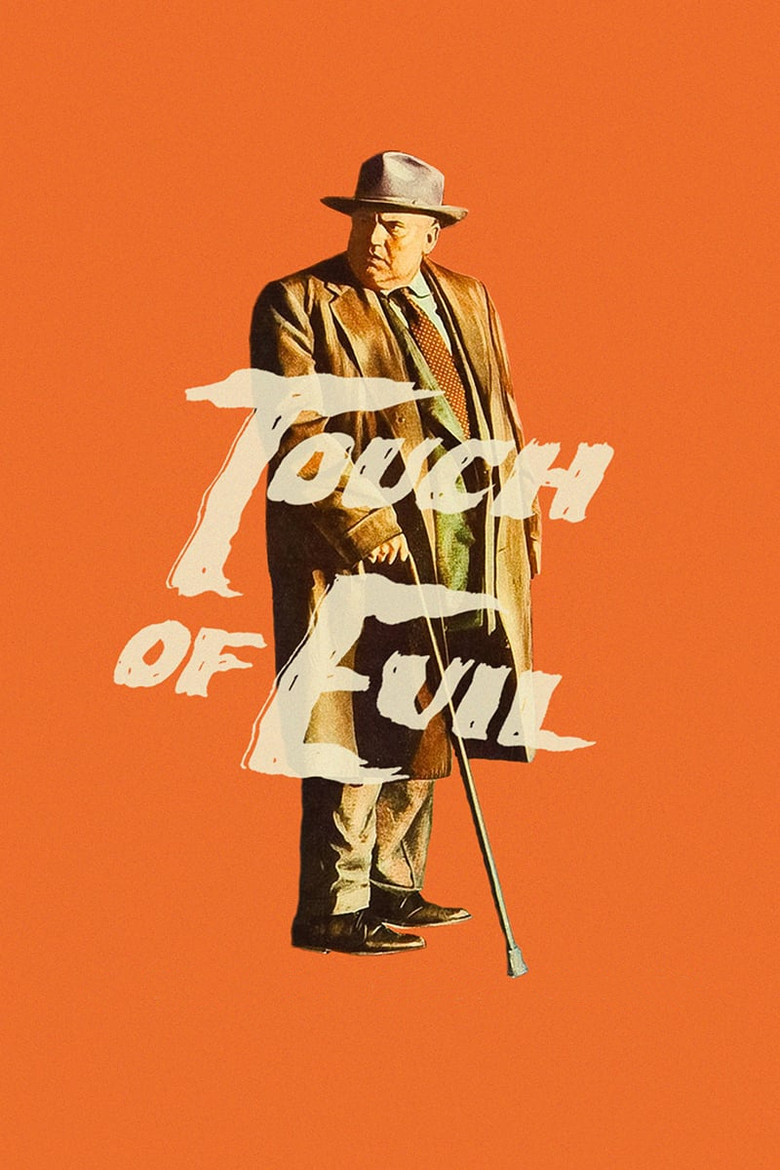
On the Mexican-American border, a time bomb planted in an American businessman's car detonates just as Mexican narcotics investigator Ramon Miguel Vargas and his new American wife, Susan, cross into the United States. The explosion draws Vargas into a joint investigation alongside the local American police captain, Hank Quinlan – a legendary, physically deteriorated lawman whose reputation for closing cases has calcified into something closer to a doctrine of convenient guilt.
As Vargas pursues the Grandi crime family's connections to the bombing, he grows increasingly uneasy with Quinlan's methods, suspecting the captain of planting evidence to frame a young Mexican suspect. Susan, meanwhile, is manipulated by the Grandi organization into a compromising situation at an isolated motel, while Quinlan – whose judgment is clouded by personal history and a resumed drinking habit – deepens his alliance with the very syndicate Vargas is trying to dismantle. Sergeant Menzies, Quinlan's loyal subordinate, is pulled between institutional loyalty and the slow recognition of his superior's corruption.
Touch of Evil places the apparatus of law enforcement itself under the genre's customary pressure, relocating noir's moral ambiguity from the criminal margins to the institutional center. Where classical noir typically pits an individual against a corrupt world, Welles constructs a system in which legitimacy and criminality are operationally indistinguishable – a structure that gives the film its particular, unsettled weight.
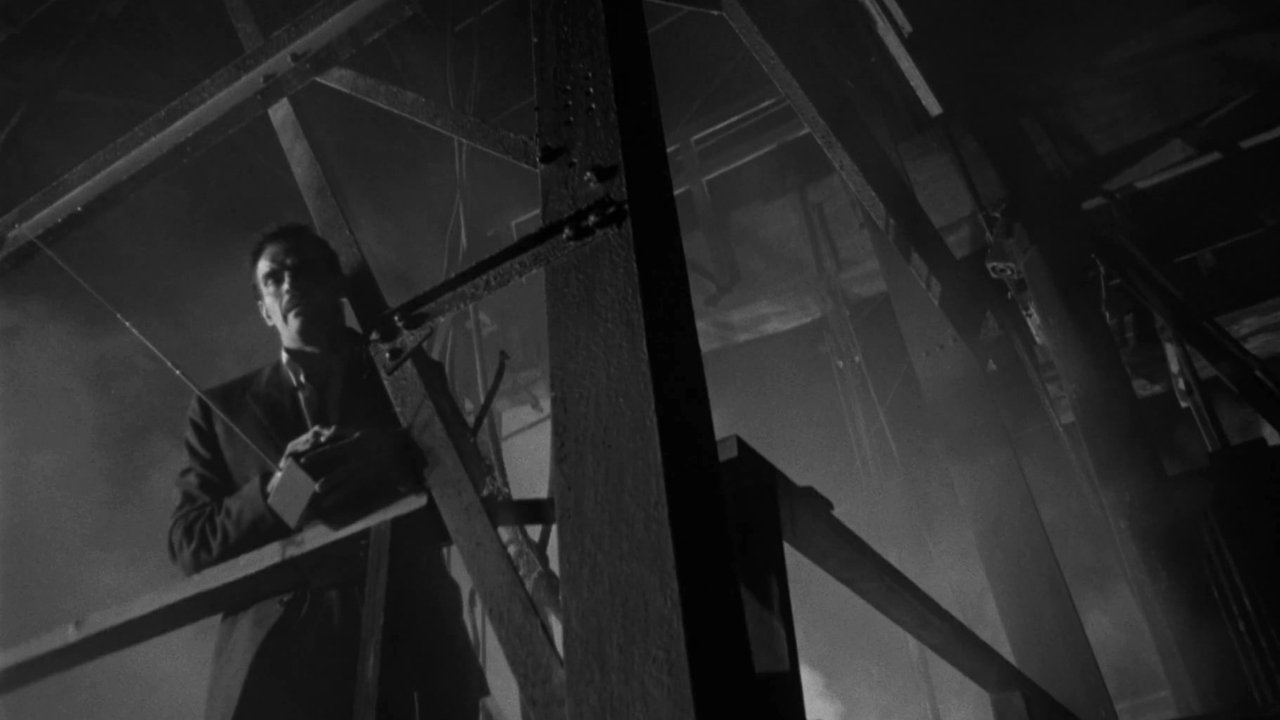
Touch of Evil arrives at the end of Hollywood noir's classical period and functions, in retrospect, as both a culmination and a diagnosis. Welles, working from a pulp novel by Whit Masterson, transforms thin material into an inquiry into institutional rot: Quinlan is not merely a corrupt cop but the logical endpoint of a justice system that has confused results with process. The film's border setting is not incidental – it externalizes a jurisdictional ambiguity that mirrors the moral one. What distinguishes Touch of Evil from the procedural noirs that preceded it is its refusal to locate evil at a safe remove from authority. Quinlan has solved real crimes; his methods have produced real convictions. That history is precisely what makes his corruption durable and socially tolerated. The film's treatment of race – Heston playing a Mexican official opposite a system coded as Anglo and contemptuous – registers the period's political anxieties in ways that grow more legible with each decade. It is a film that earns its reputation not through spectacle but through structural argument.
– Classic Noir
The film opens with a single, uninterrupted crane shot lasting approximately three minutes and twenty seconds. The camera locates a time bomb being loaded into a car trunk in extreme close-up, then ascends and pulls back to track the vehicle through the crowded streets of a border town while simultaneously following Vargas and Susan on foot. Russell Metty's wide-angle lens keeps multiple planes of action in sharp focus as the frame absorbs pedestrians, storefronts, livestock, and the competing rhythms of two nations in uneasy proximity. The shot ends – and the cut finally arrives – only when the car clears the border checkpoint and detonates. The edit is not a relief; it is a detonation.
The sustained take establishes more than technical ambition. By refusing to cut, Welles denies the audience any editorial guidance about where to look or what to fear, distributing tension across the entire frame. The bomb's presence is known; its detonation is inevitable; and yet the shot's refusal to acknowledge urgency through conventional cutting forces the viewer into a condition of suspended dread that the rest of the film will methodically sustain. It announces a film in which the mechanisms of doom operate in plain sight, unacknowledged by those moving through them.
Russell Metty's cinematography on Touch of Evil is a sustained argument conducted in shadow and distortion. Shooting largely on location in Venice, California – standing in for a fictional Mexican border town – and on Universal's back lots, Metty exploits wide-angle lenses to press deep focus into the service of claustrophobia: figures loom in the foreground while action continues unresolved behind them, and interiors that should offer safety instead feel occupied by threat from multiple directions simultaneously. Quinlan is consistently photographed from below, his bulk amplified by the lens into something architectural, immovable. The lighting favors hard sources – bare bulbs, car headlights, neon bleed – that carve faces into high contrast and leave motivation in darkness. The motel sequence abandons this grammar deliberately, shifting to a flatter, more institutional light that makes Susan's isolation feel procedural rather than dramatic. Throughout, Metty's choices serve Welles's central proposition: that corruption does not hide in shadow but operates under ordinary light, in plain institutional view.
The Criterion Channel streams the restored 1998 re-edit supervised by Walter Murch according to Welles's original memo, which is the version closest to his intentions and the one serious study of the film requires.
PeacockSubscriptionAs a Universal title, Touch of Evil has appeared on Peacock; availability varies by region and should be confirmed before viewing, as catalog titles rotate.
TubiFreeTubi has carried the film as a free, ad-supported stream, though the version available may be the original theatrical cut rather than the Murch restoration; verify before use.