Films People Pull a Fast One Night Beat Reading Room On TV Shop
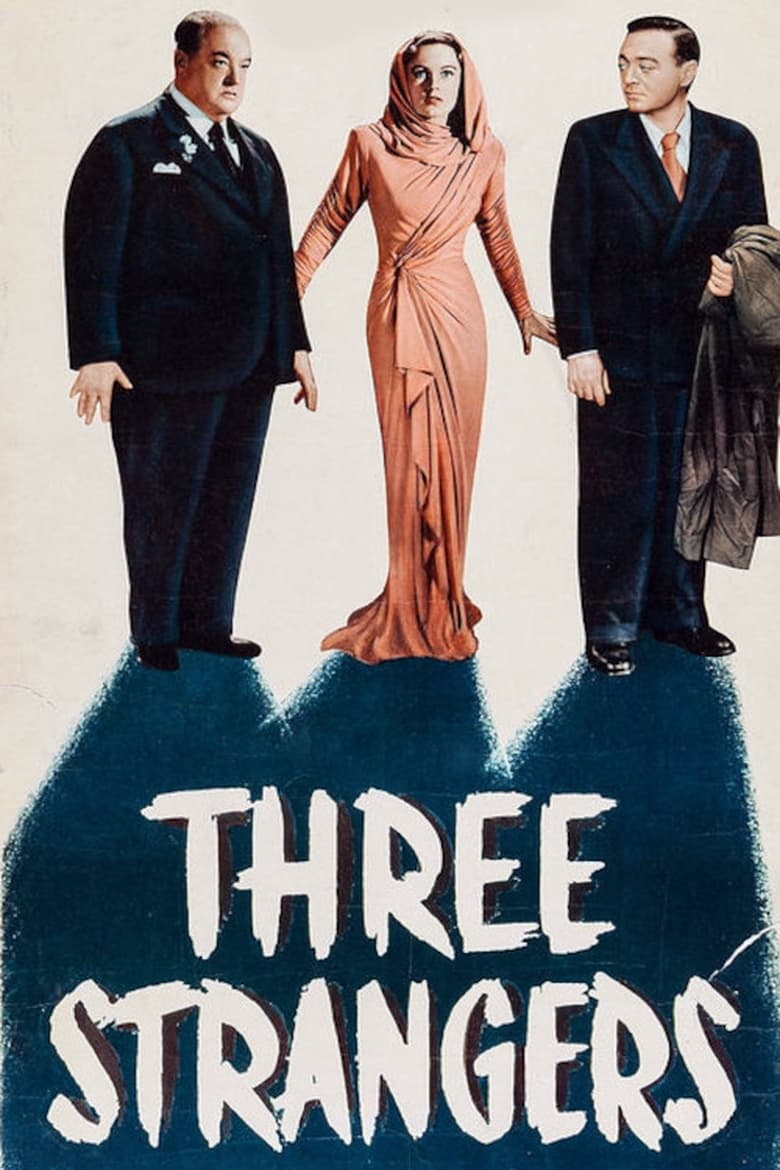
Three Strangers 1946
1946 Warner Bros. Pictures
★★★☆☆ Notable
Film Noir · 92 minutes · Black & White

Three Strangers

Directed by Jean Negulesco
Year 1946
Runtime 92 min
Studio Warner Bros. Pictures
TMDB 6.4 / 10
"Three strangers share a wish and a ticket – and each carries the ruin already inside them."

On the stroke of the Chinese New Year, Crystal Shackleford persuades two men she barely knows to join her in a private ritual before a statuette of Kwan Yin: if three strangers share a wish at the turning of the year, the goddess will grant it. The wish is a sweepstakes ticket Crystal has acquired, and the two men she draws into her parlor are Jerome K. Arbutny, a pompous, debt-laden solicitor, and Johnny West, a small-time drifter with a weakness for drink and worse company. The three agree to split any winnings, and with that compact the film's machinery of fate is set in motion.

The ticket proves to be a winner, but the money arrives at the worst possible moment for each of them. Crystal is locked in a cold war with her estranged husband Bertram Fallon, and her obsession with recovering him shades quickly into something more dangerous. Arbutny, already implicated in a client's missing funds, finds the promise of a windfall only deepening his exposure to blackmail and worse. Johnny, meanwhile, has fallen into the orbit of Icey Crane, a calculating young woman whose attachment to him is entangled with a murder he may or may not have committed. The three strands pull apart even as the winnings threaten to draw the characters back together.

Three Strangers belongs to a cluster of Warner Bros. productions of the mid-1940s that locate noir's moral corrosion not in the criminal underworld alone but in the respectable middle distances of society – the solicitor's office, the suburban drawing room, the shabby pub. The screenplay, written by John Huston and Howard Koch from Huston's original story, is interested less in detection than in the way greed and self-deception collaborate to destroy people who might, under other circumstances, have lived quietly. The film traces three separate descents without privileging one over another, an unusual structural choice that gives the work a cold, almost anthropological remove.
Classic Noir

Three Strangers occupies an instructive position in the Warner Bros. noir cycle: it is neither a crime procedural nor a femme fatale picture in the conventional sense, but a caustic triptych about the wages of wishful thinking. John Huston's original story – co-written with Howard Koch before Huston departed for military service – bears the marks of his characteristic preoccupations: the futility of appetite, the comedy of human delusion, the way moral weakness finds its punishment with bureaucratic efficiency. Director Jean Negulesco manages the three-strand narrative with more discipline than the structure might suggest, and the casting is quietly precise. Sydney Greenstreet brings to Arbutny exactly the right mixture of self-regard and panic, while Peter Lorre's Johnny West is one of his more fully inhabited performances – passive, doomed, genuinely affecting rather than merely eccentric. Geraldine Fitzgerald's Crystal is the film's coldest creation, a woman so thoroughly convinced of her own romantic logic that she cannot see it has become homicidal. As a document of postwar anxiety about respectability and its costs, the film repays sustained attention.

– Classic Noir
3 ★★★☆☆ Notable
Credits

The Crew

DirectorJean Negulesco
ScreenplayHoward Koch
CinematographyArthur Edeson
MusicAdolph Deutsch
EditingGeorge Amy
Art DirectionTed Smith
CostumesMilo Anderson
ProducerWolfgang Reinhardt
Performances

The Cast

Close Reading

The Signature Scene

Three Strangers – scene
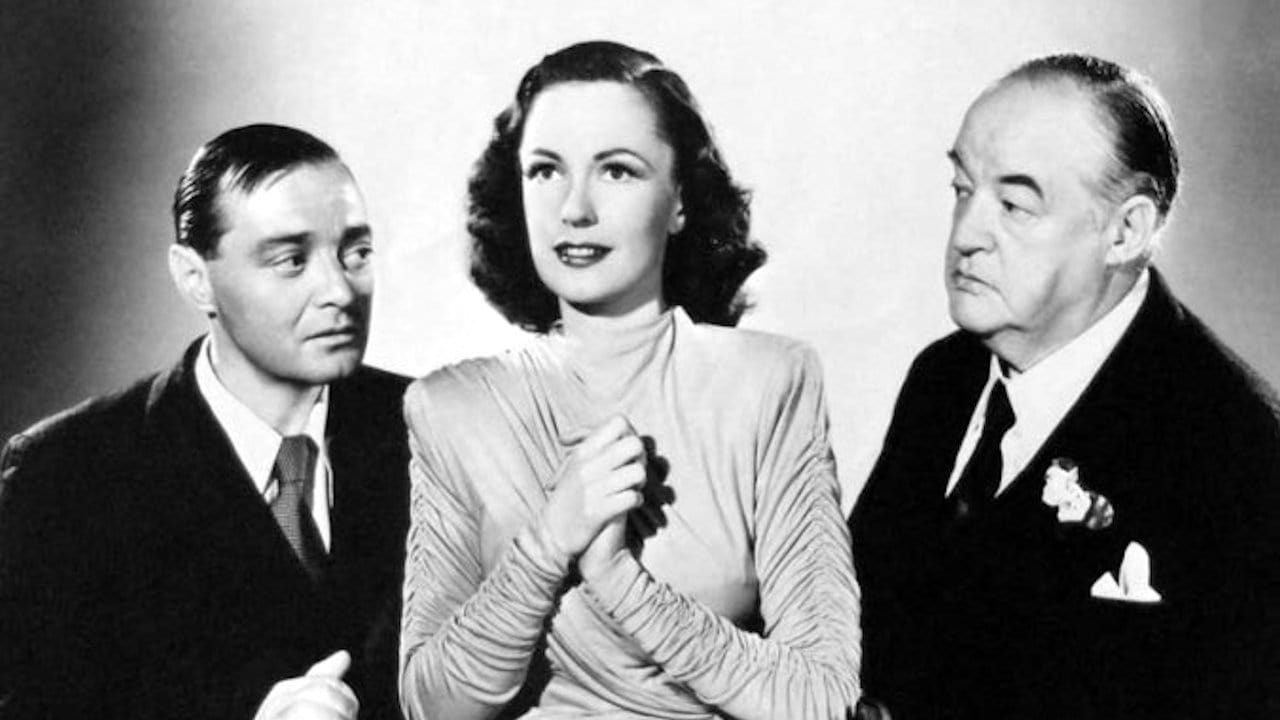
Crystal's Drawing Room, New Year's Eve Three Faces Before Kwan Yin

Arthur Edeson frames the ritual sequence in a tight, almost claustrophobic medium shot that keeps all three faces within the same plane of light, the statuette at the center pulling the eye like a vanishing point. The room's practical sources – candles and a single shaded lamp – are augmented by a key light positioned low and slightly off-axis, so that each face carries a shadow upward across the brow rather than beneath the chin, an inversion of the conventional horror setup that makes the characters look less menacing than credulous and exposed. The composition does not shift to close-ups for the moment of the wish; Negulesco and Edeson hold the wider frame, insisting on the collective nature of the act and on the equal culpability of all three.

The scene establishes the film's central argument before the plot has properly begun: these three people do not know one another and do not trust one another, yet they are willing to bind their futures to a shared delusion because each is already desperate enough to believe a goddess might intervene on their behalf. The statuette, lit to cast an oversized shadow on the wall behind it, becomes the film's presiding image – not of malevolence but of the human need to externalize responsibility for one's own desires. The compact sealed here is not between three people and a deity; it is between three people and their own worst impulses.

Visual Language

The Cinematography

🎞️
Arthur Edeson – Director of Photography

Arthur Edeson, whose career stretched back through Casablanca and The Maltese Falcon, brings to Three Strangers a lighting philosophy rooted in selective illumination rather than atmospheric saturation. Working on Warner Bros. studio sets that stand in for London interiors, Edeson avoids the rain-slicked expressionism that marks more self-conscious noirs of the period, preferring instead a controlled naturalism in which shadows accumulate at the edges of rooms rather than slashing across faces. The effect is socially precise: these are not the shadows of alleyways but of drawing rooms and solicitors' offices, and the moral darkness they suggest is accordingly quieter and more embedded. Edeson uses moderate focal lengths that keep spatial relationships legible – there is no distorting wide-angle work to signal psychological instability – allowing character behavior rather than optical rhetoric to carry the film's unease. The cinematography serves the screenplay's structural coldness; the camera observes all three protagonists with the same measured distance, declining to editorialize through lens choice or camera movement about who deserves sympathy.

In the Catalogue

Themes & Motifs

Availability

Where to Watch

Also in the Directory

See Also